
Fresh Kills Landfill
Former Staten Island landfill (1947–2001) turned into the long-term Freshkills Park project; notable for its vast scale, mid‑20th century waste role and use in post‑9/11 debris recovery.
The Fresh Kills Landfill was a large municipal landfill on Staten Island, in New York City. Established in 1947 on land that had once been tidal marshes and wet meadow, it was originally intended as a temporary disposal area but expanded over decades to become the city’s principal refuse site in the second half of the 20th century. As waste accumulated the engineered mounds grew until the complex was often described as one of the largest man‑made structures of its time. The site stopped receiving routine municipal garbage in 2001 and entered a long period of remediation and reuse planning.
Image gallery
5 Images



History and physical characteristics
Fresh Kills began with large‑scale filling of lower marshland. The area had previously been a swamp and estuarine habitat before development. Over the 1950s through the 1970s the site handled massive volumes of municipal solid waste; during its busiest years the operation received dozens of shipments each day, including as many as twenty barges a day carrying several hundred tons each in the 1960s barges. Accreted layers of compacted and covered refuse produced broad, artificial ridges and plateaus, a mass often compared in scale to major city landmarks such as the Statue of Liberty. The overall footprint covered thousands of acres across several engineered cells.
Role after September 11, 2001
In the aftermath of the September 11 attacks, Fresh Kills became a secure processing site for a substantial portion of the rubble. Approximately one third of the debris removed from the World Trade Center complex was transported to the site for sorting and recovery. Work crews and forensic teams sifted through material to recover human remains, personal effects and evidence, a difficult and solemn operation that continued for many months and involved coordination with families, investigators, and public agencies.
Closure, remediation, and conversion to parkland
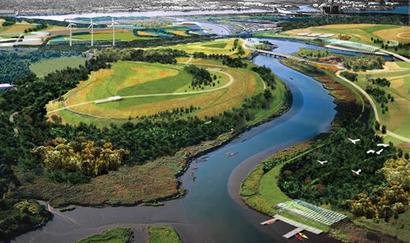
After regular disposal activities ceased in 2001 the city implemented an environmental remediation program to stabilize the site and reduce long‑term risks. Typical engineering measures included capping waste cells with layers of soil and impermeable material, installing landfill gas collection and treatment systems to control methane emissions, building leachate collection and treatment facilities, and establishing ongoing monitoring of groundwater and air. Beginning in 2008, New York City launched a multi‑decade conversion of the site into Freshkills Park, an ambitious reclamation project intended to convert former waste cells into public open space, restored wetlands, grasslands, and recreational amenities. The park design emphasizes habitat restoration, passive and active recreational areas, and infrastructural reuse; full build‑out has been planned to take many years and to be implemented in phases.
Uses, design features and planning phases
The redevelopment strategy treats Fresh Kills as an engineered landscape: mounded former landfill cells are reshaped into rolling hills, caps are planted with soil and native vegetation, and constructed wetlands are used to improve water quality and create wildlife habitat. Project partners have combined landscape architecture, ecology, and civil engineering to test techniques for long‑term stewardship. Public access has been phased, with portions opened for trails, educational programs, and limited recreation while other sections remain under remediation and monitoring.
- Operation: large‑scale municipal waste receiving and placement.
- Emergency use: processing of 9/11 debris and recovery operations.
- Remediation and reuse: capping, gas and leachate control, habitat restoration and park construction.
Legacy and notable facts
Fresh Kills is frequently cited in discussions about urban waste management, environmental remediation, and the reuse of post‑industrial land. It is an example of how a major infrastructure of waste disposal can be reimagined as public green space, and its history intersects with environmental policy, neighborhood concerns about odors and traffic, and the complex social responses to the site’s role after 9/11. The Freshkills Park initiative aims to provide new ecological value, recreational opportunities, and educational resources while acknowledging the landfill’s industrial past and the long timescales required for safe conversion.
Plans and ongoing work are overseen by city agencies and design partners; the transformation from landfill to parkland remains a long‑term effort intended to restore ecological function and provide a large new public landscape in New York City that will eventually exceed the size of Central Park.
Related articles
Author
AlegsaOnline.com Fresh Kills Landfill Leandro Alegsa
URL: https://en.alegsaonline.com/art/36645
Sources
- acc6.its.brooklyn.cuny.edu : "Staten Island Landfill: Fresh Kills"
- statenisland.pastperfect-online.com : "Items from World Trade Center Recovery Operation, Fresh Kills Landfill"
- nysm.nysed.gov : "Recovery: The World Trade Center Recovery Operation at Fresh Kills"
- nycgovparks.org : "Fresh Kills Park"