
Central Park (New York City public park)
Central Park is an 843-acre public park in Manhattan, New York City, designed by Olmsted and Vaux. It receives about 35 million visitors a year and contains lakes, Belvedere Castle, the Metropolitan Museum, and a zoo.
Central Park is a large urban park in the heart of Manhattan. Stretching roughly north–south through the center of the borough, it is one of the best-known public green spaces in the United States. The park attracts about 35 million visitors annually and functions as both a recreational area and a cultural landscape for residents and tourists.
Image gallery
10 Images


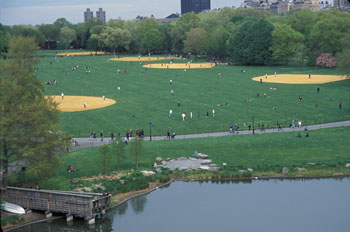


Design and layout
The park was laid out in the mid-19th century by landscape architects Frederick Law Olmsted and Calvert Vaux. Its roughly rectangular plan, a mix of naturalistic landscapes and planned promenades, contains woodlands, open meadows, formal gardens, and winding paths. Paths and drives accommodate walkers, joggers, cyclists and seasonal activities while preserving distinct zones for wildlife and quieter recreation.
Principal features
- Bodies of water and bridges: several small lakes and ponds are set into the landscape, linked by streams and ornamental bridges.
- Belvedere and viewpoints: structures such as Belvedere Castle and scenic overlooks provide panoramic views.
- Cultural institutions: the park borders prominent museums and institutions such as the Metropolitan Museum of Art.
- Wildlife and attractions: the Central Park Zoo and designated natural areas support urban biodiversity.
Geographically, the park sits in Manhattan within New York City. Visitors often follow landmark routes between 59th Street and 110th Street or move laterally between Fifth Avenue and Central Park West.
History and development
Created during a period of rapid urban growth, the park was intended to offer relief from the density of city life. Construction proceeded in stages, converting existing farms and settlements into a designed landscape. Over time facilities were added, lawns and recreational fields were developed, and historic structures restored. The park has been the setting for countless public events and has appeared frequently in film and television.
Uses, management, and significance
Today Central Park remains an important venue for recreation, culture, and community gatherings. It supports informal activities—walking, cycling, picnicking, birdwatching—and organized events such as concerts and festivals. Managed cooperatively by municipal agencies and private conservancy partners, the park is often described as the most visited city park in the United States. For more information and visitor guidance, see official resources on Central Park.


Things to see in and around Central Park
Lakes
There are several lakes in Central Park. The most famous are:
- The Reservoir: By far the largest lake. Since 1994 it has been officially named Jacqueline Kennedy Onassis Reservoir.
- The Lake: The second largest lake, its shape is completely different from the rather sterile appearance of the reservoir. At its narrowest point it is spanned by the Bow Bridge.
- Harlem Meer: Located in the far northeast.
- The Pond: Located in the very southeast of the park, directly in front of the Plaza Hotel.
- Belvedere Lake: Located directly in the center of the park, west in front of the Metropolitan Museum, also called Turtle Pond.
- The Pool: In the northwest of the park.
- Conservatory Water: Located in the east of the park at about the level of The Carlyle.
- Wollman Rink: Not a lake in the true sense of the word. In winter you can ice skate here in the southeast of the park.
Building
Southeast
Here today stand the luxury hotels The Pierre, The Sherry-Netherland Hotel and the famous Plaza Hotel. In addition, there is 745 5th Avenue (formerly the Squibb Building), built as a typical 1930s wedding cake, and the General Motors Building, built in the international style.
Until the 1960s, this area of Central Park, considered the most photographed, looked different. In place of the General Motors Building stood the eye-catching Savoy-Plaza Hotel, another luxury hotel. The demolition and subsequent construction of the General Motors Building, which barely fit in with the row of surrounding buildings, is still considered controversial today and, along with the demolition of the Singer Building, one of the biggest mistakes made by New York's city planners. Even today, you can find many postcards and posters depicting the old skyline of this area, that is, with the Savoy-Plaza Hotel.
South
To the west of the Plaza Hotel, the Hampshire House (with its green copper roof) and the Essex House (with the Essex House lettering on the roof, visible from afar) stand out. The skyline behind them, of which the black and white Solow Building is particularly eye-catching, is much higher.
West
In the southwest stand since 2004 the 229 m high Twintowers of the Time Warner Center.
Along the west side (Central Park West) are various apartment buildings, most of which are very luxurious and in which many celebrities live. The
four twintowers built in the 1930s, The Century, The Majestic, The San Remo and The Eldorado,
stand out. The San Remo is the most famous and also the most noticeable of these four. Between The Majestic and The San Remo stands the lower-rise but best known and oldest of the apartment buildings on Central Park: The Dakota. John Lennon, among others, lived here and was assassinated outside the gate.
Also built in the 1930s, The Beresford has three towers and resembles a castle.
The Art Deco style 55 Central Park West is most famous for the movie Ghostbusters and has since been called the Ghostbusters Building.
The American Museum of Natural History at 79th Street is one of the largest natural history museums in the world.
East
After the two hotels, The Pierre and The Sherry-Netherland, come numerous apartment buildings, many of which were built immediately after the Second World War. These continued to be built in the Art Deco style and blend into the built environment of Central Park.
The tallest and most prominent building on the Upper East Side is The Carlyle (it is not directly on Central Park, but a block behind it on Madison Avenue). Designed in the Art Deco style and with a green roof, the building can be seen from miles away.
The Solomon R. Guggenheim Museum is a museum of modern art. The eye-catching building was designed by Frank Lloyd Wright and opened in 1959.
Temple Emanu-El is the largest synagogue in the world and is located level with the Central Park Zoo.
Across the street, on the eastern edge within Central Park, is the Metropolitan Museum of Art, one of the world's largest and most visited art museums.


Data
- 341 hectare area
- 15 years construction time
- 7.5 million dollars
- 93.5 kilometres of footpaths
- 275 bird species
- 25 million visitors per year
- 4.07 km long
- 860 m wide
If you can't remember where you are in the park, you can use any of the more than 1,500 parking lamps to find your way. Each base has had a code of at least four digits on a plaque since 1907. The first two numbers represent the elevation of the nearest street and the last digit tells whether it's more on the east or west side (odd number). So it is not just a simple numbering of the lamps for the electrician.
Questions and answers
Q: Where is Central Park located?
A: Central Park is located in Manhattan in New York City.
Q: How many visitors does Central Park have every year?
A: Central Park has about 35,000,000 visitors every year.
Q: What makes Central Park special in terms of popularity?
A: It is the most visited city park in the United States.
Q: What places of interest are there to see in Central Park?
A: The park contains lakes, a castle, the Metropolitan Museum of Art, and the Central Park Zoo.
Q: Has Central Park ever been featured on TV or in movies?
A: Yes, the park has been shown in many movies and television programs.
Q: Can visitors go boating in Central Park?
A: Yes, visitors can go boating in the park's lakes.
Q: Does Central Park have any sports facilities?
A: Yes, Central Park has several sports facilities including tennis courts, baseball fields, and a running track.
Related articles
Author
AlegsaOnline.com Central Park (New York City public park) Leandro Alegsa
URL: https://en.alegsaonline.com/art/18065
Sources
- tpl.org : "America's Most Visited City Parks"
- centralparkzoo.com : "Know Before You Go – Central Park Zoo"
- veloso.org : Gates of Central Park
- centralparkhistory.com : "The Great Park Debate - 1850"
- centralparkhistory.com : "Taking the Land - 1850"
- ci.columbia.edu : "The Architecture and Development of New York City"
- ny.com : "The History of Central Park"
- centralparkhistory.com : "Robert Moses and a New Deal"
- centralparknyc.org : "The History of Central Park"
- nytimes.com : Nurturing the People Who Help Central Park