
Francium (element 87)
Francium is a highly radioactive alkali metal (symbol Fr, Z=87), extremely rare on Earth and known mainly from brief-lived isotopes; discovered by Marguerite Perey in 1939 and used only in research.
Francium is a chemical element with symbol Fr and atomic number 87. It occupies the bottom of the alkali metal column of the periodic table and is predicted to share many chemical traits with cesium and other group 1 metals. What sets francium apart is its extreme radioactivity and scarcity: all of its isotopes are short-lived, and only minute amounts exist naturally at any given time.
Image gallery
3 Images
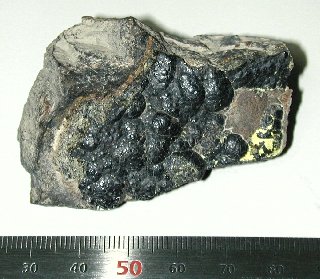

Characteristics
Francium is a highly radioactive, metallic element predicted to be soft and silvery like other alkali metals, though no stable bulk sample has been isolated because of its rapid decay. Its isotopes decay by alpha or beta emission; the most commonly referenced isotope, francium-223, has a half-life on the order of tens of minutes. As an alkali metal, francium reacts rapidly with water and oxygen to form hydroxides and oxides, and it is expected to be extremely electropositive. It also has among the lowest measured or predicted values of electronegativity and electron affinity of all elements.
Occurrence and production
In nature francium is produced in trace amounts through the radioactive decay chains of heavier elements in uranium and thorium ores. At any moment the total amount of francium in the Earth's crust is extremely small — on the order of only a few grams to a few dozen grams — because production and decay are in dynamic balance. Because natural quantities are inadequate for experiments, researchers create francium in nuclear reactors or particle accelerators by bombarding targets or by isolating it as a decay product of heavier radioactive isotopes.
History and naming
The existence of an element with atomic number 87 was predicted by the periodic table long before it was isolated. Francium was discovered in 1939 by French chemist Marguerite Perey while she was studying radioactive decay series; she named the new element after her native country. Earlier searches had produced ambiguous or incorrect claims, but Perey's identification was accepted after careful chemical separation and spectral analysis.
Uses and scientific importance
Because francium is so rare and radioactive, it has no commercial applications. Its primary role is in basic scientific research where individual atoms or tiny samples are used to test theories of atomic structure, electron correlation in heavy atoms, and weak interactions. Experimental work includes laser trapping and spectroscopy of francium atoms to measure atomic properties that are sensitive to relativistic and nuclear effects. Production and handling require specialized facilities and radiological controls.
Notable facts and distinctions
- Placement: francium is the heaviest of the naturally occurring alkali metals and lies under cesium in group 1 on the periodic table. Periodic group
- Radioactivity: all isotopes decay quickly; the most stable isotopes last for minutes rather than days. Isotopes
- Scarcity: only trace amounts are present in the Earth's crust at any time, produced by decay of heavier elements. Natural occurrence
- Chemical behavior: reacts violently with water like other alkali metals and forms simple salts and hydroxides. Chemical reactivity
- Naming and discovery: identified by Marguerite Perey in 1939 and named for France. Discovery details
- Research: used in atomic physics and spectroscopy; no practical industrial uses. Research applications
- Production methods: synthesized in accelerators or separated from decay chains for laboratory study. Production
- Physical properties: predicted to be metallic and soft but rarely observed in macroscopic form. Physical properties
- Electronegativity and affinity: among the lowest of all elements, consistent with its extreme electropositivity. Electronegativity
- Safety: strong radioactivity requires strict handling controls and limits experimental sample sizes. Safety
- Comparisons: francium is often cited alongside other rare elements when discussing scarcity and short-lived isotopes. Comparative rarity
- Further reading: authoritative summaries and experimental reports document its spectroscopy and atomic measurements. Further reading
Because francium can be produced and studied only in specialized laboratories and exists naturally only in vanishing amounts, our knowledge of its chemistry and physics comes from small-scale experiments and theoretical predictions that extend trends observed in other alkali metals. These studies continue to refine understanding of heavy, short-lived atoms and the effects of relativity on chemical behavior.
Related articles
Author
AlegsaOnline.com Francium (element 87) Leandro Alegsa
URL: https://en.alegsaonline.com/art/36098
Sources
- chemistryexplained.com : "Francium, Chemical Element"