
Fullerene (carbon cage molecule)
Fullerenes are hollow carbon molecules that form spheres, ellipsoids or tubes (buckyballs and nanotubes). Discovered in 1985, they are an allotrope of carbon with distinctive structure, properties and applications.
Overview
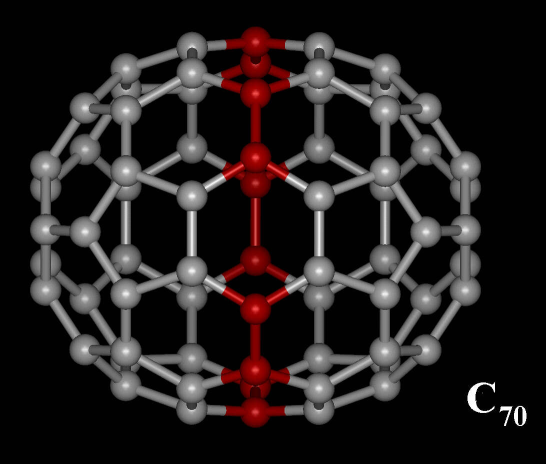
A fullerene is a molecule made entirely of carbon atoms arranged to form a hollow closed shell, tube, or ellipsoid. These structures include spherical "buckyballs" and cylindrical carbon nanotubes, and they represent a distinct allotrope of carbon alongside diamond, graphite and graphene. The term fullerene originally referred to cage-like molecules such as C60 and C70 but now covers a family of related carbon cages of varying size and shape. For a basic definition see molecule composed entirely of carbon and for the element itself see carbon.

Image gallery
10 Images





Structure and key characteristics
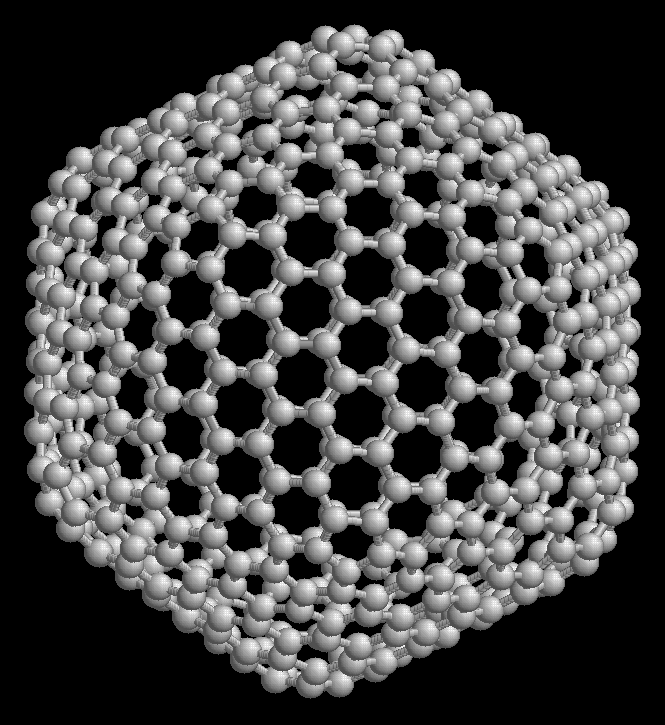
Most common fullerenes are closed networks of sp2-hybridized carbon atoms forming pentagons and hexagons. The best-known example, C60, has a truncated icosahedron geometry with 12 pentagons and 20 hexagons; its shape resembles a soccer ball. Stability of many cage structures follows rules such as the isolated pentagon rule (IPR). Fullerenes display delocalized π-electron systems, which give them distinctive electronic and chemical behavior: they can accept electrons, be chemically functionalized at many sites, and show unusual mechanical resilience.
History and discovery
Fullerenes were first identified experimentally in 1985 by a team of researchers using mass spectrometry and spectroscopic analysis; the discovery is attributed to Robert Curl, Harold Kroto and Richard Smalley, who later received the Nobel Prize in Chemistry for this work. The name honors architect Buckminster Fuller because the C60 cage resembles his geodesic dome designs; see related notes on Buckminster Fuller and his geodesic domes. Early work followed laboratory studies of carbon clusters produced from vaporized graphite; the original experiments and context are described in several historical accounts and reviews (discovery reports).

Synthesis methods and physical properties
Fullerenes are prepared by methods that vaporize carbon and allow cages to form in a controlled atmosphere. Classical laboratory production uses an electric arc between graphite electrodes in an inert gas atmosphere such as helium or argon; precursor and carrier gases are described in experimental protocols (graphite, inert gases, helium, argon). Other methods include laser ablation, combustion and chemical vapor deposition tailored to produce specific sizes or nanotube arrays. Fullerenes show distinctive optical absorbance, relatively low solubility in many solvents unless derivatized, and variable electrical properties: some doped fullerenes become superconducting, while others act as electron acceptors useful in organic electronics.
Applications and examples
Research and development have explored fullerenes in several areas. Representative directions include:
- Materials science: reinforcing agents, lubricants and components of composite materials.
- Electronics and energy: active layers in organic photovoltaics, electron-transport materials and components of molecular electronics.
- Nanotechnology and medicine: platforms for drug delivery, imaging contrast agents, and tools for nanoscale fabrication after suitable functionalization.
- Fundamental research: templates for chemistry on curved π-systems and studies of quantum confinement in carbon cages.

Distinctions and notable facts
Fullerenes differ from other carbon forms by their closed-cage topology. Carbon nanotubes are a related class formed as rolled graphene sheets and were characterized later; both classes share many synthesis techniques and some properties but differ in shape and anisotropy. Small variations in cage size and symmetry produce distinct chemical reactivity and physical behavior. Because fullerenes can be chemically modified, they serve as a versatile platform bridging molecular chemistry and nanoscale materials science. For more introductory material and technical reviews see the linked resources above.
Questions and answers
Q: What is a fullerene?
A: A fullerene is any molecule composed entirely of carbon, in the form of a hollow sphere, ellipsoid, or tube.
Q: Who discovered the fullerene?
A: The fullerene was discovered in 1985 by Robert Curl, Harold Kroto and Richard Smalley at the University of Sussex and Rice University.
Q: Why is it named after Buckminster Fuller?
A: It is named after Buckminster Fuller because his famous Geodesic domes are similar in shape to the spherical fullerenes which are also called buckyballs.
Q: How are fullerenes made?
A: Fullerenes are usually made by heating graphite in an electric arc in the presence of inert gases such as helium or argon.
Q: What does C60 refer to?
A: C60 refers to a rotating structure of a particular type of fullerene that resembles a soccer ball.
Q: What does the network of C60 refer to?
A: The network of C60 refers to its chemical structure which consists of 60 carbon atoms connected together with bonds forming hexagons and pentagons like those found on a soccer ball.
Related articles
Author
AlegsaOnline.com Fullerene (carbon cage molecule) Leandro Alegsa
URL: https://en.alegsaonline.com/art/36981