
Fractionating column (distillation device)
A fractionating column is an apparatus used in chemistry and industry to separate components of a liquid mixture by repeated vaporization and condensation during fractional distillation.
A fractionating column is an apparatus used to separate mixtures of liquids with different boiling behavior by exploiting vapor–liquid equilibrium. It is a central component of fractional distillation, where rising vapors and descending condensate exchange heat and mass repeatedly so that more volatile components concentrate toward the column top and less volatile components remain toward the bottom. Columns are found in laboratory setups and in large industrial towers.
Image gallery
7 Images



Basic principle and operation
Separation in a fractionating column relies on repeated partial vaporization and condensation. As a liquid mixture is heated, vapors carrying the more volatile component ascend and cool; contact with cooler surfaces or packing causes condensation and liquid to flow back down. Controlled reflux—the return of condensed liquid to the column—improves purity by enabling many equilibrium steps within a single physical device.
Designs and components
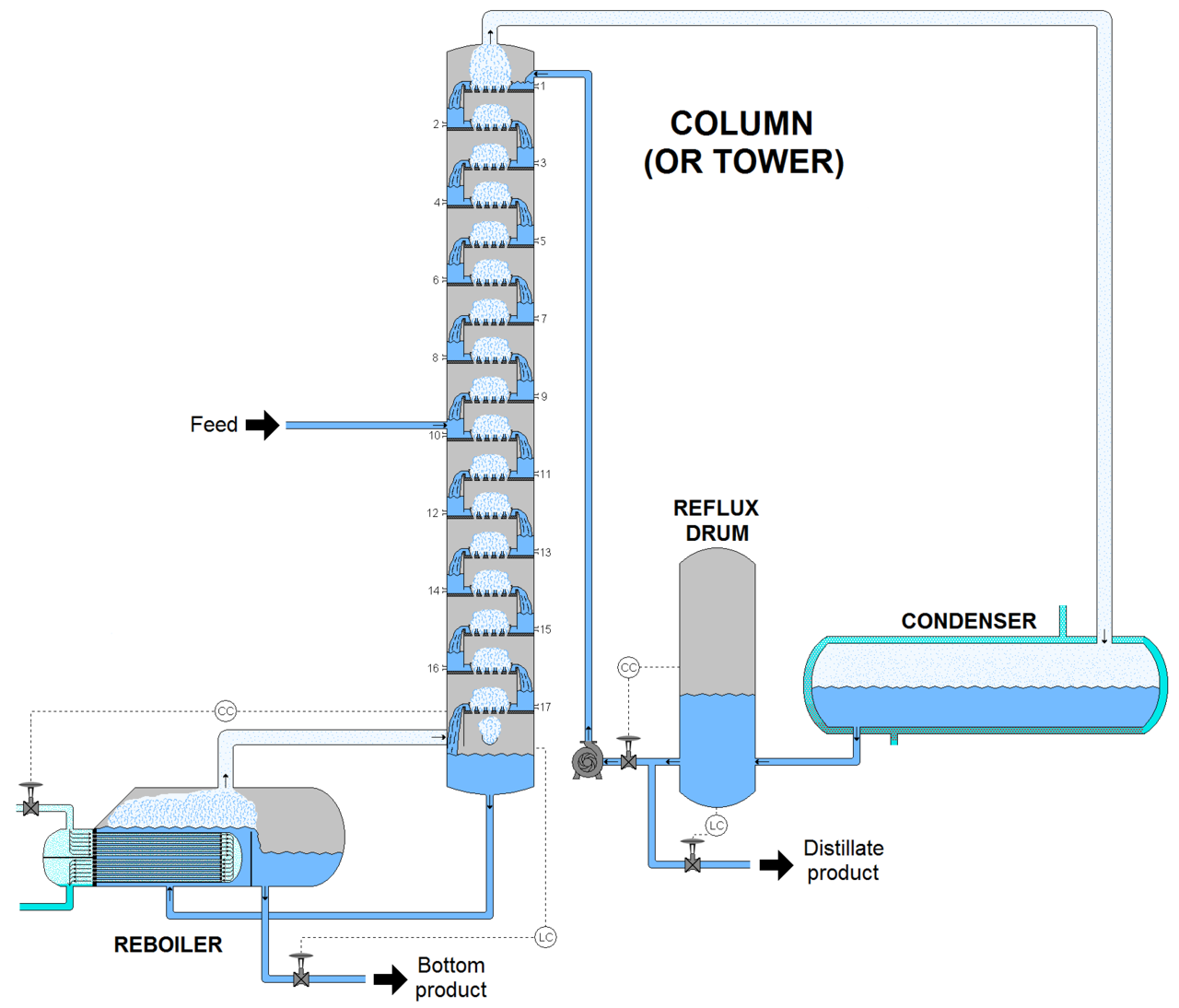
Common laboratory and industrial designs include plate (tray) columns and packed columns. Typical elements are:
- Reboiler at the base to generate vapors.
- Column body containing trays or packing to enhance contact area.
- Condenser at the top to liquefy overhead vapor and supply reflux.
- Feed and draw-off points to introduce and remove streams.
Types and performance measures
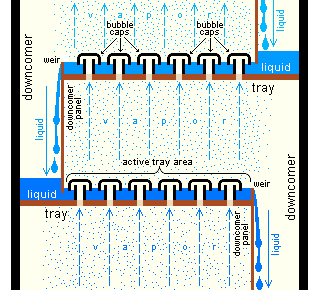
Plate columns use discrete stages (sieve, valve or bubble-cap trays); packed columns use structured or random packing (metal, ceramic, glass) to create surface area. Efficiency is often expressed as number of theoretical plates or height equivalent to a theoretical plate (HETP); higher values mean better separation but can require larger columns or more reflux.
Applications and notable facts
Fractionating columns are used in petroleum refining, chemical manufacture, laboratory purification, and production of spirits (subject to regulation). Some mixtures form azeotropes that limit achievable purity and require special techniques. Large outdoor fractionating columns are commonly called fractionating towers or distillation towers in industry. For background reading on related concepts see chemistry and definitions of low-boiling and high-boiling components.
Related articles
Author
AlegsaOnline.com Fractionating column (distillation device) Leandro Alegsa
URL: https://en.alegsaonline.com/art/35964