
Flag of Saint Lucia
Description, symbolism, history, and usage of the national flag of Saint Lucia, including its design elements and notable features.
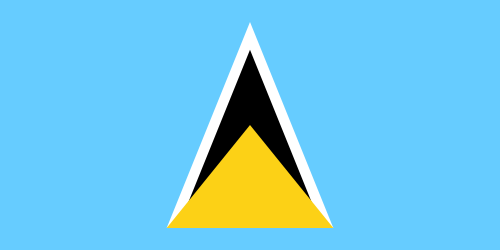
The national flag of Saint Lucia is a distinct emblem featuring a light blue background and a set of superimposed triangles near the hoist. For an official description and technical specifications see the official description. The flag is used by government institutions, displayed at national events, and represents the island state in international settings.
Design and components
The flag's arrangement combines color fields and geometric shapes to form a compact, symbolic motif. Key elements include:
- Blue field — the overall light blue background is shown and discussed in many sources; see blue field.
- Yellow triangle — a narrow golden or yellow isosceles triangle positioned before the darker pair; reference gold triangle.
- Black and white isosceles triangle — a larger black triangle edged (fimbriated) in white that sits behind the yellow element; compare descriptions at isosceles triangle and white fimbriation.
- Together these shapes form a stylized double-triangle motif often interpreted as a representation of the island's geography and culture; technical notes appear at black triangle and further context at further reading.
Symbolism and interpretation
The blue background commonly stands for the sky and surrounding Caribbean Sea. The yellow element is associated with sunshine or prosperity, while the dark triangle with a white edge evokes unity of the island's people and contrasts of heritage. Designers and commentators have read the double-triangle as an abstract depiction of the island's twin peaks or as a synthesis of natural and cultural identity.
History and adoption
The current composition grew from earlier proposals and modified designs made during the mid-20th century as Saint Lucia progressed toward greater self-government and eventual independence. The present flag formalized a motif that had been refined over time to balance aesthetic clarity with symbolic meaning. National authorities maintain official guidance on correct colors and proportions.
Usage and notable facts
The flag is displayed on public buildings, during ceremonies, and by citizens on patriotic occasions. It is relatively uncommon among national flags for its layered triangular design rather than simpler emblems. Variants exist for naval and governmental use; protocol for display is governed by national practice and etiquette.
For visual references, production guidelines, and historical notes consult the linked entries and official sources above for further study.
Related articles
Author
AlegsaOnline.com Flag of Saint Lucia Leandro Alegsa
URL: https://en.alegsaonline.com/art/34894