
Flag of Saudi Arabia
National flag of Saudi Arabia: a green field bearing the white Arabic shahada in Thuluth script and a horizontal sword. Covers design, script, symbolism, history, production and handling rules.
Overview
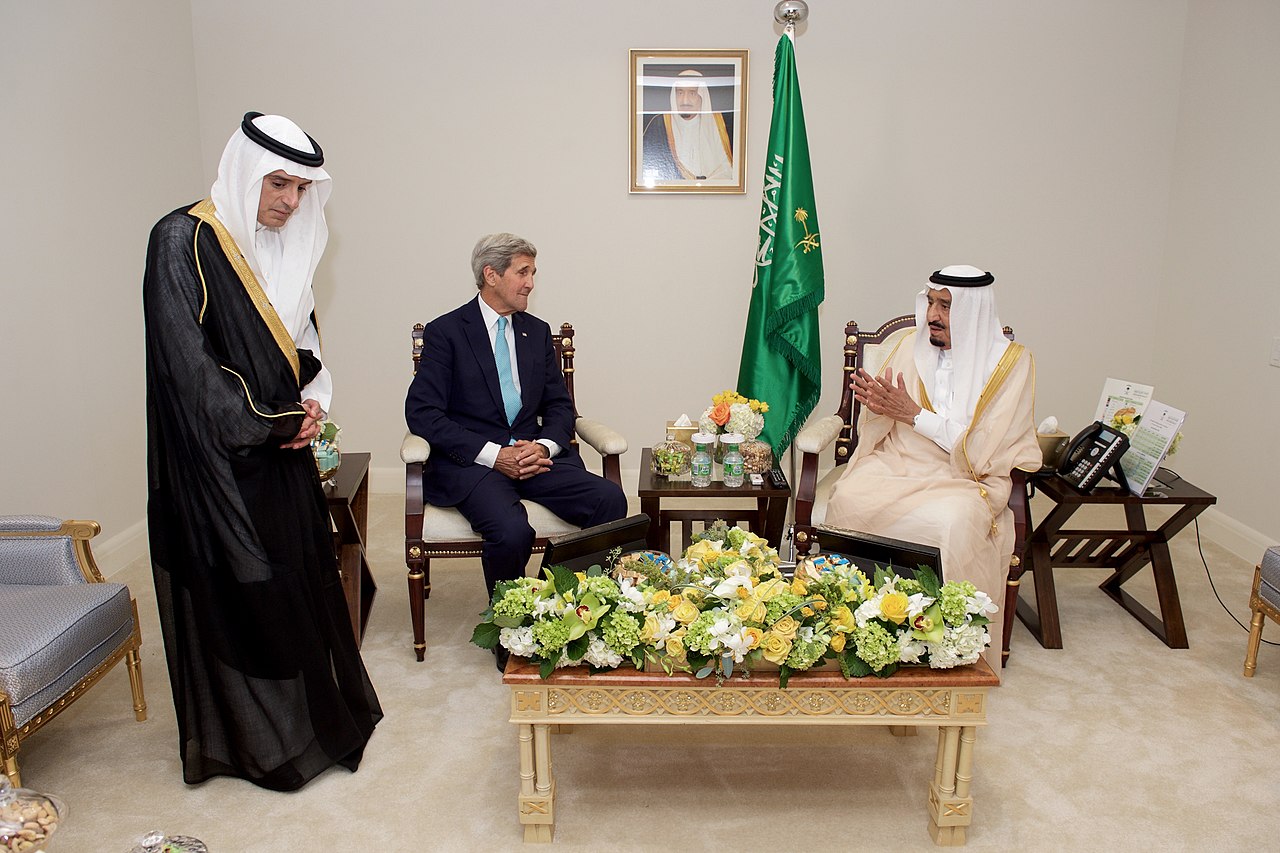
The flag of Saudi Arabia is the national banner and one of the principal state symbols of the Kingdom of Saudi Arabia. It consists of a green field bearing a white Arabic inscription and a horizontal white sword. The present, widely used form of the flag was standardized in the 20th century and is generally dated to 1973 for the current official specification. The flag's elements reflect Islamic identity and the historical foundations of the Saudi state.
Image gallery
2 Images
Design and symbolism
The field is green, a color long associated with Islam and widely used on the flags and emblems of Muslim-majority societies. The principal device is the shahada, the Islamic declaration of faith, executed in an ornate classical Arabic style. Beneath (and slightly to one side of) the inscription appears a single white sword. The sword functions visually to underline and balance the script and, in symbolism, evokes concepts such as strength, authority, defence of faith and, in some interpretations, justice. The sword has also been associated with the historical role of the ruling House of Saud in unifying the territory now known as Saudi Arabia.
Inscription and script
The inscription on the flag is the shahada: "lā ʾilāha ʾillā -llāh, Muḥammadun rasūl Allāh" ("There is no god but Allah; Muhammad is the Messenger of Allah"). It is rendered in a calligraphic style related to Thuluth, an ornamental form of Arabic script that has been used for decoration and monumental inscriptions for many centuries. Because the phrase is a sacred profession of faith for Muslims, authorities and cultural practice treat the inscription with religious respect; this affects how reproductions and public uses of the flag are regulated and perceived.
Sword, orientation and reversible layout
To preserve correct reading of the shahada and the proper orientation of the sword on both faces, official Saudi flags are usually produced as double-sided (not as a simple mirrored print). That means the lettering reads correctly from right to left on either side and the sword points from the hoist toward the fly on both faces. This requirement leads to a distinctive arrangement sometimes described as "sinister-hoisted" on the obverse side: the hoist appears on the right when the front face is viewed, an unusual solution adopted to avoid mirroring the sacred text.
Proportions, colours and specification
Over time the exact shape of the sword, the calligraphic treatment, and proportions of the field relative to the devices have been refined and standardized by official specification. These technical details determine how the shahada and sword are placed and scaled on the green field. Precise legal and manufacturing specifications are set by the government and may be cited in official documentation.
History and adoption
Green banners and flags bearing Islamic inscriptions have existed across the Arabian Peninsula and the broader Muslim world for many centuries. The specific combination of the shahada with a sword became associated with the rulers who established the modern Saudi state during the unification campaigns of the early 20th century. Variants were used by successive administrations before the present form was formalized in the later 20th century.
Use, protocol and restrictions
Because the shahada is a sacred phrase in Islam, the flag is treated with particular care in public life. Official protocol commonly prescribes respectful handling and display. In many contexts it is not customary to lower the national flag to half-mast, and the flag is seldom used in disposable or novelty items where it might be degraded or discarded. These practices are informed both by civic regulation and by cultural and religious considerations.
Variants and related flags
There are flags and banners in the Muslim world that use green fields and Arabic inscriptions; at a glance some may resemble the Saudi flag. Many of those do not include the sword, use different texts or lettering styles, or have different proportions. Saudi Arabia also employs distinct royal, military and institutional standards and emblems that incorporate national elements in modified forms under separate regulations.
Further reading and links
- Official flag usage and government information
- Government sources on national symbols
- Overview of Saudi Arabia
- Historical dates and adoption information
- Legal specifications and regulations
- Arabic script and calligraphy styles
- Information on the sword symbol
- Details on Thuluth and related scripts
- Background on the shahada
- Religious significance and translations
- Titles and historical references
- Heraldic and symbolic interpretations
- Comparisons with other Arabic-script flags
The flag of Saudi Arabia combines religious text and national symbolism in a form that is both visually distinctive and culturally significant. Its treatment in law and custom reflects the intersection of national identity and religious reverence, making it one of the more carefully regulated flags in contemporary practice.
Related articles
Author
AlegsaOnline.com Flag of Saudi Arabia Leandro Alegsa
URL: https://en.alegsaonline.com/art/34899