
Fiordland penguin (Eudyptes pachyrhynchus) — tawaki
A crested penguin native to southwestern New Zealand, the Fiordland penguin (tawaki) nests in coastal forest, feeds on fish, squid and krill, and faces threats from introduced predators and habitat change.
Overview
The Fiordland penguin (Eudyptes pachyrhynchus), commonly called tawaki in Māori, is one of the crested penguins. It is notable for its yellow facial crests, dark upperparts and white underparts. Secretive by nature, this species spends much of its life at sea, returning to shore to breed in sheltered coastal habitat. The Fiordland penguin is an emblematic bird of New Zealand's southern coastline and islands.
Image gallery
4 Images


Identification and characteristics
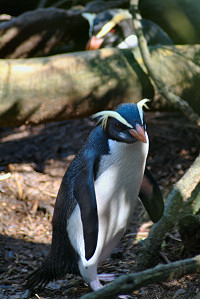
Fiordland penguins have a distinctive appearance that separates them from other penguins: bold yellow crests sweep from above the eye toward the rear of the head, contrasting with a mostly black head and back and a white belly. The bill is robust and coloured orange to reddish-orange, and the tail is relatively short and narrow. Adult size is typically similar to medium-sized penguins, often reported at roughly 45–60 cm (17–24 in) in length and weighing a few kilograms. As they age, plumage and crest colour may darken or appear more pronounced.
Distribution and habitat
Fiordland penguins breed mainly along the rugged, forested coasts of southwestern New Zealand, especially in and around the Fiordland region and nearby islands. They nest in dense coastal forest, in burrows, under tree roots, in rock crevices or among boulders, often hidden from view. While their core range is in New Zealand, a small number of vagrant records have been reported across the Tasman Sea, including occasional sightings in Tasmania. For more general context on crested penguins see crested penguins.
Diet, foraging and predators
At sea, Fiordland penguins forage for a diet composed mainly of small schooling fish, squid and crustaceans such as krill. They dive and pursue prey underwater, often hunting close to the coast. Squid are a common component of their diet and an important protein source for chicks; see also squid articles for general information. Natural marine predators include seals and large fish, and at sea they can be vulnerable to bycatch in fishing gear.
Breeding, life history and conservation
Fiordland penguins typically return to the same nesting areas each year. As with other members of the genus Eudyptes, they commonly lay two eggs; the second egg is usually larger and more likely to produce a surviving chick. Pairs tend to be territorial around burrow entrances and show strong site fidelity. Lifespan in the wild can extend over a decade, with many individuals living into their teens.
Threats and notable facts
- Major threats include habitat disturbance, introduced terrestrial predators (such as stoats, dogs and feral cats), fisheries interactions and changes in prey availability.
- Nesting in forested coastal areas makes them particularly vulnerable to habitat loss and human disturbance.
- The species is culturally significant; its Māori name tawaki is commonly used in New Zealand conservation work.
Conservation efforts focus on protecting breeding sites, controlling introduced predators, reducing bycatch and monitoring populations. For further reading on the Fiordland region and its wildlife, see regional resources linked to New Zealand and its marine environment such as New Zealand-oriented materials. Additional background on crested penguins and related species can be found via broader references to crested penguins and marine prey articles like those on squid and krill.
Related articles
Author
AlegsaOnline.com Fiordland penguin (Eudyptes pachyrhynchus) — tawaki Leandro Alegsa
URL: https://en.alegsaonline.com/art/34448
Sources
- dictionary.reference.com : "Krill"