
Krill: Small, Swarming Crustaceans That Drive Marine Food Webs
Krill are small, shrimp-like crustaceans found throughout the world's oceans. They form dense swarms, perform large migrations, and are a critical food source for many marine species and fisheries.
Overview
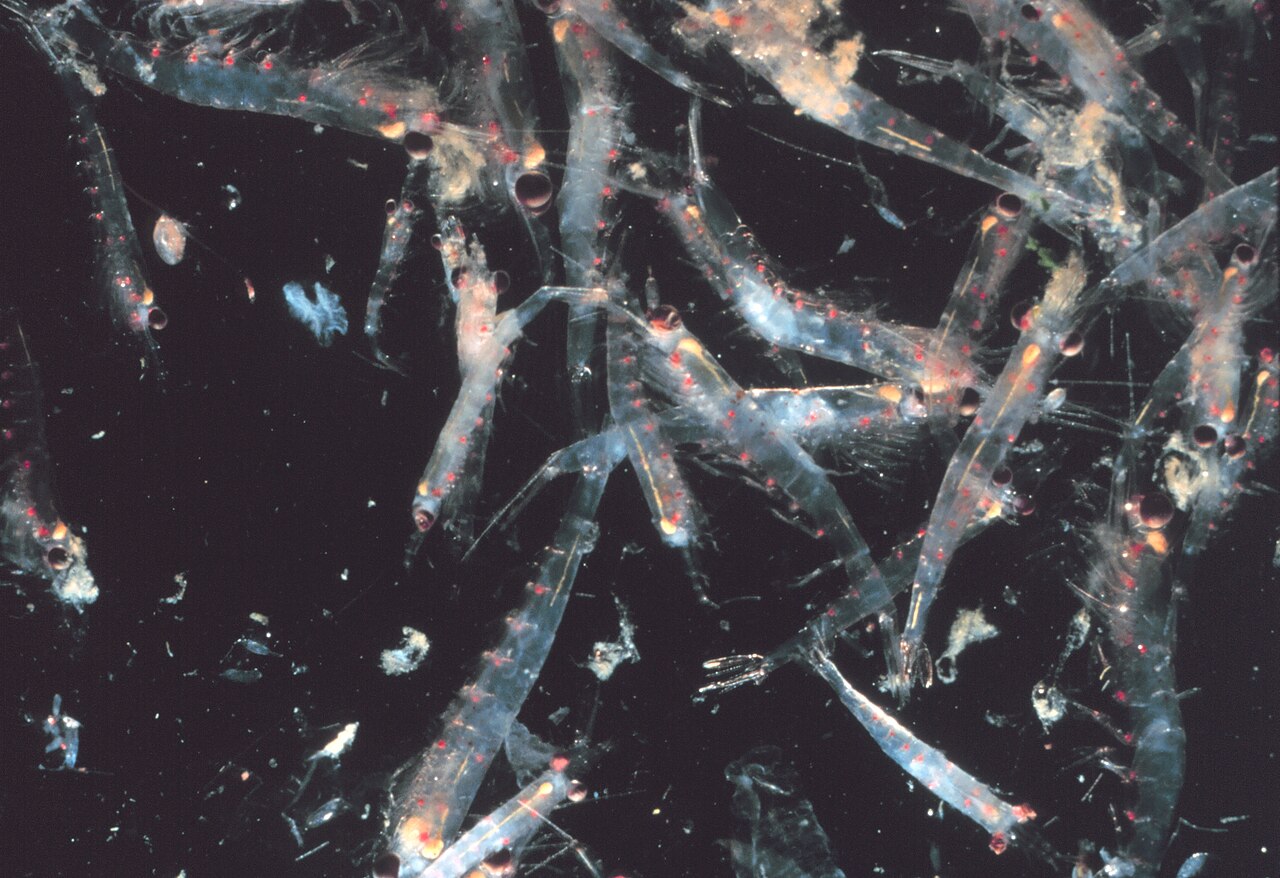
Krill are small, usually pinkish or translucent, shrimp-like animals belonging to the order Euphausiacea of crustaceans. They occur throughout the oceans of the world, from polar regions to the tropics. Individual krill are typically a few centimetres long, but in nutrient-rich zones they often congregate in enormous swarms that can stretch for kilometres and may contain thousands to millions of animals per cubic metre.
Image gallery
10 Images




Form, feeding and behaviour
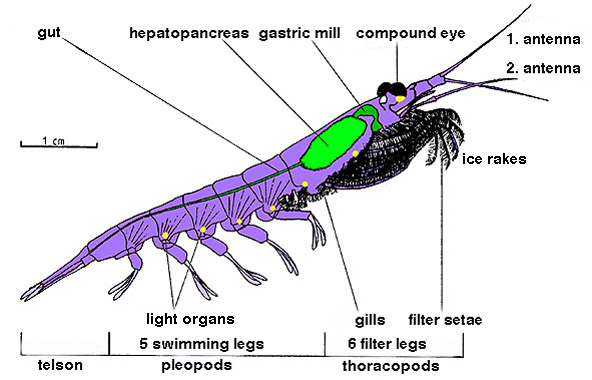
Krill possess a segmented body with a carapace, jointed appendages for swimming and feeding, and—as a distinctive anatomical trait—externally visible gills. Many species are filter feeders: they harvest phytoplankton with specialized thoracic appendages and also consume small zooplankton and detritus. Most krill undertake pronounced daily vertical migrations, rising toward surface waters to feed at night and descending to deeper, darker waters by day. These regular movements help transfer energy and nutrients through the water column.
Ecological importance
Krill sit low in the food chain but are a keystone group because they convert primary production into concentrated biomass that larger animals can consume. One species, the Antarctic krill (Euphausia superba), is particularly abundant in the Southern Ocean; estimates suggest a total biomass on the order of hundreds of millions of tonnes, making them one of the most plentiful animal groups by mass in the planet's oceans. That biomass supports massive seasonal feeding by predators and sustains complex food webs.
Predators and examples
A wide variety of marine life depend on krill as a major or seasonal food source. Typical predators include:
- Large whales such as baleen species that filter krill from seawater.
- Seals and other pinnipeds, which feed intensively where krill are dense—see seals.
- Penguins, which often rely on krill during breeding—see penguins.
- Sea birds and other birds that time migrations and breeding to krill availability.
- Many fish, as well as cephalopods like squid and even filter-feeding species such as whale sharks.
Because krill are eaten by such a range of animals, fluctuations in their abundance can ripple through entire ecosystems.
Human uses and fisheries
Krill are harvested in some regions for use as animal feed, aquaculture feed, and dietary supplements rich in omega-3 fatty acids. Fisheries are most active for Antarctic krill; catches are managed and monitored because of their ecological role. Weight measures and conversions are often cited in reporting—historical and scientific accounts may reference quantities in long tons or short tons to convey scale.
Conservation and notable facts
Conservation concerns about krill focus on the effects of climate change, ocean acidification, and expanding fisheries on krill distribution and productivity. Southern Ocean krill, for example, are linked to sea ice dynamics because ice-associated algae are an important early-season food source. In addition to their ecological role, krill are notable for their swarming behaviour, the scale of their migrations, and their visible gill structures that distinguish them from many true shrimp. Scientific monitoring, ecosystem-based fishery management, and international agreements aim to balance sustainable use with protection of the animals that depend on krill for survival.
For further general information and resources about krill biology, ecology, and fisheries management see broader summaries and specialist reports (overview, classification, ocean distribution, global context, swarms, food web links, Southern Ocean studies, Antarctic krill, tonne conversions, alternate weight units, seal diets, penguin feeding, seabird interactions, commercial fish, cephalopods, large filter feeders, migration patterns, anatomical details).
Questions and answers
Q: What are krill?
A: Krill are small shrimp-like crustaceans about an inch or so long, found in all the oceans of the world.
Q: What do krill feed on?
A: Krill feed on phytoplankton and to a lesser extent zooplankton.
Q: Why are krill ecologically important?
A: Krill are ecologically very important because they make up the largest part of the diet of many animals.
Q: How much biomass does Antarctic krill have?
A: The Antarctic krill, Euphausia superba, has an estimated biomass of over 500,000,000 tonnes (490,000,000 long tons; 550,000,000 short tons).
Q: Who eats krill?
A: Krill is eaten by many animals including whales, seals, penguins, birds, fish squid and whale sharks.
Q: How much of the biomass is eaten each year?
A: Over half of the biomass is eaten each year and replaced by growth and reproduction.
Q: How can you tell a krill apart from other crustaceans such as true shrimp? A: You can tell a krill apart from other crustaceans such as true shrimp by their externally visible gills.
Related articles
Author
AlegsaOnline.com Krill: Small, Swarming Crustaceans That Drive Marine Food Webs Leandro Alegsa
URL: https://en.alegsaonline.com/art/54450
Sources
- doi.org : 10.1002/bio.1170100205
- pubmed.ncbi.nlm.nih.gov : 7676855
- pnas.org : "Crossreactivity between the light-emitting systems of distantly related organisms: novel type of light-emitting compound"
- doi.org : 10.1073/pnas.77.3.1394
- jstor.org : 8463
- ncbi.nlm.nih.gov : 348501
- pubmed.ncbi.nlm.nih.gov : 16592787
- isbc.unibo.it : Encyclopedia of Ocean Science
- biology.duke.edu : "The red and the black: bioluminescence and the color of animals in the deep sea"
- doi.org : 10.1093/icb/45.2.234