
Fezouata Formation
An Early Ordovician Moroccan Lagerstätte with exceptionally preserved fossils that extend Burgess Shale–type assemblages beyond the Cambrian and illuminate early Paleozoic marine ecosystems.
The Fezouata Formation is a sequence of sedimentary rocks exposed in the Anti-Atlas region of southeastern Morocco. It comprises interleaved units commonly referred to as the Lower and Upper Fezouata formations and is best known for exceptionally preserved fossils recovered from fine-grained mudstones. The formation's geographic and stratigraphic context can be explored further at the site location.
Image gallery
10 Images


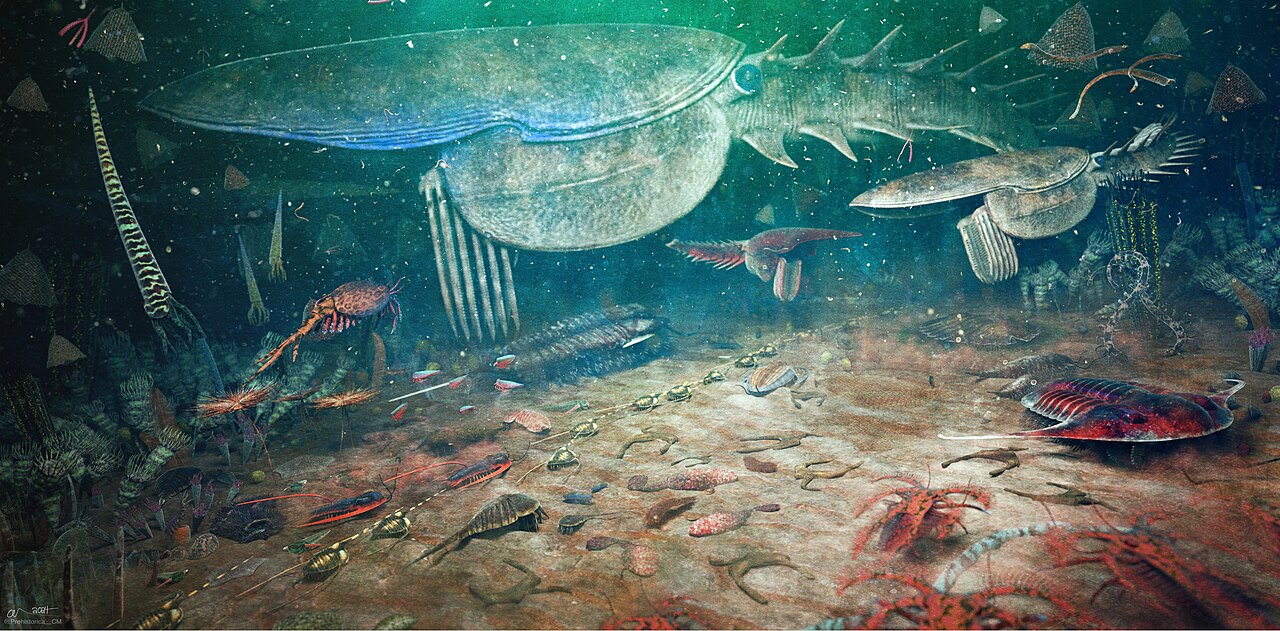


Setting and preservation
The deposits represent shallow marine environments of the Early Ordovician and are classified among so-called Burgess Shale-type Lagerstätten because soft tissues and delicate anatomical details are often conserved. Preservation appears to result from rapid burial in low-oxygen, fine siliciclastic sediments that limited decay and scavenging, producing layers with high fossil fidelity that complement more common shelly fossil records.
Age and stratigraphy
These rocks date to the Lower Ordovician, placing them after the Cambrian Period. The formation includes several fossil-bearing beds separated by horizons of less productive strata; work on their precise stratigraphic relationships continues, and they have become key reference points for studying early Paleozoic ecosystems.
Fossil assemblage and importance
The fossilized fauna includes a mix of mineralized and soft-bodied organisms: trilobites, brachiopods, sponges, echinoderms, various arthropods and wormlike taxa, plus other groups that are otherwise rare or absent in typical shelly fossil lists. Many taxa resemble members of the Cambrian Burgess Shale community, demonstrating that distinctive soft-bodied lineages persisted into the Ordovician rather than disappearing at the end of the Cambrian as once thought (mid-Cambrian extinction hypotheses).
Because of this continuity, the Fezouata biota has reshaped views of early Paleozoic biodiversification by filling a temporal gap between the Cambrian Explosion and later Ordovician radiations. It provides vital data on anatomy, ecology, and the evolutionary longevity of several unusual body plans and lifestyles associated with the Burgess Shale assemblages (Burgess Shale biota).
Notable features and research uses
- Konservat‑Lagerstätte: exceptional soft‑tissue preservation informs anatomy beyond hard parts.
- Paleoecology: helps reconstruct community structure, trophic interactions, and environmental gradients in early Paleozoic seas.
- Evolutionary significance: documents the survival and transformation of Cambrian-style taxa into the Ordovician.
- Educational and scientific value: specimens are used in comparative studies, museum displays, and to calibrate evolutionary and stratigraphic models.
Ongoing fieldwork and laboratory study continue to refine the Fezouata Formation's taxonomic inventory, taphonomic pathways and stratigraphic framework, making it an active focus for understanding the dynamics of early animal life on Earth.
Questions and answers
Q: What are the Fezouata formations in Morocco?
A: The Fezouata formations in Morocco are Burgess Shale type deposits dating to the Lower Ordovician.
Q: What types of organisms were found in the fossilized fauna of the Fezouata formations?
A: Numerous organisms were found in the fossilized fauna of the Fezouata formations, including some that were previously thought to have died out after the mid-Cambrian.
Q: When do the Fezouata formations date back to?
A: The Fezouata formations date back to the Lower Ordovician.
Q: What does the discovery of the Fezouata formations prove about the Burgess Shale biota?
A: The discovery of the Fezouata formations proves conclusively that the Burgess Shale biota did not go extinct in the Cambrian.
Q: Are the Fezouata formations located only in Morocco?
A: Yes, the Fezouata formations are located only in Morocco.
Q: What is the Burgess Shale biota?
A: The Burgess Shale biota refers to the diverse and well-preserved fossilized fauna discovered in the Burgess Shale formation in Canada.
Q: Why is the discovery of organisms previously thought to have gone extinct important?
A: The discovery of organisms previously thought to have gone extinct is important because it adds to our understanding of the evolution of life on Earth and challenges previously held beliefs about the timing and extent of when certain organisms existed.
Related articles
Author
AlegsaOnline.com Fezouata Formation Leandro Alegsa
URL: https://en.alegsaonline.com/art/34144
Sources
- nature.com : nature.com/articles/nature09038?error=cookies_not_supported&code=df276b55-00db-41f4-a228-…
- news.bbc.co.uk : (BBC News) Victoria Gill, "Fossil find resolves ancient extinction mystery"
- searchanddiscovery.com : Exceptionally preserved faunas from the Lower Ordovician of the Anti-Atlas, Morocco
- nature.com : nature.com/articles/news.2010.234?error=cookies_not_supported&code=2d1e4f7a-fa6f-4081-8fc…