
Fauna — the animal life of regions, habitats and geological eras
Fauna denotes the animals characteristic of a place, habitat or period. This article explains its meanings, classification uses in ecology and paleontology, and how it contrasts with flora.
Overview
Fauna is the collective term for animal organisms or animal life associated with a particular geographic area, habitat, or geological time. Used alongside flora — the plant life of a place — it summarizes the variety and composition of animals in ecosystems studied by biologists and naturalists. The term applies equally to living communities and to fossil assemblages described in paleontology.
Image gallery
6 Images
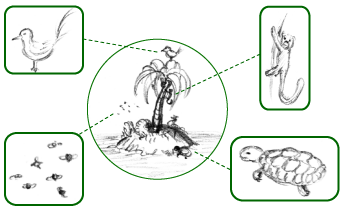




Components and classification
A fauna can be described at many scales: from the microscopic animals in soil, through the vertebrates of a country, to the entire assemblage of creatures in a biome. Scientists categorize fauna by taxonomic groups (mammals, birds, insects), by functional role (predators, pollinators, decomposers), or by the habitat they occupy (freshwater, marine, desert). Catalogs of regional fauna often list native, endemic, introduced, and invasive species.
Historical and paleontological use
In geology and paleontology, fauna names identify the animal communities of particular time intervals. For example, paleontologists compare the Eocene fauna with the Miocene fauna to understand long-term changes in climate and biodiversity. Fossil faunas provide key evidence for evolutionary events, biogeographic shifts, and mass extinctions.
Ecological role and importance
Faunal assemblages shape ecosystem processes: animals pollinate plants, cycle nutrients, regulate populations of other organisms, and influence habitat structure. Conservation efforts often focus on preserving representative fauna to maintain ecological function. Studies of a habitat's fauna — whether a coral reef, savannah, or urban park — reveal the health and resilience of that system.
Uses, examples and practical lists
The word "fauna" is also used for published lists and reference works that enumerate the animal species of a region or group. Field guides, checklists, and faunal surveys help researchers, managers and the public track species distribution, monitor invasive species, and inform conservation planning. One might speak of the fauna of a particular habitat or compare the flora and fauna of a savannah and a rainforest.
Distinctions and notable facts
- Fauna vs. flora: fauna refers to animals; flora to plants; together they describe biological communities.
- Endemic fauna are species found only in a specific area; invasive fauna can alter native ecosystems.
- Regional faunal lists are often compiled into catalogs or museums' collections and cited in scientific literature (botany and zoology cross-reference these data).
- Monitoring changes in fauna over time helps detect environmental change and guide policy (animal conservation) and research priorities (life science programs).
By summarizing which animals occur where and when, the concept of fauna remains central to ecology, conservation, and the study of Earth's biological history.
Related articles
Author
AlegsaOnline.com Fauna — the animal life of regions, habitats and geological eras Leandro Alegsa
URL: https://en.alegsaonline.com/art/33671