
Flood basalt (trap) provinces: formation, characteristics, and global significance
Flood basalts are vast, low-viscosity basaltic lava flows produced by enormous volcanic events that form plateaus and oceanic plateaus, with major geological and environmental impacts.
Overview
Flood basalts, often called trap basalts, are the products of exceptionally large volcanic eruptions or sequences of eruptions that pour out low-viscosity basaltic lava across extensive areas. Instead of building steep volcanic cones, these lavas spread widely and repeatedly to form thick, layered plateaus or oceanic plateaus. Flood basalt events are episodic and are evidence that Earth's volcanic activity can concentrate into brief, intense intervals.
Image gallery
10 Images




Characteristics and deposits
Flood basalt provinces are characterized by vast, relatively flat accumulations of basaltic rock, sometimes hundreds of metres thick and extending over hundreds of thousands to millions of square kilometres. Individual flows are typically thin and extensive, stacking to create step-like topography (the word "trap" derives from a Scandinavian word for stairs). The lava involved is mafic — rich in iron and magnesium — and its low viscosity permits it to travel long distances.
Formation and mechanisms
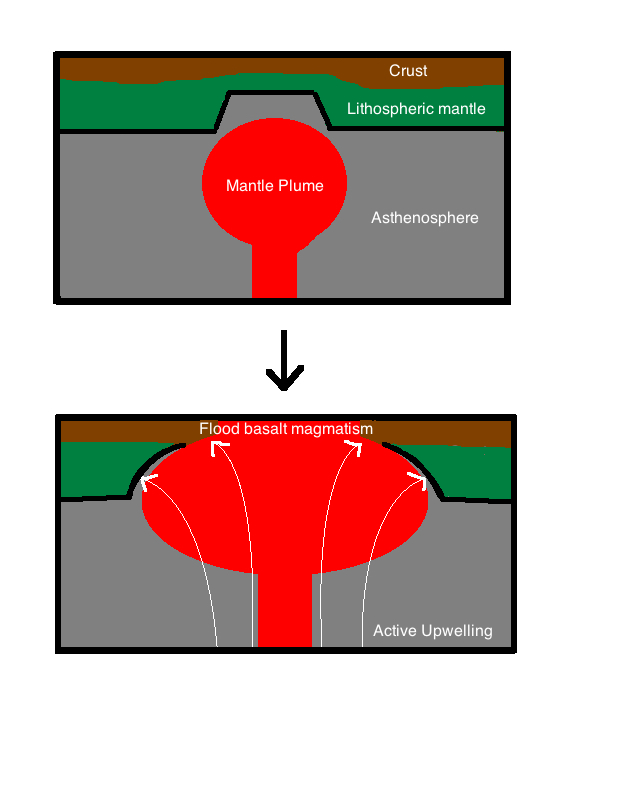
Scientists explain flood basalts through combinations of mantle processes. One common model invokes a mantle plume or hotspot that delivers a high heat flux from deep in the mantle, producing large volumes of basaltic melt. Continental rifting or lithospheric thinning can facilitate decompression melting and allow this melt to reach the surface. Partial melting commonly occurs in the upper mantle and asthenosphere at depths that may range from tens to a few hundred kilometres, although precise depths vary by province.
History and notable examples
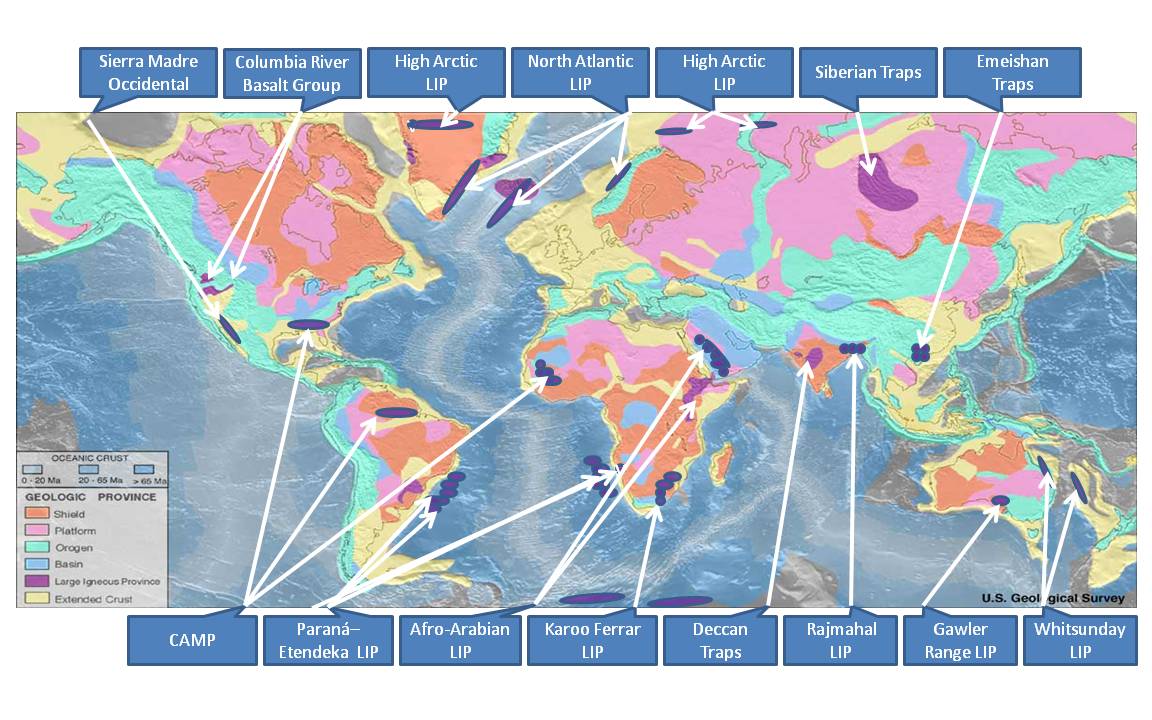
Flood basalt events have punctuated Earth history and are associated with some of the planet's largest igneous provinces. Well-known continental examples include the Deccan Traps (India), the Siberian Traps (Russia) and the Columbia River Basalt Group (northwestern United States). Oceanic examples include large plateaus such as the Ontong Java Plateau. These provinces formed in different geological eras and have been studied for their timing, duration and links to other global changes.
Impacts, importance and distinctions
Flood basalt eruptions can have major environmental consequences because they release large volumes of gases — including carbon dioxide and sulfur species — and inject aerosols and particulates into the atmosphere. Some large igneous provinces are temporally associated with dramatic climate shifts and, in several cases, with mass extinction intervals; scientists view these associations cautiously, seeking evidence of timing and causal mechanisms. Geologically, flood basalts differ from stratovolcanoes and smaller basaltic shield volcanoes mainly by their scale, eruption rates, and the way lava is emplaced.
Further reading and resources
- Overview of large volcanic eruptions
- Flood basalts on ocean floors
- Basalt composition and properties
- Lava flow dynamics
- Scale and extent of igneous provinces
- Flood basalt events in Earth history
- Plateau formation and morphology
- Relationship to mountain building
- Implications for Earth's thermal history
- Continental rifting and volcanism
- Partial melting processes
- Magma generation in the mantle
- Viscosity and flow behaviour of basalt
- Why flood basalts produce plateaus, not tall cones
- Asthenosphere and melting depth
- Heat sources for large igneous provinces
- Hotspots, plumes and surface volcanism
Questions and answers
Q: What is a flood basalt?
A: A flood basalt is the result of a giant volcanic eruption or series of eruptions that coats large stretches of land or the ocean floor with basalt lava.
Q: How large can flood basalts cover?
A: Flood basalts have covered areas as large as an entire continent in prehistory, creating great plateaus and mountain ranges.
Q: What causes flood basalts?
A: Flood basalts are caused by the combination of continental rifting and its associated melting, along with a mantle plume producing vast quantities of a basaltic magma.
Q: Where do flood basalts start from?
A: Flood basalts start at between 100 and 400 km depth, in the asthenosphere.
Q: What is necessary for partial melting to occur on such a large scale?
A: It is necessary to have a large heat input in order for partial melting to occur on such a large scale as that of the traps, expelling huge quantities of lava.
Q: Where does this heat input come from?
A: The heat input comes from near a hotspot, resulting in a mixture of magma from the depths of the hotspot with superficial magma produced by a mantle plume.
Q: How do we know that Earth has periods of higher activity rather than being in uniform steady state?
A: We know that Earth has periods of higher activity rather than being in uniform steady state because floods basalts have erupted at various times throughout Earth history - they are clear evidence for this fact.
Related articles
Author
AlegsaOnline.com Flood basalt (trap) provinces: formation, characteristics, and global significance Leandro Alegsa
URL: https://en.alegsaonline.com/art/35156
Sources
- myweb.uiowa.edu : myweb.uiowa.edu/dpeate/downloads/Parana-review.pdf.
- prizemining.com : Muskox Property - The Muskox Intrusion