
Flat Earth Society
Organization advocating a flat-Earth model; founded in 1956, rooted in earlier zetetic movements, now largely a small movement sustained online and notable for conspiracy claims and public controversy.
Overview
The Flat Earth Society, formally known in some eras as the International Flat Earth Research Society, is an organization associated with the belief that the Earth is flat rather than a globe. The group and its successors present arguments and materials asserting a flat-Earth model and often position themselves in opposition to mainstream geoscience. For historical reference and membership information some maintain an official website; the Society's central claim that the Earth is flat is often summarized in public materials and debates (flat Earth) in contrast to the widely accepted spherical model (sphere).
Image gallery
4 Images


Core beliefs and claims
Different branches and adherents describe the flat Earth in varying ways, but common elements include:
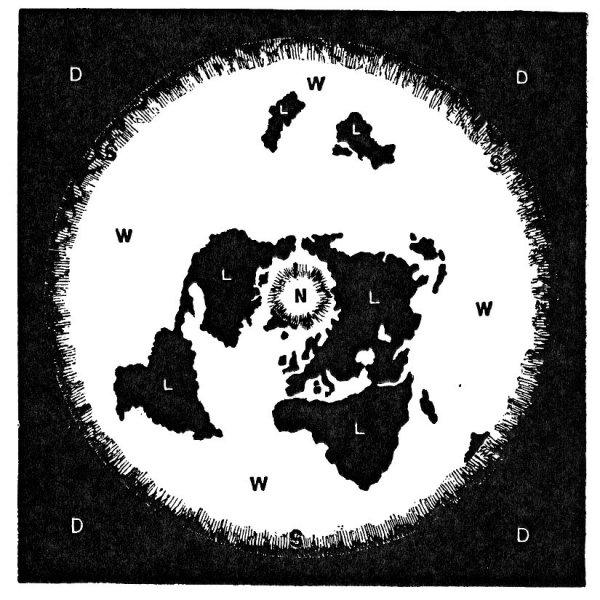
- Earth as a flat disc rather than a sphere, often with the North Pole near the center and Antarctica forming an outer ice wall.
- Rejection of much conventional evidence for a spherical Earth, including some astronomical and geodetic measurements.
- Claims that imagery and data from space agencies are fabricated or misleading, frequently invoking conspiratorial explanations.
History and development
The modern Flat Earth Society was established in 1956 by Samuel Shenton in England as an organized effort to promote flat-Earth ideas. It developed from an earlier 19th-century tradition of "zetetic" inquiry associated with figures like Samuel Rowbotham, who published material arguing for a non-spherical Earth. Charles K. Johnson led the Society through much of the 20th century and made his home a focal point for the group's activities; his death in 2001 marked a decline in the organization’s visible activity, though related groups and websites continued the work under the same or similar names.
Evidence, counterclaims, and criticism
Flat Earth claims are challenged by multiple lines of evidence from astronomy, physics, navigation and direct observation. Examples of mainstream rebuttals include observations of planetary bodies, satellite and probe data, circumnavigation, time zones, and measurements of Earth's curvature. Advocates of the flat-Earth view often respond by asserting that photographs from space are staged or manipulated (photographs) and by alleging institutional cover-ups, sometimes naming space agencies like NASA and asserting conspiracy theories (conspiracy claims).
Modern presence and cultural impact
While support for a flat Earth has never been large compared with the global scientific consensus, the topic has had recurring visibility. In recent decades the internet and social media have allowed flat-Earth ideas to reach new audiences, giving rise to online forums, videos, and public debates. The topic frequently appears in discussions about science communication, misinformation, and the sociology of fringe beliefs. Public figures, comedians, and educators sometimes use the Flat Earth Society and its claims as case studies in critical thinking and media literacy.
Notable distinctions and legacy
The Flat Earth Society is best understood as part of a broader historical and cultural phenomenon: long-standing human interest in cosmology, periodic resistance to scientific consensus, and the formation of communities around alternative interpretations of observation. Although scientific institutions overwhelmingly support the spherical Earth model, the Flat Earth Society has had outsized cultural visibility and continues to be cited in conversations about belief, evidence, and the role of authority in science.
Further reading and context
- Accounts of 19th-century zetetic writers and the evolution of the modern movement.
- Scientific explanations of Earth's shape from astronomy and geodesy.
- Discussions of how social media affects the spread of unconventional scientific views.
Related articles
Author
AlegsaOnline.com Flat Earth Society Leandro Alegsa
URL: https://en.alegsaonline.com/art/35029