
Fold (geology): Types, Formation, and Significance
A fold is a bend in originally planar rock layers produced by ductile deformation under stress. This article describes fold geometry, causes, scales, classification and their importance in geology.
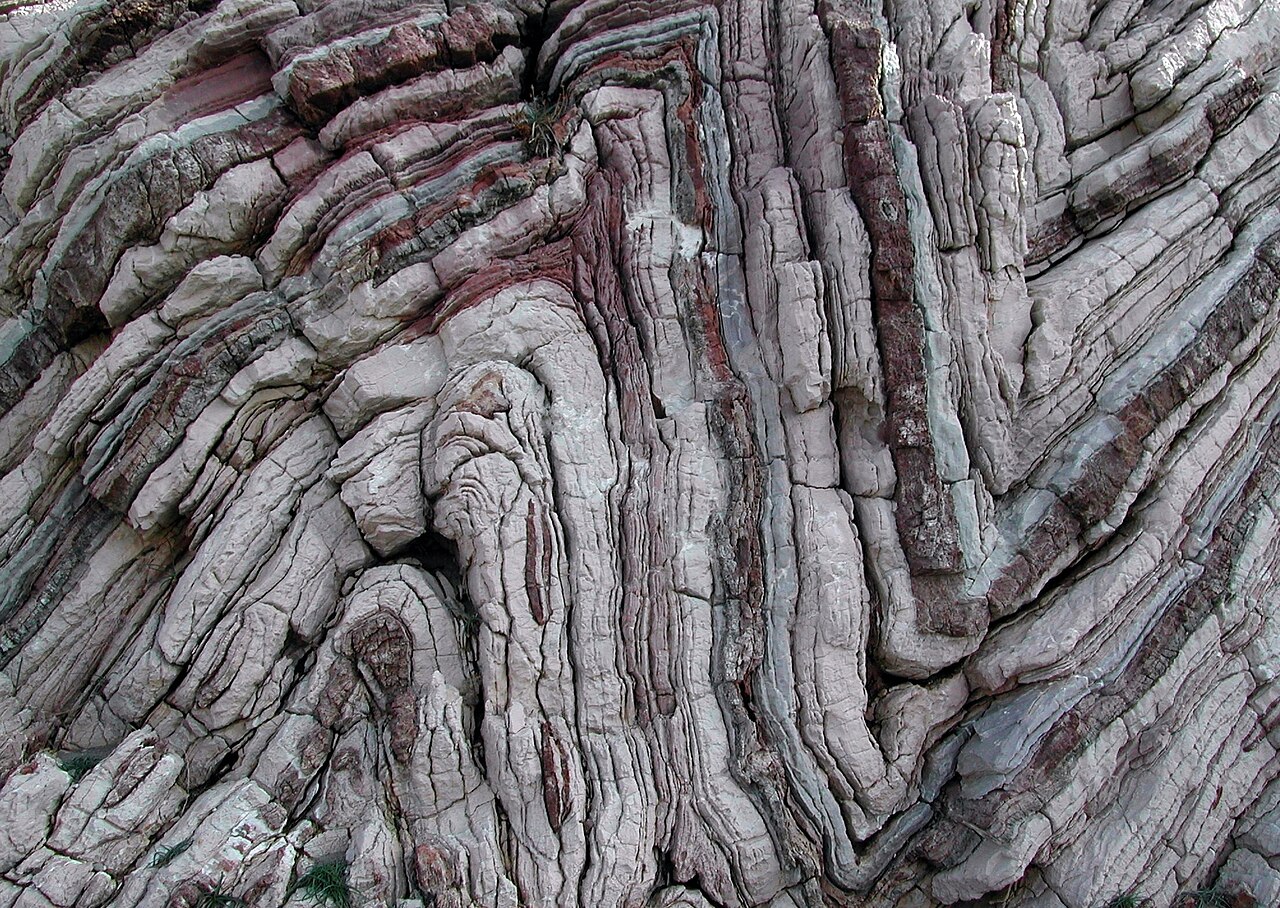
A fold in geological terms is a bend or curve in originally flat or gently inclined rock layers that results from deformation under stress. Folding typically affects layered rocks such as sedimentary strata, but can also involve layered igneous or metamorphic rocks. Folds form when rock undergoes ductile (plastic) deformation rather than brittle failure, usually under conditions of elevated temperature, pressure and prolonged stress related to tectonic processes.
Image gallery
10 Images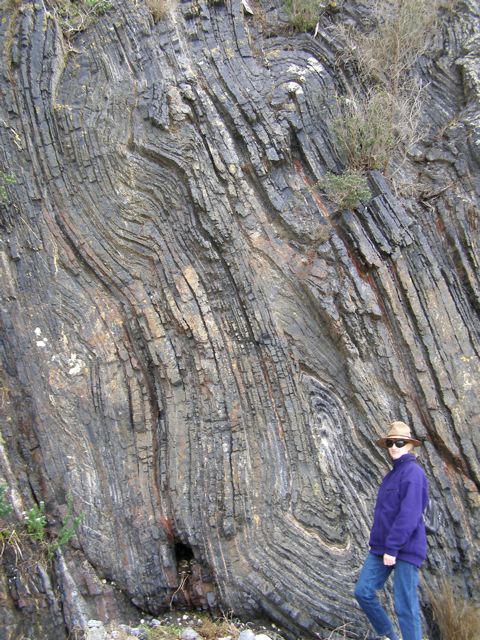




Basic geometry and parts of a fold
Folds are described by several standard terms that describe their shape and orientation. The limbs are the flanks of the fold, the hinge (or hinge line) is where curvature is greatest, and the axial plane is an imaginary surface that divides the fold as symmetrically as possible. Folds may plunge (the hinge line tilts) or be non-plunging. Common geometric distinctions include symmetrical versus asymmetrical folds, upright versus overturned folds, and open versus tight folds based on the tightness of curvature.
Common fold types
- Anticline — a convex-upward fold with the oldest beds at its core.
- Syncline — a concave-upward fold with the youngest beds in its core.
- Monocline — a step-like fold in otherwise horizontal strata.
- Recumbent and isoclinal folds — examples of extreme deformation where limbs are nearly parallel or overturned.
How folds form
Folding is most commonly driven by horizontal compressive forces associated with plate tectonics, for example at convergent margins where crustal shortening produces mountain belts. The mechanical response of rock depends on temperature, pressure, rock composition and strain rate; under ductile conditions rocks bend and flow. Several specific mechanisms produce folds: layer-parallel shortening (buckle folding), flexural-slip (sliding along bedding planes), and flow folding in more homogeneous rocks. Folding is one of the endogenetic processes that operate within the Earth's crust and is often linked with regional metamorphism and faulting.
Scale, occurrence and examples
Folds occur over a wide range of scales: microscopic crinkles visible only in thin section, metre- to kilometre-scale folds exposed in outcrop, and mountain-scale folds extending tens to hundreds of kilometres as part of fold belts. Extensive arrays of folds form fold trains; when distributed on a regional scale they make up fold-and-thrust belts typical of orogenic zones. Well-known mountain systems such as parts of the Appalachians and the Himalaya show large, complex folded structures produced during continental collision and crustal shortening.
Importance and applications
Recognizing and analyzing folds is critical in structural geology, resource exploration and geotechnical engineering. Anticlines can form traps for hydrocarbons and groundwater; folded strata can concentrate or disperse mineralization. Mapping fold geometry helps geologists reconstruct deformation histories and tectonic evolution. Seismic reflection data, geological mapping and cross‑section construction are standard tools for studying subsurface and surface folds.
Distinctions and notable concepts
Folding contrasts with brittle deformation (faulting) and with simple tilting of beds. In many mountain belts folding is accompanied by faulting and metamorphism; distinguishing between different deformation mechanisms often requires field observations at multiple scales. For further background on basic concepts see geology overview, references on sedimentary layering, and introductory material on strata. For processes involving stress and temperature consult sources about pressure effects and the role of plate tectonics. Technical descriptions of compressive folding and orogenic belts are discussed in literature on compression and orogenic zones.
Questions and answers
Q: What is a fold in geology?
A: A fold is when originally flat, level surfaces like sedimentary strata are bent or curved as a result of pressure and high temperature.
Q: What causes folds to form in rock layers?
A: When two forces act towards each other from opposite sides, rock layers are bent into folds. The process by which folds are formed due to compression is known as folding.
Q: Where does folding take place?
A: Folding takes place within the Earth's crust and is one of the endogenetic processes.
Q: Do folds in rocks differ in size?
A: Yes, folds in rocks can vary in size from microscopic crinkles to mountain-sized folds.
Q: Can multiple folds occur in a region?
A: Yes, multiple folds can occur in a region and are sometimes distributed on a regional scale, which constitutes a fold belt.
Q: Are there different types of folds?
A: Yes, there can be isolated folds and fold trains of different sizes, on a variety of scales.
Q: Where are large-scale folds typically found?
A: Large-scale folds are mainly found along a collision boundary between two tectonic plates.
Related articles
Author
AlegsaOnline.com Fold (geology): Types, Formation, and Significance Leandro Alegsa
URL: https://en.alegsaonline.com/art/35353