
Estrildid finches
Small, social seed-eating passerines of the Old World tropics and Australasia, known for varied plumage, domed grass nests, and importance in aviculture and research.
Overview
The estrildid finches are a group of small, often colorful passerine birds native to the tropical and subtropical regions of the Old World and Australasia. They are commonly treated as the family Estrildidae and include familiar cage and wild species such as zebra finches and munias. These birds are primarily seed-eaters, live in flocks, and occupy a range of open and semi-open habitats across Africa, Asia, many Pacific islands and Australia. For historical and comparative context see Old World treatments of passerines.
Image gallery
10 Images


Key characteristics
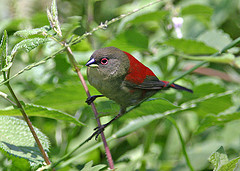
Estrildid finches share a suite of anatomical and behavioral traits that make them recognisable as a group. Typical features include short, stout, conical bills adapted for cracking seeds; a generally compact body; and a tendency to be gregarious. Plumage ranges from dull browns and streaks to bright reds, greens and patterned faces, depending on species.
- Bill: short, thick and pointed; optimized for granivory.
- Size: mostly small, usually under 15 cm in length.
- Plumage: highly variable—some species are cryptic, others vividly coloured.
- Nesting: build enclosed or domed nests of grass and fibres; many also make roost nests.
Behavior, diet and reproduction
Most estrildids are specialist seed-eaters, foraging on the ground or among grasses and shrubs. They are social and often form sizeable flocks outside the breeding season, which provides protection and improved foraging success. Vocal communication is important; songs and calls vary by species and can be elaborate in courtship.
Breeding pairs typically construct a domed nest of grasses or plant fibre in a bush, grass tussock or tree. Clutches commonly contain several white eggs and both parents usually participate in incubation and feeding of nestlings. Some species are known to build additional nests that serve as communal roosts.
Certain estrildid hosts are targeted by brood-parasitic birds such as indigobirds and whydahs, which lay their eggs in the nests of estrildids; the parasitic chicks often mimic host vocalizations and gape patterns to secure feeding.
Distribution, habitats and adaptations
Estrildid finches occupy a wide range of habitats in the Old World tropics and Australasia, from grasslands and savannas to agricultural fields, wetlands and forest edges. While most species prefer warm climates, a few have adapted to cooler southern regions of Australia and higher elevations in Asia and Africa. Islands across the Pacific host a number of endemic estrildid species, and some taxa have been introduced outside their native ranges through the cage-bird trade.
For regional ecological information and species accounts consult resources covering Australasia and island avifaunas; conservation and distribution details vary regionally.
Human interactions and conservation
Estrildids are popular in aviculture because many species are hardy in captivity and show attractive plumage and social behaviour. The zebra finch (Taeniopygia guttata) in particular has become an important model in laboratory studies of behavior and neurobiology. Conversely, some estrildids can damage cereal crops and are regarded as agricultural pests where abundant.
Conservation status across the family ranges from secure to threatened. Primary concerns include habitat loss, trapping for the pet trade, competition and predation by introduced species, and disease. Efforts to protect vulnerable species combine habitat management, legal protection and captive-breeding programs in some cases. For conservation frameworks and further reading see regional action plans and assessments at authoritative sites such as conservation portals.
Taxonomy and notable taxa
The classification of estrildids has evolved: they were once placed near the true sparrows (Passeridae) but are now usually recognized as a distinct family, Estrildidae, within the larger assemblage of oscine passerines. Molecular studies have clarified relationships among major lineages and the affinities of genera such as Estrilda, Lonchura (munias and mannikins), Taeniopygia (zebra finch), Erythrura (parrotfinches) and others.
Notable species often cited in literature and aviculture include the zebra finch, Gouldian finch, society finch, red avadavat and Java sparrow. Each illustrates different aspects of the family's diversity in plumage, behaviour and human significance.
Related articles
Author
AlegsaOnline.com Estrildid finches Leandro Alegsa
URL: https://en.alegsaonline.com/art/32327