
Parallel (geometry)
Parallel describes lines or planes that do not meet: in Euclidean space they remain a constant distance apart. The concept appears in axioms, vector calculus, design, and non-Euclidean geometry.
Overview
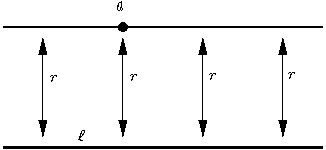
In geometry, the term "parallel" identifies a relation between two straight lines or two planes that never meet, no matter how far they are extended. In the Euclidean plane two distinct lines that are parallel have no points in common and remain a fixed distance apart. The standard notation for two parallel lines is ℓ1 ∥ ℓ2. For more general background see geometry or definitions of lines and planes.
Image gallery
8 Images



Key characteristics
Parallelism in Euclidean geometry has several elementary properties that are useful in proofs and applications. When two non-vertical lines in the plane are parallel, they have equal slopes. In linear-algebra terms, direction vectors of parallel lines are scalar multiples of one another. For two lines given by ax + by + c1 = 0 and ax + by + c2 = 0, the perpendicular distance between them equals |c2 - c1| / sqrt(a^2 + b^2). If a line intersects one of two parallel lines, corresponding and alternate interior angles formed by a transversal are equal; conversely, these equal-angle conditions imply parallelism.
History and axioms
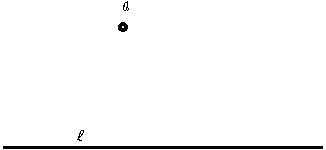
Parallelism has been central to geometry since antiquity. Euclid's Elements treated the behavior of parallel lines in a set of postulates and propositions; the so-called parallel postulate was long regarded as less self-evident than the others. In the 19th century alternative formulations such as Playfair's axiom ("through a point not on a line there is exactly one line parallel to the given line") became standard. The study of consistency and alternatives to the parallel postulate led directly to the development of non-Euclidean geometries.
Uses and examples
- Practical design: architecture, engineering drawings, and machine parts use parallel lines and planes to ensure proper alignment and fit.
- Computer graphics: parallel projection preserves parallelism of lines and is used for technical illustrations and isometric views.
- Mathematical proofs: parallelism yields angle equalities and congruent triangles used in many geometric arguments.
- Analytic geometry: testing parallelism via slopes or vector cross products is common in coordinate methods.
Related concepts and notable distinctions
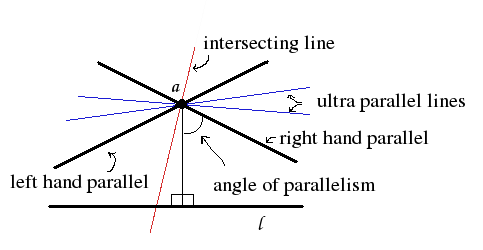
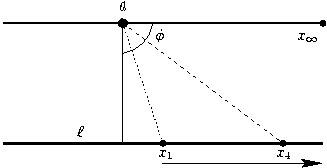
In three-dimensional space, "parallel" may refer to parallel lines or parallel planes; two lines in 3D that do not intersect need not be parallel — they can be skew, meaning they lie in different, non-parallel planes and have no point of intersection. In spherical geometry, true parallel lines do not exist because great circles always meet; in hyperbolic geometry there are infinitely many distinct lines through a point that do not intersect a given line, illustrating how parallelism depends on the underlying geometry. For further reading see parallel lines and related axioms axiomatics.
Related articles
Author
AlegsaOnline.com Parallel (geometry) Leandro Alegsa
URL: https://en.alegsaonline.com/art/74533