
Enthalpy of fusion (latent heat of melting)
The enthalpy of fusion is the heat required to convert a solid into a liquid at constant pressure. This article explains its meaning, causes, measurement, examples, and applications.
Overview
The enthalpy of fusion (often called the latent heat of fusion) is the amount of energy that must be supplied to a substance to change it from a solid into a liquid at constant pressure and at its melting temperature. During this process the temperature of the material typically remains unchanged while the material absorbs heat to overcome structural forces in the solid state. The concept helps explain why melting and freezing occur at fixed temperatures under given pressures.
Image gallery
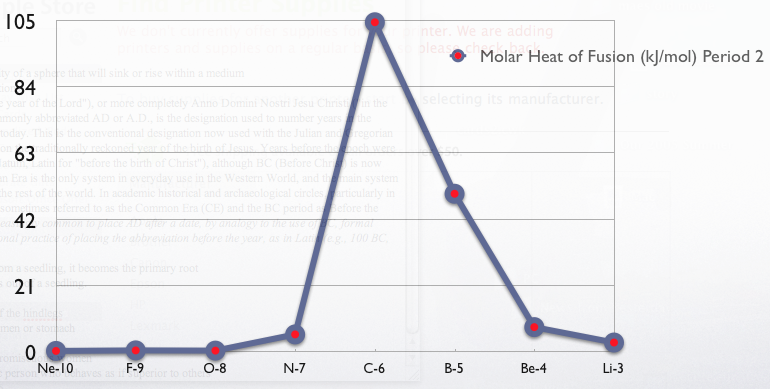
2 Images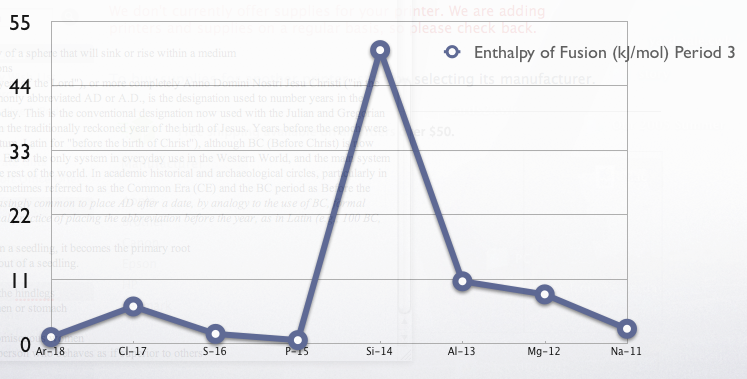
Physical meaning and thermodynamic context
At the microscopic level, melting requires work to break or loosen the ordered arrangement of particles in a crystal or amorphous solid so they can move more freely. In thermodynamics, the enthalpy of fusion is defined as the enthalpy change for the phase transition per amount of substance (commonly per mole or per kilogram) at constant pressure. Under typical laboratory conditions, the heat added at the melting point appears as enthalpy rather than as a temperature increase because the energy is consumed by changes in molecular interactions and potential energy.
Key factors and measurable forms
Several properties determine the magnitude of the enthalpy of fusion: the strength and nature of bonding (ionic, covalent, metallic, hydrogen-bonding, van der Waals), crystal packing, and the degree of order in the solid. It can be reported as a molar value or as a specific value per unit mass. Pressure and impurities also influence melting behavior: raising pressure can alter the melting temperature and therefore change the heat required to transform the phase.
History and terminology
The idea of hidden or "latent" heat goes back to early calorimetry; the term "latent heat" historically distinguished heat that produces phase change from heat that changes temperature. Pioneering studies in the 18th century established that substances absorb heat during melting without a rise in temperature. Modern treatments place the quantity within the enthalpy framework of classical thermodynamics and use precise calorimetric techniques to measure it.
Examples, measurement, and applications
A familiar example is ice melting at its equilibrium temperature: heat must be added to convert ice to liquid water while the temperature remains constant until the phase change is complete. Calorimeters and differential scanning calorimetry are common methods to determine the enthalpy of fusion. Practical applications include thermal energy storage (phase-change materials), metallurgy (controlling melting and solidification), food science (freeze–thaw behavior), and environmental processes involving ice and snow.
Notable distinctions and practical notes
Enthalpy of fusion differs from heat capacity: the former refers to the heat associated with a phase change at a fixed temperature, while the latter is the heat needed to change temperature within a single phase. In systems under nonstandard pressure or with mixed components, melting often occurs over a range of temperatures rather than at a sharp point. For further technical discussion and data tables consult specialized references and measurement standards such as those summarized in typical thermodynamics texts and databases (reference, compilations). For introductory explanations see educational resources (teaching, examples).
Related articles
Author
AlegsaOnline.com Enthalpy of fusion (latent heat of melting) Leandro Alegsa
URL: https://en.alegsaonline.com/art/31604