
Equuleus: the Little Horse constellation
Equuleus is a small, faint northern constellation traditionally depicted as a foal. It is one of the smallest constellations and has a long classical heritage in celestial cartography and myth.
Overview
Equuleus is a minor constellation in the northern celestial hemisphere traditionally represented as a little horse or foal. It is notable for its compact size and faint stars, making it a subtle feature of the night sky rather than a prominent pattern. Despite its modest appearance, Equuleus has been recorded since antiquity and appears on classical star charts.
Image gallery
5 Images


Location and characteristics
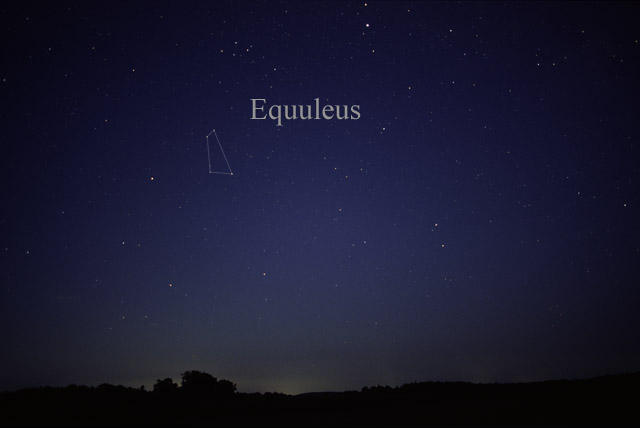
Equuleus occupies a small patch of sky near several better-known constellations. From mid-northern latitudes it lies high in the late-summer and autumn skies. The pattern is formed by a handful of relatively dim stars; none of them dominate the heavens and many require clear, dark conditions to be seen with the unaided eye. Because of its small area, Equuleus contains few deep-sky objects compared with larger constellations.
History and mythology
The constellation has roots in Greco-Roman astronomical tradition and was one of the classical constellations cataloged by early star-mapping scholars. Its name is Latin for "little foal," and ancient writers linked it to various local myths that relate to horses and heroic figures. Over centuries, star atlases preserved the foal motif even as detailed stories and attributions varied between cultures and authors.
Observation and notable features
- Visibility: best seen in late summer and autumn in the Northern Hemisphere.
- Appearance: a compact, faint grouping without very bright anchor stars.
- Astronomical interest: more often studied for its historical context than for spectacular objects.
Significance and distinctions
Equuleus is often mentioned in reference works because of its status as one of the smallest constellations, and because it exemplifies how cultural imagery (in this case a young horse) has been imposed on patterns of stars. While it does not contain famous deep-sky landmarks, it remains part of the classical set of constellations used for celestial navigation, historical studies, and educational introductions to the night sky.
Further reading
For star charts, observing tips, and historical background consult general constellation guides and modern atlases that cover classical constellations and their mythology. Many such resources include maps showing Equuleus in relation to neighboring constellations.
Related articles
Author
AlegsaOnline.com Equuleus: the Little Horse constellation Leandro Alegsa
URL: https://en.alegsaonline.com/art/31835