
Eagle Nebula (Messier 16, NGC 6611)
A young open star cluster and emission nebula in Serpens, famous for the Hubble image of the 'Pillars of Creation' and for active regions of star formation within its gas and dust.
Overview
The Eagle Nebula is a region of active star formation that combines a young open cluster with surrounding emission nebula. It is most commonly known by its catalog names Messier 16 (M16) and NGC 6611. The object lies within the boundaries of the constellation Serpens and is often described in observational guides as an open cluster embedded in glowing interstellar material.
Image gallery
7 Images




Characteristics and components
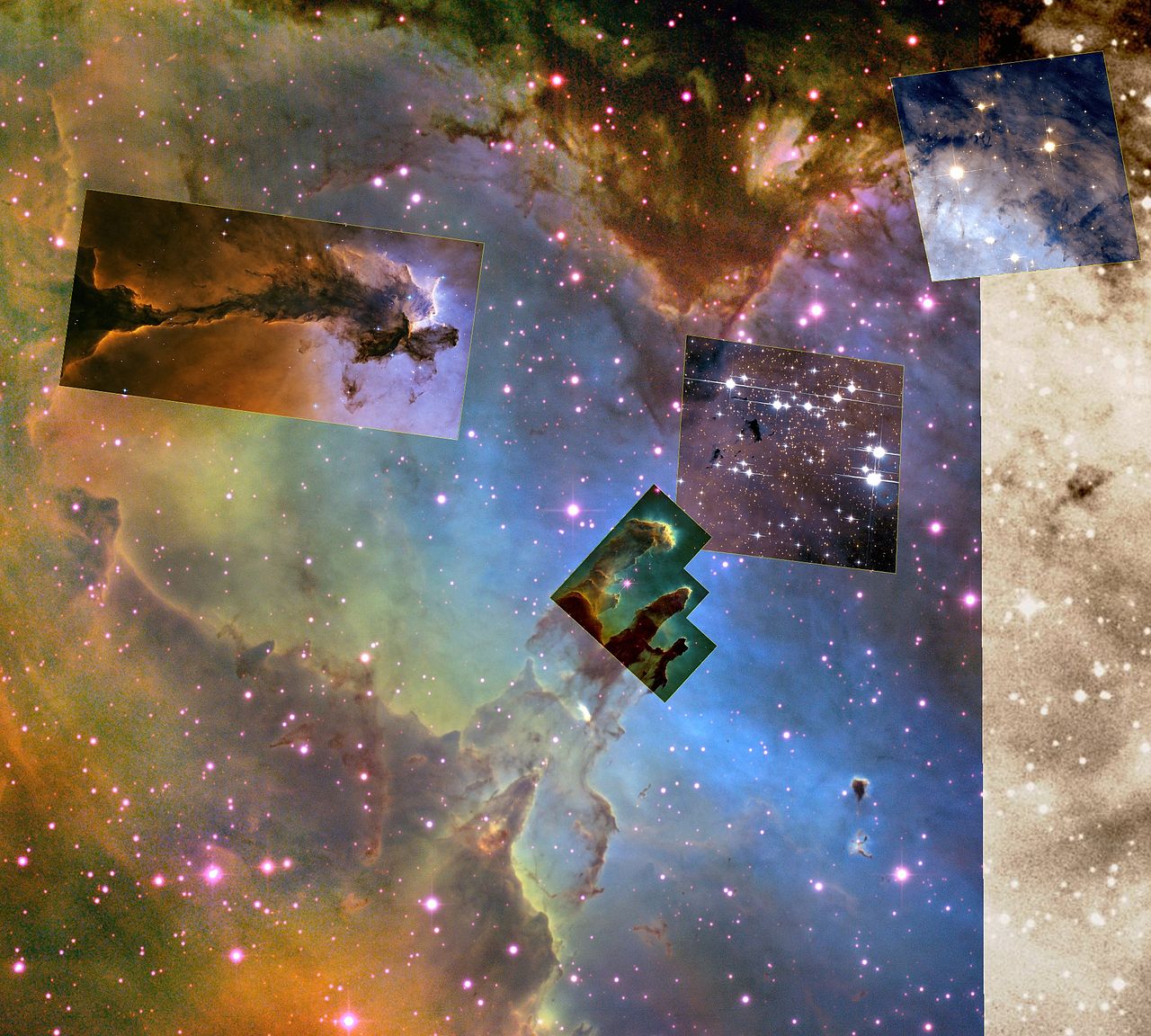
The visible structure includes bright ionized gas illuminated by hot young stars and darker lanes of gas and dust that cast silhouettes against the nebular glow. The central cluster hosts many massive, luminous stars whose radiation shapes and erodes nearby clouds. Astronomers identify the region through both its optical emission and through infrared and radio observations, which reveal ongoing formation of protostars in dense cores.
Pillars of Creation and imaging
A distinctive feature near the nebula's center — columns of cold gas often called the "Pillars of Creation" — attracted widespread attention after being photographed by the Hubble Space Telescope image. These pillar-like structures are composed of dense molecular material and harbour sites where new stars are forming. High-resolution images emphasize how stellar winds and ultraviolet light carve and sculpt the surrounding cloud.
History and observation
The region has been known to observers since the 18th century and is catalogued as M16 in the Messier list and as NGC 6611 in the New General Catalogue. It is a popular target for amateur telescopes and for scientific study because its combination of young stars, bright nebular emission, and complex dust structures offers a clear view of star-formation processes at work. Multiwavelength studies—from visible light to infrared and radio—help reveal embedded objects that are hidden in optical images.
Scientific importance and processes
Researchers study the Eagle Nebula to understand how massive stars influence their birth environments. The nebula presents examples of triggered star formation, where shock fronts and radiation from existing stars compress surrounding gas, and of photoevaporation, where intense ultraviolet light slowly disperses molecular clouds. Lists of notable features often include:
- the young stellar cluster (M16/NGC 6611),
- dense molecular columns and globules,
- active star-forming regions, and
- bright emission from ionized hydrogen and other elements.
Names and notable facts
Beyond its catalogue identifiers, the nebula has acquired evocative informal names—such as the "Star Queen" and "The Spire"—based on visual impressions of dark lanes and bright filaments. Observers should note that the striking shapes seen in photographs depend strongly on wavelength and resolution; infrared views often reveal protostars and structures that are invisible in the optical. For further reading and images, consult authoritative observatory resources and image archives such as the constellation reference and dedicated nebular surveys; introductory materials and image galleries also highlight the Eagle Nebula's interplay of light, wind and dust in sculpting newborn stars (nebula overview).
Related articles
Author
AlegsaOnline.com Eagle Nebula (Messier 16, NGC 6611) Leandro Alegsa
URL: https://en.alegsaonline.com/art/29507
Sources
- earthsky.org : "The awesome beauty of M16, the Eagle Nebula"