
Earth-crosser asteroid
Asteroids whose orbits intersect Earth's path. Covers definitions, orbital types, origins, impact risk and monitoring, and notable examples and distinctions among near-Earth asteroids.
Overview
An Earth-crosser asteroid is any asteroid whose orbital path intersects or cuts across the orbital path of Earth. These objects are a subset of near-Earth asteroids (NEAs) and can come arbitrarily close to our planet at some point in their orbit. The term highlights the geometric relationship between the two orbital paths rather than predicting an impact.
Image gallery
2 Images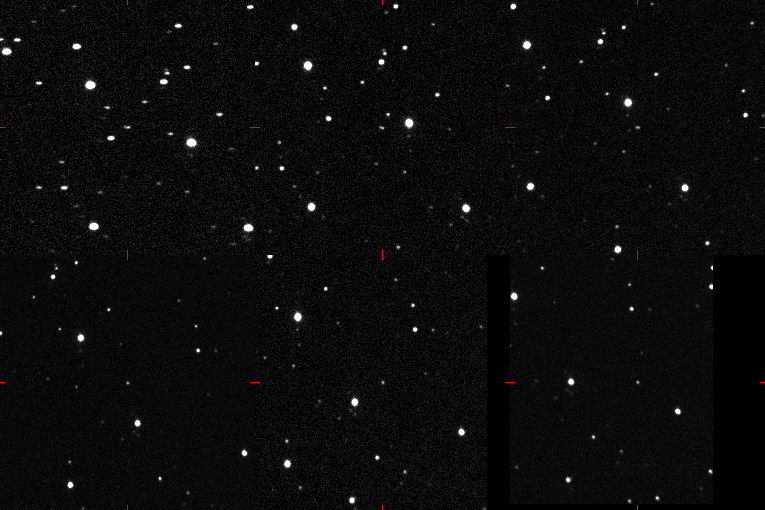

Characteristics and classification
Earth-crossers are classified by how their orbits relate to Earth's. Two common groups are:
- Apollo asteroids: bodies with semi-major axes larger than Earth's and perihelion distances less than Earth's aphelion, so their orbits cross Earth's.
- Aten asteroids: bodies with semi-major axes smaller than Earth's but aphelion distances greater than Earth's perihelion, also producing crossings.
Other orbital parameters used to describe crossings include eccentricity, inclination and the minimum orbit intersection distance (MOID), a key metric for assessing close approaches.
Origin and orbital evolution
Most Earth-crossing asteroids originate in the main asteroid belt between Mars and Jupiter. Gravitational perturbations — from planets and resonances with Jupiter — or collisions can alter an asteroid's orbit, sending it inward where it may evolve into an Earth-crossing trajectory. Non-gravitational forces, such as the Yarkovsky effect, also slowly change orbits over long timescales.
Importance, risks and monitoring
Earth-crossers matter because of impact potential and scientific opportunity. Agencies and surveys track these objects to refine orbits and estimate impact probabilities. Potentially hazardous asteroids (PHAs) are Earth-crossers or close-approachers above a size threshold and below a MOID cutoff. Observational programs and space missions study them for planetary defense and research.
Notable examples and distinctions
Famous Earth-crossers include asteroids discussed widely in public and scientific contexts. Some have been targets for spacecraft missions or close-approach studies. It is important to distinguish Earth-crossers from near-Earth objects that do not cross Earth's orbit (for example, Amor asteroids, which approach but generally do not cross). For more technical definitions see orbit classifications, orbital dynamics references at dynamical resources, and observational program pages such as survey information.
Monitoring and characterization remain active fields: improved surveys increase discovery rates, and refined orbital solutions reduce uncertainty about future encounters. Understanding these objects supports both scientific exploration and planetary safety.
Related articles
Author
AlegsaOnline.com Earth-crosser asteroid Leandro Alegsa
URL: https://en.alegsaonline.com/art/29563