
Eclipse (astronomy)
An eclipse occurs when one celestial body passes into the shadow of another, producing solar, lunar, and related events; important for observation, culture, and scientific measurement.
An eclipse is an astronomical alignment in which one object in the sky moves into the shadow of another. In planetary systems such as the Solar System this alignment—called a syzygy—normally involves at least three bodies in a common gravitational field. The word is most commonly applied to the familiar solar and lunar eclipses but also covers related phenomena seen when stars, planets, moons or smaller bodies pass in front of one another.
Image gallery
10 Images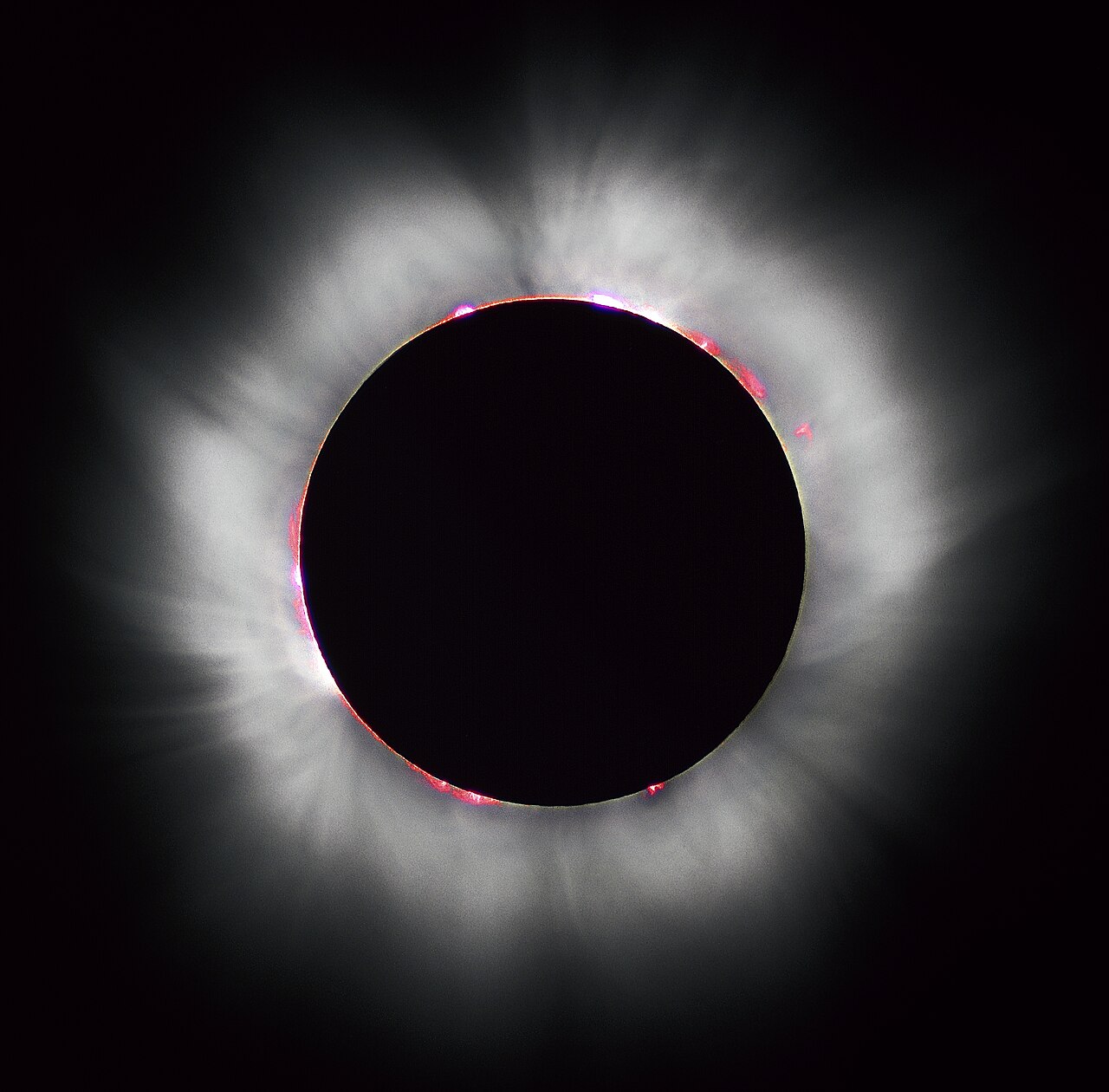





How eclipses occur
Eclipses depend on geometry: the relative sizes, distances and apparent angular diameters of the bodies. When the Moon or another body moves into the shadow of a larger object, regions of complete and partial shadow form. The darkest central region is the umbra, surrounded by a partial shadow (penumbra) and, for some alignments, an antumbral zone. Because bodies orbit within the same gravitational system, precise timing and orbital motion determine whether an alignment produces a brief crossing or extended concealment; for example, no solar eclipse can last longer than about 7 minutes 58 seconds because of the relative speeds and distances of Earth and Moon.
Types and common examples
- Solar eclipses: occur when the Moon casts its shadow on Earth. These include total, annular, partial and hybrid varieties depending on how the Moon's disk covers the Sun (solar eclipse).
- Lunar eclipses: take place when the Moon passes into Earth's shadow and can be penumbral, partial, or total (lunar eclipse).
- Occultations: when one body hides another from view but the Sun is not involved, the event is usually called an occultation.
- These events often involve the Moon and Earth in the familiar cases visible from our planet, but comparable alignments occur throughout the universe.
Observers classify eclipses by how much of the background source is covered and by the shadows produced. A total solar eclipse briefly replaces daylight with darkness along a narrow ground track; an annular eclipse leaves a bright ring of the Sun visible when the eclipsing body appears smaller than the source.
History, cultural impact and scientific use
Eclipses have been recorded across human history and often interpreted as omens or used to fix dates in chronicles. They also became tools of science: accurate observations of eclipses contributed to orbital theory and, in the 20th century, were used to test predictions of general relativity. Predictive schemes such as the Saros cycle let astronomers forecast where and when repeatable patterns of eclipses will occur.
Observation and practical notes
Viewing a lunar eclipse is safe with the naked eye; viewing a solar eclipse requires certified solar filters, eclipse glasses or indirect projection to avoid eye injury. Modern instruments—telescopes, cameras and spacecraft—make it possible to study transient phenomena during eclipses, such as the solar corona, atmospheric effects on eclipsed bodies, or changes to reflected light that reveal composition and structure.
Broader contexts and distinctions
Outside Earth, eclipses appear in many contexts: moons cast shadows on planets, planets transit stars (observed as dips in starlight during exoplanet studies), and small bodies produce occultations that help measure sizes and atmospheres. Professional and amateur observers continue to use eclipses as precise probes of motion, light scattering, and the dynamics of celestial bodies, linking an ancient spectacle to modern astrophysics.
For further reading and observing resources see astronomical event guides, technical references at geometry and motion, shadow modeling pages at shadow dynamics, and outreach materials on the Solar System and gravitational interactions. Practical safety and viewing instructions are available from public outreach sources (solar, lunar), while detailed predictions and historical records can be found via specialized catalogs (lunar, Earth) and occultation databases (occultation).
Questions and answers
Q: What is an eclipse?
A: An eclipse is an astronomical event when one object in the sky moves into the shadow of another object.
Q: What is syzygy?
A: Syzygy is a term used to describe a situation where three or more objects in the sky are lined up in a straight line in the same gravitational system.
Q: How does an eclipse occur in the Solar System?
A: An eclipse occurs in the Solar System when one object moves into the shadow of another object, resulting in syzygy.
Q: What kind of events are usually referred to as eclipses?
A: Solar and lunar eclipses, where the Moon's shadow crosses the Earth's surface or when the Moon moves into the shadow of Earth, are usually referred to as eclipses.
Q: What is the maximum duration of a solar eclipse?
A: No solar eclipse can last longer than 7 minutes and 58 seconds due to the speed at which the Earth and Moon move.
Q: What is an occultation?
A: An occultation is an event where one object passes in front of another object when the Sun is not involved.
Q: What is the meaning of "system of stars"?
A: "System of stars" refers to a collection of stars or celestial objects that are gravitationally bound together.
Related articles
Author
AlegsaOnline.com Eclipse (astronomy) Leandro Alegsa
URL: https://en.alegsaonline.com/art/29909
Sources
- query.nytimes.com : "Science Watch: A Really Big Syzygy"
- in.gr : in.gr
- lingvozone.com : lingvozone.com/main.jsp?action=translation&do=dictionary&language_id_from=23&language_id_…
- translate.google.com : Google Translation