
Dune
A dune is a mound or ridge of loose sediment, typically sand, shaped by wind or water. Dunes occur in deserts, coasts, river systems and other environments, and have ecological, geological and human importance.
Overview
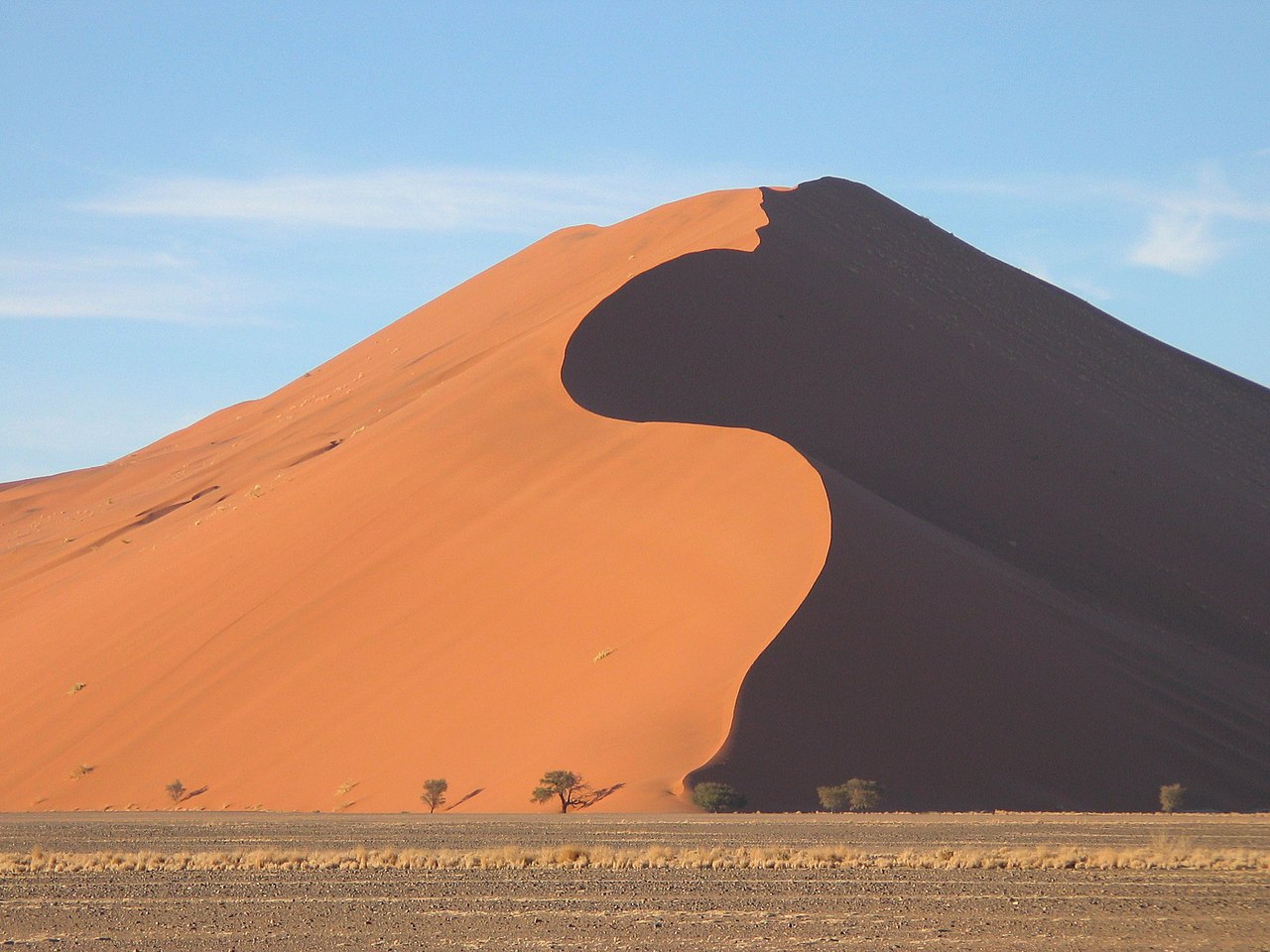
A dune is a natural accumulation of loose sediment—most often sand—forming a hill, ridge or mound shaped and moved by flowing fluids. In the study of physical geography and geomorphology, dunes are recognised as dynamic landforms produced mainly by wind (aeolian) action, and in some settings by water currents or waves. Their size ranges from small ripples to extensive dune fields that dominate large portions of deserts and some coastal zones.
Image gallery
10 Images




Formation and structure
Dunes form when sediment transported by wind or water loses momentum and settles. Wind-driven grains saltate (bounce) and creep, accumulating where velocity drops or where an obstacle traps sand. Over time, a slip face develops: a steeper downwind slope where grains avalanche. Internal layers called cross-beds record changing wind directions and strengths and are important in interpreting ancient environments.
Common dune types
- Barchan: crescent-shaped dunes with horns pointing downwind, common where sand supply is limited.
- Transverse: long, wave-like ridges perpendicular to prevailing winds and formed where sand is abundant.
- Linear (seif): long straight or slightly sinuous ridges aligned with wind direction.
- Star: radiating arms formed by multidirectional winds, producing tall, complex mounds.
- Parabolic: U-shaped dunes usually anchored by vegetation, with horns pointing upwind and common on coasts.
Occurrence and broader significance
Dunes cover sandy deserts, stabilised coastal beaches and some river floodplains. They are prominent on other planetary bodies as well; for example, administrators of planetary science have documented extensive dune fields on Mars and tidal-flat analogues on Titan. Beach dunes play a protective role against storm surge and coastal erosion, while desert dunes affect desert ecology and landscape evolution. Further reading on sand characteristics and transport can be found at resources about sand and wind processes.
Human interactions and management
Humans interact with dunes in many ways: they are sites for recreation, sources of sand for construction, and natural barriers that protect inland areas. Where dunes encroach on roads, farms or settlements, management techniques include planting vegetation, installing sand fences, or engineering hard structures. Poor land use and vegetation loss can accelerate dune migration and contribute to desertification or coastal erosion. Historical and cultural aspects of dunes—such as their role in shaping trade routes or coastal settlements—are discussed in regional studies and guides (coastal dune studies, sediment deposition).
Notable facts and distinctions
Not all dunes are made of quartz sand; grains can be volcanic, shell, or ice-derived on other worlds. Dune behavior varies with grain size, moisture, vegetation and wind regime. Scientists monitor dune migration both for hazard mitigation and as indicators of climatic change—shifts in dune morphology can reflect long-term changes in wind patterns or sediment supply (dune morphology).
Related articles
Author
AlegsaOnline.com Dune Leandro Alegsa
URL: https://en.alegsaonline.com/art/29229