
Dravidian languages
A language family of South Asia spoken mainly in southern India and neighbouring regions, with major languages like Tamil, Telugu, Kannada and Malayalam and several smaller tribal tongues.
The Dravidian languages are a linked group of languages traditionally associated with the Dravidian peoples. They are concentrated in South India and have extended presence in parts of western Bangladesh, northern Sri Lanka and southern Pakistan. Scholars typically recognise around 26 distinct Dravidian languages, and together their speakers number roughly 200–220 million. Some Dravidian tongues are major regional languages with long literary histories; others are small tribal languages spoken by relatively few people.
Image gallery
5 Images
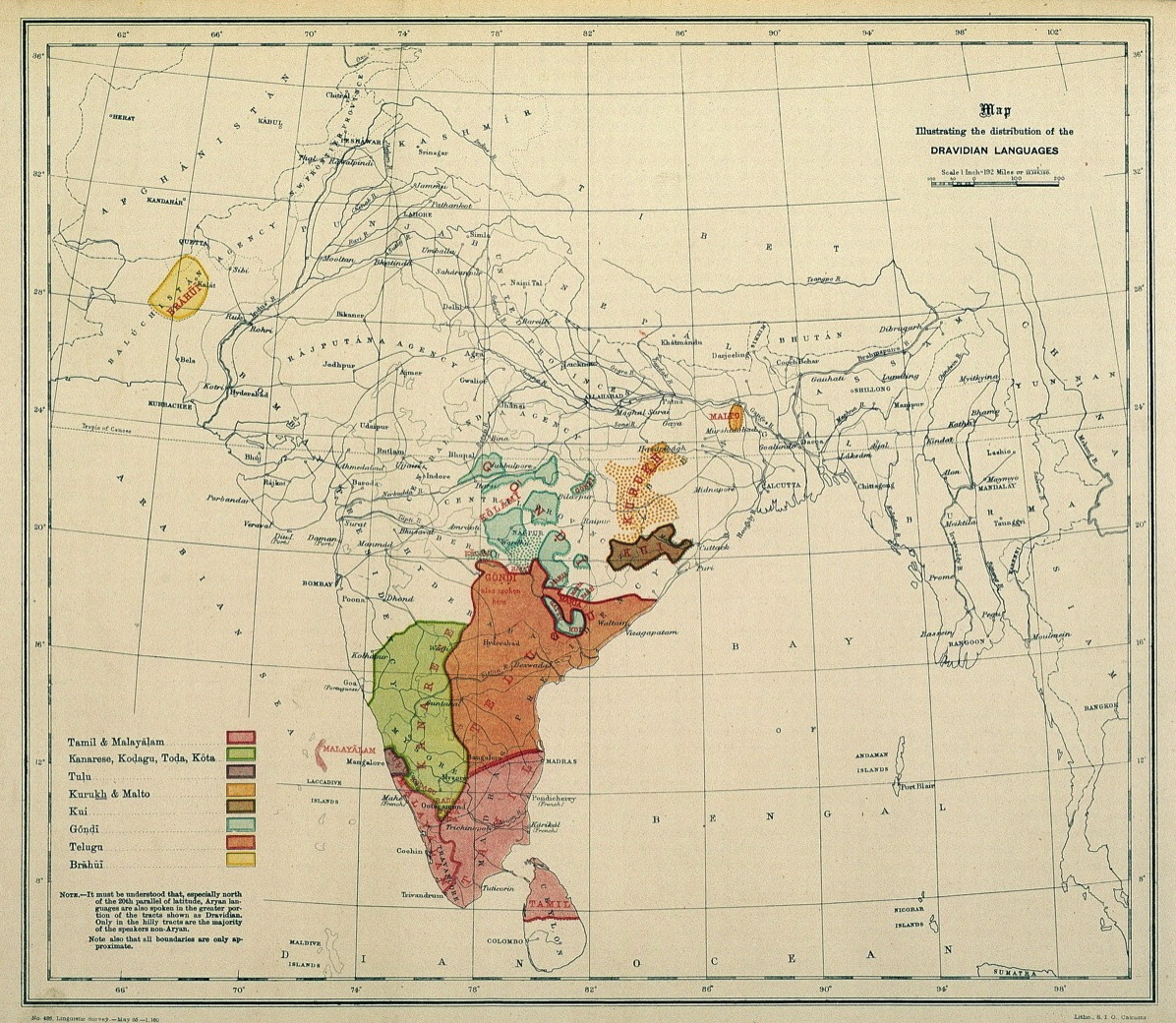


Classification and major members
Conventional classifications divide the family into broad branches — northern, central, south‑central and southern — each containing clusters of related languages. Prominent modern languages include Tamil, Telugu, Kannada and Malayalam, which serve as official languages in several Indian states and have rich written traditions. Northern branches include languages such as Kurukh and Malto, while the isolated Brahui is spoken far to the west in Balochistan; Brahui speakers also live in parts of Afghanistan and neighboring areas and the language is often cited as a notable outlier (Brahui).
Linguistic features
Dravidian languages share structural traits that distinguish them from many neighbouring Indo‑Aryan languages. They are generally agglutinative, forming words by combining a sequence of suffixes; they typically follow subject–object–verb word order and use postpositions rather than prepositions. Case marking on nouns, a rich system of verbal agreement, retroflex consonants and contrasts in vowel length are common. Despite these shared features, individual languages differ substantially in phonology, morphology and vocabulary.
History and development
Evidence from comparative linguistics, inscriptions and literary texts suggests an ancient presence of Dravidian languages on the Indian subcontinent. Historical interactions with Indo‑Aryan languages have produced significant lexical borrowing in both directions. Early written attestations appear in inscriptions and classical works: for example, Tamil has an uninterrupted literary record reaching back many centuries, while other languages developed their scripts and literatures at different times. The geographical range of the family was likely broader in antiquity than it is today, with subsequent population movements and language shifts reshaping distribution.
Social role, vitality and examples
The largest Dravidian languages function as major regional media of education, administration and mass communication; they have modern standard forms, active publishing sectors and cinema industries. At the same time, several smaller Dravidian languages are spoken by indigenous or scheduled communities and face pressures from dominant regional languages. Some speech varieties extend beyond national boundaries: for instance, dialects of Kurukh appear in Nepal and Bhutan, while Brahui is found in parts of Pakistan and Afghanistan.
Distinctive facts and resources
- Major literary traditions include the classical Tamil corpus and extensive medieval and modern literatures in Telugu, Kannada and Malayalam.
- Scripts used for Dravidian languages derive from ancient Brahmi but have diversified into distinct writing systems (Tamil script, Telugu–Kannada script family, etc.).
- Community initiatives and academic programs work on documentation and revitalisation for endangered Dravidian languages.
For concise overviews and classification charts, see general references on the language family, surveys of the Dravidian peoples, regional language policies in South India and studies of minority Dravidian languages in Bangladesh, Sri Lanka, Pakistan and beyond. Statistical and descriptive material on the number of languages and speaker populations is summarised in overviews such as the one indexed at language counts.
Related articles
Author
AlegsaOnline.com Dravidian languages Leandro Alegsa
URL: https://en.alegsaonline.com/art/28890