
Dom Juan (Molière): Dom Juan ou Le Festin de pierre
Dom Juan is Molière's 1660 play about the legendary libertine whose cynical rejection of repentance brings supernatural retribution; it blends comedy, social critique and tragic conclusion.
Overview
Molière's Dom Juan, often given the French title Dom Juan ou Le Festin de pierre, is a five-act play first performed on February 15, 1660 at the Palace-Royal stage in Paris (Palais-Royal). Molière presents a complex picture of the legendary Don Juan: a nobleman whose wit, audacity and amorous conquests coexist with contempt for religious and social norms. The work mixes comedy, satire and serious moral questioning, and closes with a supernatural reckoning that underlines its tragic potential.
Image gallery
4 Images

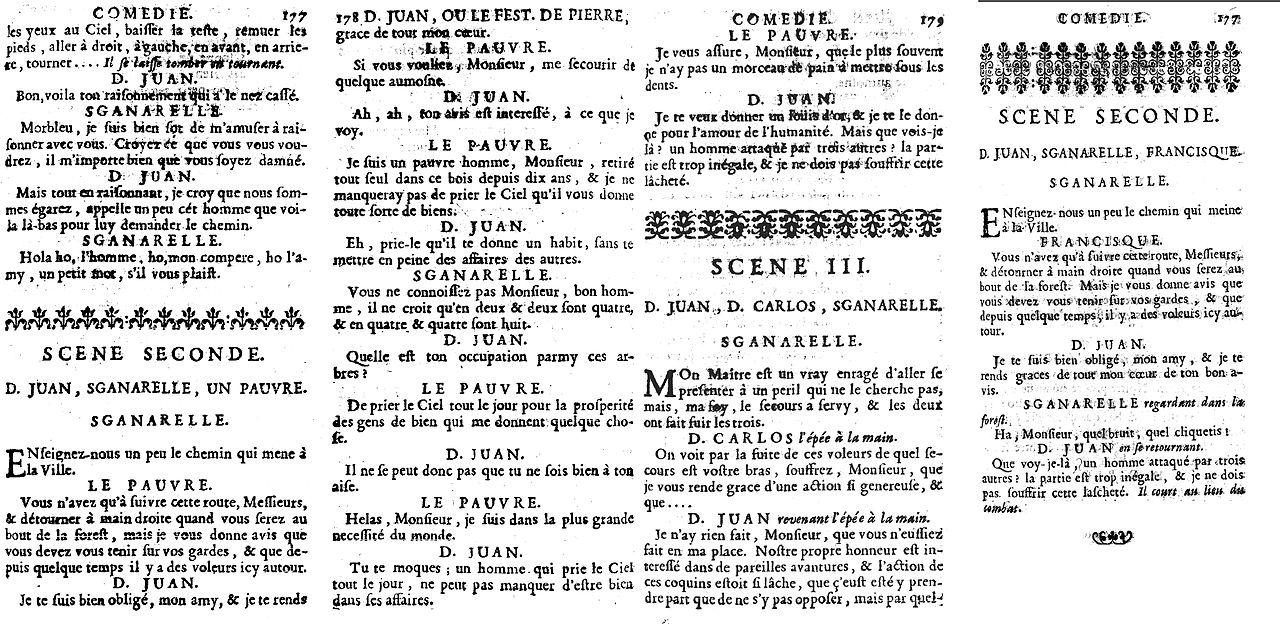

Plot and structure
The plot follows Dom Juan and his devoted but morally anxious servant Sganarelle as they travel, seduce and evade consequences. Key episodes include Dom Juan's abandonment of Elvire, scenes of disguise and flight, and the chilling finale in which a statue of a man Dom Juan has killed—the Commandeur—returns to demand justice. The play alternates brisk comic scenes with confrontations that probe hypocrisy, faith and the limits of rationalism.
Characters
- Dom Juan — the arrogant, eloquent libertine whose refusal to repent drives the drama
- Sganarelle — his servant; a source of comic commentary and moral conscience
- Elvire — a woman whom Dom Juan has wronged and who seeks reparation
- The Commandeur (the stone statue) — a supernatural figure that represents divine judgment
Themes and style
Molière balances rapid comic dialogue and farcical situations with darker reflections on hypocrisy, religious skepticism and aristocratic privilege. The play questions social pretension and moral complacency while allowing the central character a charisma that complicates moral judgment. Its tone can shift abruptly from lewd humor to solemn admonition, producing a tension that has interested critics and directors for centuries.
Language, form and performance
Written in verse and prose, the play uses witty repartee and elaborate monologues to reveal character and argument. Sganarelle's plainspoken voice often frames the audience's response, while Dom Juan's rhetoric both seduces and provokes. Since its premiere the play has been adapted in many stagings, varied to emphasize either the comedy or the darker philosophical elements.
Reception and controversy
At the time of its first performances the candid treatment of religion and libertinism provoked debate about theatrical morality and censorship. Authorities and contemporary commentators challenged some passages for their perceived irreverence, and the play's mixture of mockery and moral lesson ensured lively discussion. Over time critical opinion has ranged from condemnation to admiration for Molière's dramatic daring.
Influence and adaptations
Dom Juan has influenced a broad cultural legacy. It provided source material and dramatic situations later used by librettist Lorenzo da Ponte and composer Wolfgang Amadeus Mozart in the opera Don Giovanni, and the figure of Don Juan has been reworked across literature, music and theatre. Performers and directors continue to reimagine the play, highlighting either its satirical bite or its existential implications.
Translations, scholarship and legacy
Scholars study Dom Juan for its dramatic technique, its place in Molière's career and its commentary on 17th-century French society. The play appears in many modern editions and has been translated into numerous languages; editions often include commentary on textual variants and staging practices. Its ambiguous hero and striking ending make it a permanent subject of theatrical repertoires and academic inquiry.
Further reading and resources
For general background on the author and work see basic reference sources and modern introductions to French classical theatre. Other useful starting points include specialized studies of Molière's depiction of religion, the history of Don Juan legends, and comparative studies of the play and the opera Don Giovanni.
Related articles
Author
AlegsaOnline.com Dom Juan (Molière): Dom Juan ou Le Festin de pierre Leandro Alegsa
URL: https://en.alegsaonline.com/art/28253