
Don Giovanni (Mozart opera)
Don Giovanni, a two-act dramma giocoso by Mozart with a libretto by Lorenzo Da Ponte, dramatizes the Don Juan legend and blends comic and tragic elements; premiered in Prague, 1787.
Overview
Don Giovanni is a two-act Italian opera composed by Wolfgang Amadeus Mozart (Mozart) with a libretto by Lorenzo Da Ponte (Da Ponte). The work, often classified as dramma giocoso, was first staged at the National Theatre in Prague (Prague) on 29 October 1787. It interweaves elements of comedy, drama and supernatural retribution to retell the long-standing Don Juan tale, producing music celebrated for its dramatic pacing, orchestral color and ensemble writing.
Image gallery
10 Images


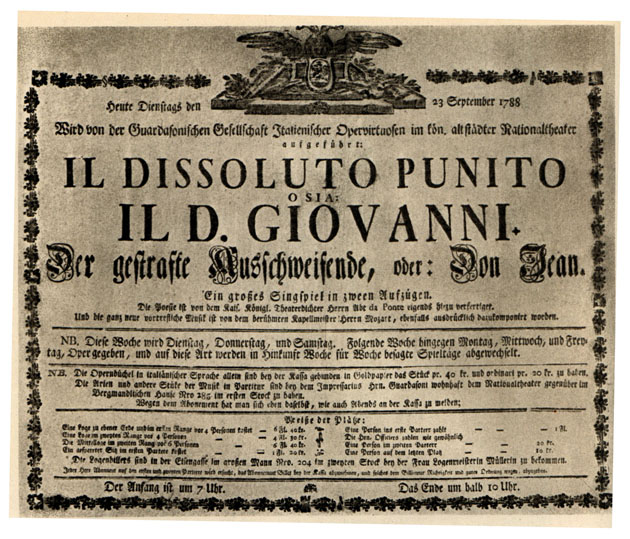


Plot and themes
The story follows the libertine Don Giovanni, his servant Leporello and a cast of victims and pursuers. In broad outline the plot presents seduction, deception, and a final moral reckoning: despite opportunities to repent, the protagonist refuses and is carried off by supernatural forces to his doom (Hell). Themes include the conflict between social order and personal license, the comic exposure of hypocrisy, and music’s power to suggest inner life.
Structure, roles and musical highlights
Written in two acts, the score balances solo arias, duets and large ensembles. Notable numbers that are frequently cited in discussions of the opera include Leporello’s catalogue aria and the duet "Là ci darem la mano," which contrast wit and intimacy. Principal roles typically performed are:
- Don Giovanni (baritone)
- Leporello, his servant (bass)
- Donna Anna (soprano)
- Don Ottavio (tenor)
- Donna Elvira (soprano)
History and composition
Mozart and Da Ponte drew on a long tradition of Don Juan stories and earlier stage works when creating their version. The collaboration produced a libretto that mixed buffa (comic) situations with more serious dramatic moments; the composer responded with music that supports rapid shifts of mood and complex ensemble writing. The opera’s premiere in Prague was a considerable success and led to rapid dissemination across European houses.
Performance, adaptations and legacy
Don Giovanni has remained one of the most frequently staged operas worldwide. It was seen in the United States as early as 1826 in a production associated with Da Ponte himself (United States). The work has been adapted to film and theatre—among them a cinematic version by Joseph Losey in 1979—and continues to attract new interpretations. Music historians value the score for its psychological depth, the efficiency of its musical drama and its influence on later composers.
Notable facts and distinctions
The opera transforms a folktale into a complex stage drama, pushing operatic ensemble writing forward at a key moment in Mozart’s career. Its combination of comic machinery and moral consequence makes it a persistent subject of study and performance; in the modern repertory it consistently ranks among the most performed operas.
For additional background on the libretto and sources consult links to the text and historical accounts: libretto resources and composer biographies via opera references.
Questions and answers
Q: What is Don Giovanni?
A: Don Giovanni is an Italian opera in two acts about the character better known as Don Juan.
Q: Who wrote the music for Don Giovanni?
A: The music for Don Giovanni was written by Wolfgang Amadeus Mozart.
Q: Who is the author of the libretto for Don Giovanni?
A: The libretto for Don Giovanni was written by Lorenzo da Ponte.
Q: When was Don Giovanni first performed and where?
A: Don Giovanni was first performed at the National Theatre in Prague on 29 October 1787.
Q: Was Don Giovanni a success?
A: Yes, Don Giovanni was a great success after its first performance in Prague.
Q: What is the story of Don Giovanni?
A: Don Giovanni is about a libertine and murderer who refuses to repent and is taken alive to Hell.
Q: Has Don Giovanni been adapted in other forms?
A: Yes, Don Giovanni has been adapted into plays, operas, and a ballet prior to Mozart's version which became very popular and was later adapted into a movie by Joseph Losey in 1979.
Related articles
Author
AlegsaOnline.com Don Giovanni (Mozart opera) Leandro Alegsa
URL: https://en.alegsaonline.com/art/28349