
Don Carlos (play) — Schiller's historical tragedy
Don Carlos is a five-act historical tragedy by Friedrich Schiller (written 1783–1787). It dramatizes power, conscience and forbidden love in 16th-century Spain and inspired notable operas, including Verdi's Don Carlo.
Don Carlos is a five-act historical tragedy by German dramatist Friedrich Schiller, composed between 1783 and 1787. Its original German title appears as Don Karlos, Infant von Spanien. The play treats events set at the court of Philip II of Spain in the 16th century and centers on the conflicts between private desire and state power.
Image gallery
1 Image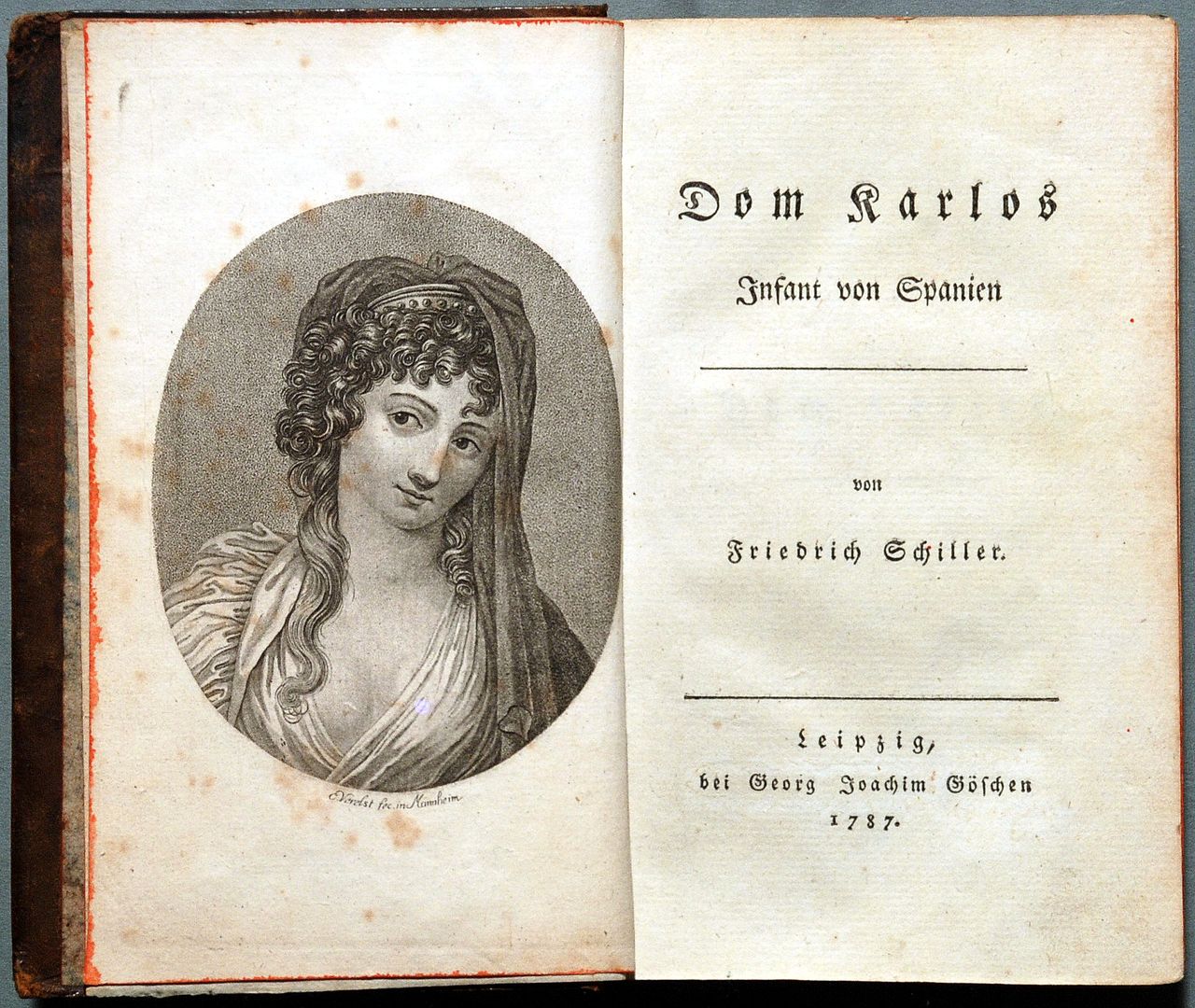
Plot and principal characters
The drama follows Carlos, Prince of Asturias, who becomes entangled in court intrigues, romantic jealousy and political idealism. Key figures include the king, Queen Elisabeth, the princess’s confidant Eboli, and the idealistic nobleman Rodrigo (the Marquis of Posa). The play presents love that cannot be fulfilled, friendship tested by conscience, and the machinery of authority culminating in charges brought by the Inquisition in the course of the drama.
Style and themes
Unlike Schiller’s earlier works, Don Carlos was written largely in a metrical, dramatic verse (often iambic) and combines lyrical passages with political debate. Major themes are absolutism versus liberty, the tension between public duty and private loyalty, the corrupting effects of political intrigue, and the moral costs of compromise. The relationship between Carlos and Rodrigo exemplifies debates about enlightenment ideals and personal sacrifice.
Structure and notable scenes
- Five acts that move from intimate exchanges to public crisis.
- Scenes of confession, confrontation and courtroom-like judgment that foreground moral conflict.
- Moments of poetic rhetoric balanced with plotting and espionage.
History, reception and adaptations
First circulated and staged in the late 1780s, Don Carlos became one of Schiller’s major mature tragedies and has been revised in different editions for performance. Its combination of political argument and intimate tragedy made it attractive for later adaptation into music and theatre. Several operatic adaptations were based on Schiller’s drama. The best-known is Giuseppe Verdi’s grand opera, titled variously Don Carlos or Don Carlo, which reinterprets characters and episodes for the operatic stage.
Significance and distinctions
Don Carlos remains notable for marrying high poetic language with debate about political freedom and the limits of sovereignty. It is often discussed alongside Schiller’s other historical plays as an exploration of Enlightenment-era questions about the state, individual conscience and reform. Readers and audiences continue to appreciate both its dramatic intensity and its philosophical ambitions.
Questions and answers
Q: What is Don Carlos?
A: Don Carlos is a historical tragedy in five acts by Friedrich Schiller.
Q: When was Don Carlos written?
A: Don Carlos was written between 1783 and 1787.
Q: Who is the main character in Don Carlos?
A: The main person in Don Carlos is Carlos, Prince of Asturias.
Q: What historical events is Don Carlos about?
A: Don Carlos is about historical events in the 16th century under the reign of king Philip II of Spain.
Q: What is the writing style of Don Carlos?
A: Don Carlos is written in iambic verse.
Q: What is the story about in Don Carlos?
A: The story of Don Carlos is about intrigue and misunderstanding. Don Carlos loves his father's wife Elisabeth, while the queen's lady-in-waiting Eboli loves Carlos. In the end, the Inquisition delivers a death sentence on Carlos.
Q: What other works have been based on Don Carlos?
A: Several operas have been composed on the basis of Don Carlos, including Don Carlos (also known as Don Carlo) by Giuseppe Verdi.
Related articles
Author
AlegsaOnline.com Don Carlos (play) — Schiller's historical tragedy Leandro Alegsa
URL: https://en.alegsaonline.com/art/28341