
Dice: forms, history, uses, and notable properties
Overview of dice: common shapes, numbering, history, uses in games and gambling, fairness issues, polyhedral varieties, and practical notes for play and manufacture.
Overview
Dice are small objects used to introduce chance into games, decision processes, and simulations. The word "die" is singular and "dice" is plural in standard English. Most widely recognized are six-sided cubic dice, but other shapes and systems exist. Dice are used wherever a random discrete outcome is needed, from casual board games to professional gambling and statistical demonstrations. They are commonly rolled by hand, but may also be shaken in a cup or generated digitally.
Image gallery
10 Images




Shapes and numbering
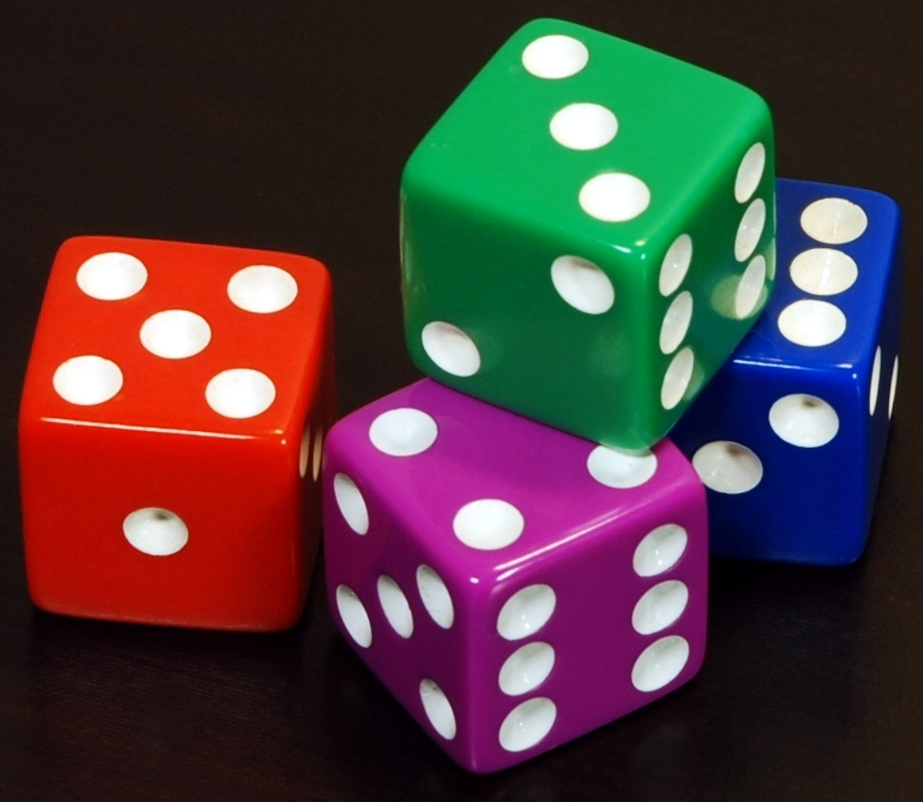
Traditional dice are cubes marked with faces numbered one through six, typically shown as pips or numerals. A standard Western convention places opposite faces so their numbers add to seven. Beyond the cube, a family of polyhedral dice is used in role‑playing games and mathematical contexts; common members include four‑sided, eight‑sided, ten‑sided, twelve‑sided and twenty‑sided dice. Such sets are often identified by notation like d6 for a six‑sided die. Materials vary: plastic, wood, metal, bone and other substances are used to mold or carve dice.
History and development
Games of chance using shaped objects are ancient and widespread. Early forms of randomizing objects include knucklebones and carved tokens; over centuries the manufacture and decoration of dice evolved alongside gaming cultures. Modern mass production enabled highly uniform plastic dice and a wide variety of decorative finishes. In parallel, mathematical study of dice outcomes contributed to probability theory and gaming design.
Uses and examples
Dice appear in many board games and tabletop activities. Simple examples include traditional board games that advance a token by the number rolled and complex strategy games that use multiple dice for combat resolution. Popular board and party games that incorporate dice include Monopoly, Yahtzee and Risk. Role‑playing games frequently employ sets of polyhedral dice to determine skill checks and damage. Dice are also used in teaching probability, in cryptographic or randomized algorithms, and in some ceremonial or divinatory contexts. For general references to game use see game resources.
Fairness, manipulation and testing
Fair dice are intended to give each face an equal chance of landing up. Imperfections in shape, uneven weight distribution or deliberate modification (for example inserting a weight) can bias results; such tampering is commonly described as cheating. Casinos and serious players use certified dice, visual inspections, and statistical testing to detect bias. Simple home tests include rolling a die many times and comparing frequencies. Online and electronic games often substitute pseudorandom number generators to emulate die rolls.
Characteristics and probability
When one die is rolled, each face of a fair six‑sided die has an equal probability. With multiple dice the distribution of sums becomes shaped by combinatorics: for example two six‑sided dice produce a bell‑like distribution of totals. Different polyhedral dice have different outcome spaces useful for varied game mechanics. For physical design and mathematical discussion see materials on cubic dice, polyhedral dice and markings like pips and numerals. The act of introducing randomness itself—rolling or otherwise generating an outcome—is covered in resources about randomness and chance.
Notable facts and distinctions
- Singular vs. plural: "die" (one) and "dice" (two or more) are the traditional forms.
- Opposite faces on standard six‑sided dice usually total seven, a widely adopted but not universal convention.
- Polyhedral dice expand the range of possible outcomes in gaming systems that need more than six faces.
- Heavy or asymmetric dice can be created intentionally or accidentally; regulated play requires verified fairness.
For practical play, choose dice that are visually clear, well balanced and appropriate to the game system. Many hobby stores sell matched sets of polyhedral dice for role‑playing and specialized dice for collectors and casinos. Further reading and resources may be found through introductory game design and probability guides, as well as dedicated communities and manuals at game resources and other reference sites.
Related articles
Author
AlegsaOnline.com Dice: forms, history, uses, and notable properties Leandro Alegsa
URL: https://en.alegsaonline.com/art/27164