
Deoxyribose: the sugar of DNA
Deoxyribose is a five‑carbon sugar that forms the central sugar component of DNA. It differs from ribose by lacking a 2′ hydroxyl group, which influences structure, stability, and biological function.
Overview
Deoxyribose, more precisely 2‑deoxy‑D‑ribose, is the pentose (five‑carbon) sugar found in deoxyribonucleic acid. In DNA each deoxyribose unit links a nucleobase at its 1′ carbon and a phosphate group at its 5′ carbon, creating the alternating sugar–phosphate backbone characteristic of the molecule. For a general introduction to DNA structure see DNA.
Image gallery
3 Images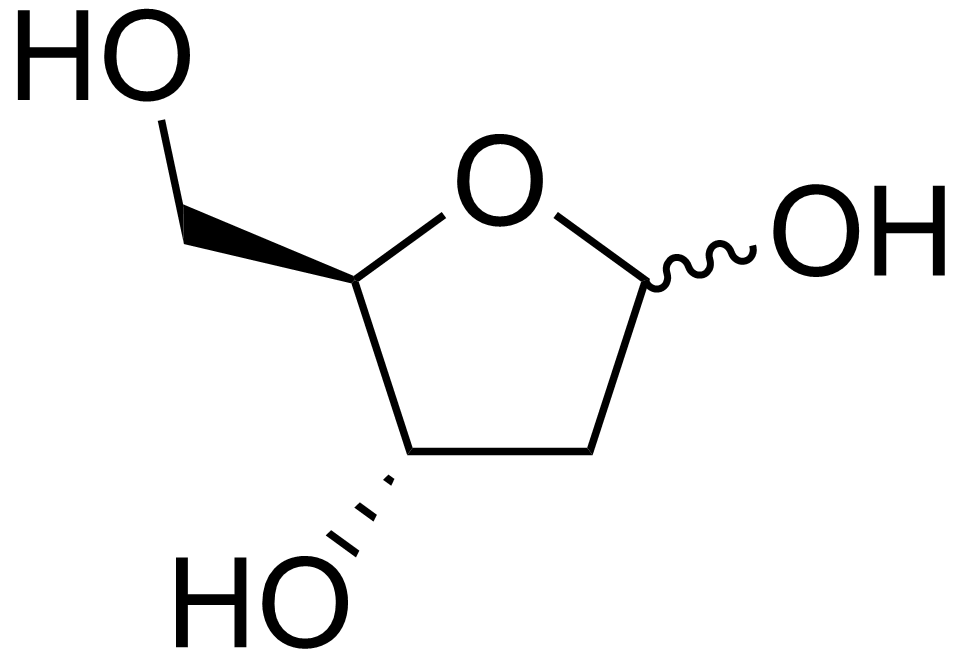


Chemical characteristics
Chemically, deoxyribose has the empirical formula C5H10O4 and can exist in an open‑chain (aldehyde) form or as a five‑membered furanose ring, which is the form incorporated into DNA. It is called “deoxy” because it lacks the hydroxyl (–OH) group at the 2′ carbon that is present in ribose. That difference—absence of the 2′‑OH—is central to many of the physical and chemical properties that distinguish DNA from RNA; for contrast, see ribose and RNA.
Biological role and importance
Deoxyribose is not free‑standing in most cells but appears as part of deoxyribonucleotides (dNTPs), the building blocks of DNA. During replication and repair these deoxyribonucleotides are joined by phosphodiester bonds, producing a stable polymer suited to long‑term information storage. The missing 2′ hydroxyl reduces susceptibility to hydrolysis compared with RNA, contributing to DNA’s greater chemical stability and suitability for genomic storage.
Origin and biosynthesis
Cells produce deoxyribonucleotides through reduction of ribonucleotides, a reaction catalyzed by ribonucleotide reductase, which converts the 2′‑OH into hydrogen. Historically, sugars of nucleic acids were characterized in early biochemical studies of nucleic acids in the 20th century; those analyses established the distinction between ribose and deoxyribose and their association with RNA and DNA respectively.
Practical notes and distinctions
- Structural effect: the sugar pucker of deoxyribose favors conformations that support the B‑form helix typical of cellular DNA.
- Chemical reactivity: lack of the 2′‑OH reduces backbone cleavage and alters enzyme recognition relative to RNA.
- Applications: deoxyribose derivatives are used in nucleotide synthesis, molecular biology reagents, and serve as a scaffold for many chemical analogs used in research and medicine.
Because of its central role in genetics and molecular biology, deoxyribose remains a fundamental topic in biochemistry and biotechnology. For more background on related sugars and nucleic acids, consult general resources on DNA and on the chemistry of ribose and RNA.
Related articles
Author
AlegsaOnline.com Deoxyribose: the sugar of DNA Leandro Alegsa
URL: https://en.alegsaonline.com/art/26672