
Daphnis (moon of Saturn)
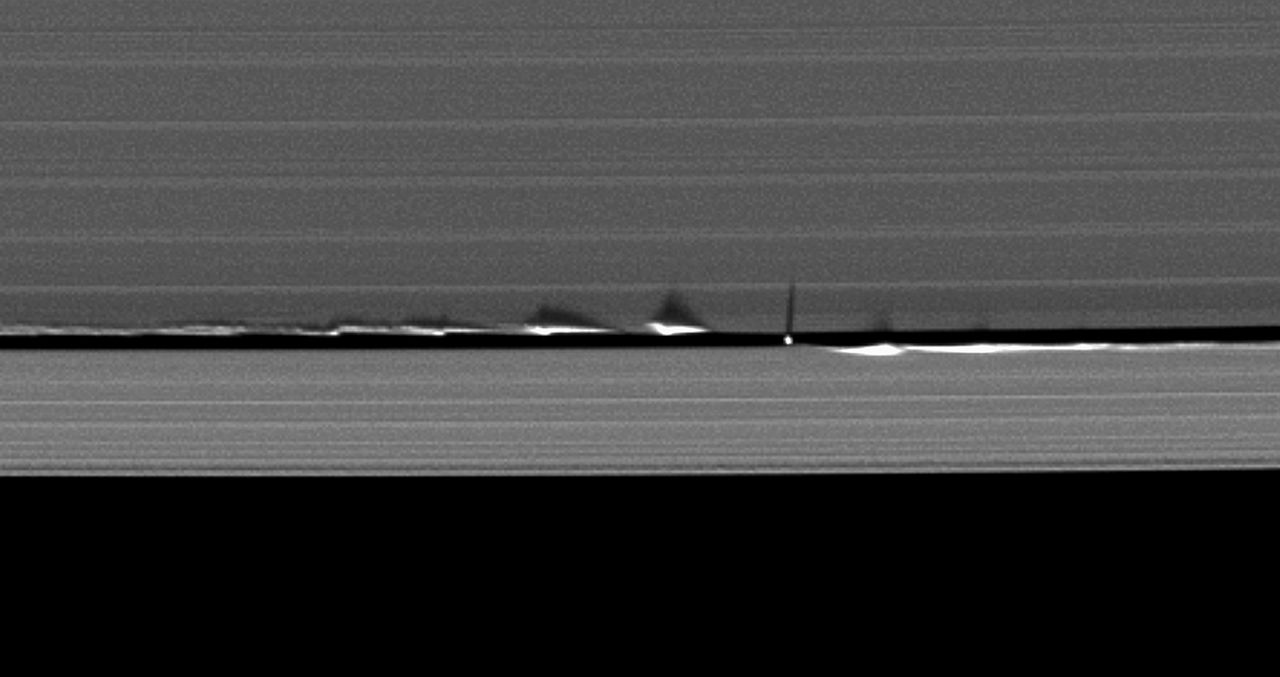
Daphnis is a tiny shepherd moon of Saturn that orbits in the Keeler Gap. Discovered by Cassini in 2005, it is roughly 6–8 km across and produces visible waves and wakes in the planet's rings.
Overview
Daphnis is a small natural satellite of Saturn that orbits within the Keeler Gap, a narrow opening in Saturn's A ring. Its gravitational influence on nearby ring particles produces striking edge waves and wakes that were first seen clearly in images from the Cassini probe. The moon's name derives from a pastoral figure in Greek mythology.
Image gallery
3 Images

Physical characteristics
Daphnis is only a few kilometres across, with estimates commonly cited in the range of about 6–8 km in diameter. It is irregular in shape, likely composed mostly of water ice with a surface scarred by impact craters and covered by regolith like many small icy bodies. For a compact summary of measured dimensions and properties see size and parameters.
Orbit and dynamics
The moon follows an orbit located squarely inside the Keeler Gap. Its slight orbital eccentricity and inclination cause it to tug on ring particles both radially and vertically, producing ripples that can extend above and below the ring plane. These interactions make Daphnis an excellent example of how even a very small moon can sculpt and maintain ring structure; further technical details are available from mission summaries such as mission data.
Discovery and observations
Daphnis was discovered in 2005 in images taken by the Cassini–Huygens spacecraft. Cassini subsequently provided higher-resolution views that revealed the moon's role in generating the distinctive waves on the edges of the Keeler Gap. Observational reports and image archives from the Cassini mission discuss these findings in depth: Cassini observations.
Importance and distinctions
Although tiny compared with major moons, Daphnis is scientifically important because it exhibits visible, dynamically driven effects on Saturn's rings. It is often compared to other gap-occupying moons such as Pan (in the Encke Gap); studying these bodies helps researchers understand ring-moon interactions, the processes that maintain gaps, and the microphysics of ring particles. For comparative summaries see related summaries.
- Role: A shepherd moon that perturbs ring edges.
- Size: Roughly several kilometres across.
- Notable: Produces radial and vertical waves visible in spacecraft images.
Continued analysis of archival Cassini data and future missions will refine our understanding of Daphnis and similar small moons, helping to illuminate the dynamic interplay between satellites and planetary rings.
Related articles
Author
AlegsaOnline.com Daphnis (moon of Saturn) Leandro Alegsa
URL: https://en.alegsaonline.com/art/25481