
De revolutionibus orbium coelestium — Copernicus and the heliocentric work
Nicolaus Copernicus's 1543 De revolutionibus proposed a Sun-centered system, challenged the Ptolemaic universe and helped launch the Copernican and Scientific Revolutions.
Overview
Nicolaus Copernicus published De revolutionibus orbium coelestium (On the revolutions of the heavenly spheres) in 1543. Printed in Nuremberg, the work presented a model of the cosmos in which the Earth and other planets revolve around the Sun, rather than occupying the unmoving centre of the universe. This heliocentric proposal offered an alternative to the long-established geocentric system of Ptolemy and set the stage for profound changes in astronomy and natural philosophy.
Image gallery
8 Images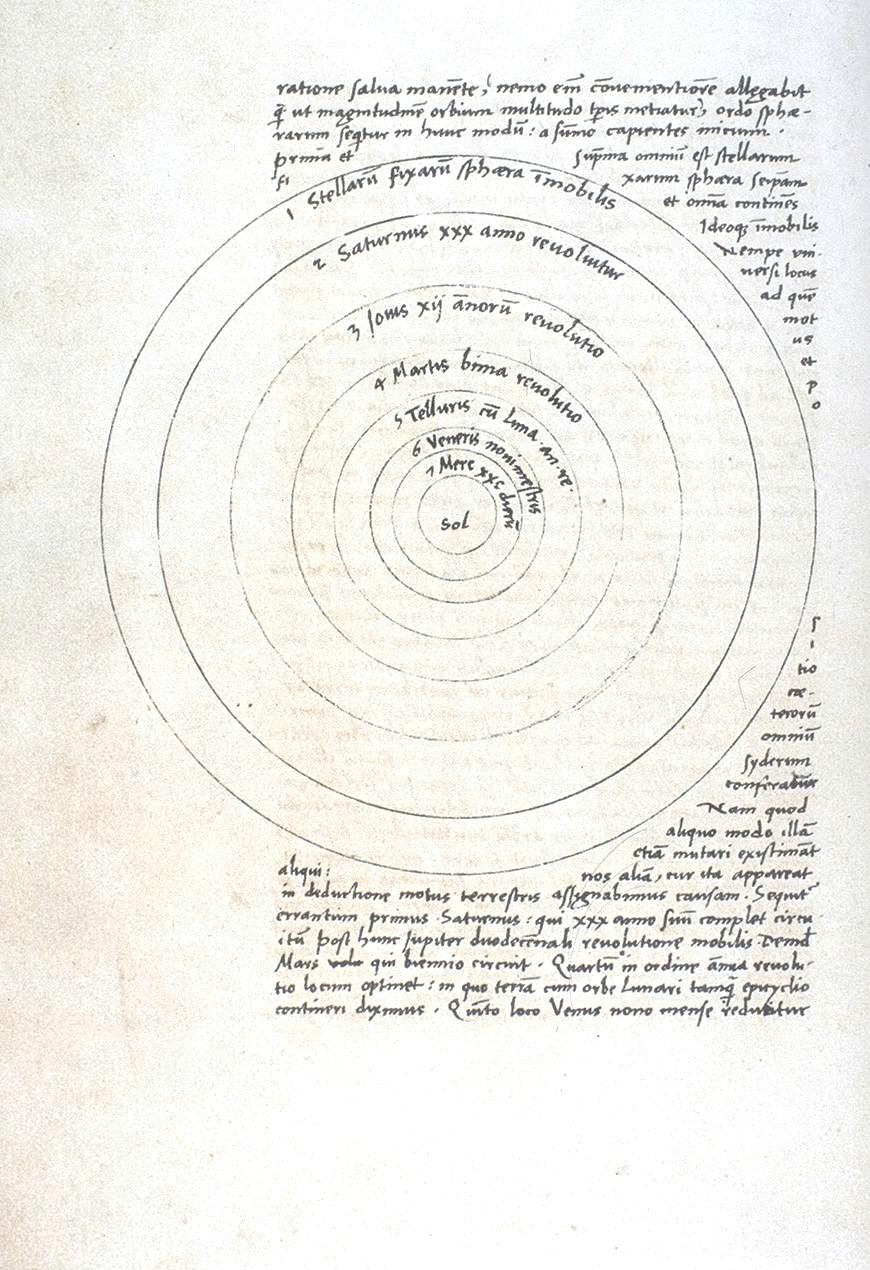



Contents and method
De revolutionibus is organised as a mathematical and astronomical treatise. Its six books move from general principles and geometry to detailed models of planetary motion. Copernicus retained classical tools such as uniform circular motion, eccentrics and epicycles, but rearranged their application so that the Sun lies near the centre and the Earth becomes one planet among several. The book explains apparent phenomena — including planetary retrograde motion — as consequences of Earth's motion and relative positions of planets, rather than as complex adjustments to an immobile Earth.
Publication history and editorial framing
The book was printed at the end of Copernicus's life; tradition holds he saw a copy shortly before his death in 1543. Its printed edition included an unsigned preface that presented the heliocentric model as a computational device rather than a literal description of reality; that preface is now commonly attributed to a contemporary theologian. Copernicus dedicated the work to Pope Paul III, reflecting the humanist and scholarly context in which the book circulated.
Key features
- Reordering of the planetary sequence with the Sun near the centre.
- Explanation of retrograde motion by relative orbital motion rather than by epicyclic contrivances alone.
- Use of classical geometry and circular orbits, leaving some empirical discrepancies unresolved.
- Presentation as a mathematical astronomical theory intended to improve predictive tables.
Reception and significance
Initial responses were mixed. Some astronomers and mathematicians found the heliocentric scheme elegant and useful for computation; others resisted because it contradicted prevailing interpretations of scripture and Aristotelian physics. The work did not immediately displace Ptolemaic models: it lacked a full dynamical explanation for planetary motion and still relied on adjustments that limited its observational accuracy. Over the next century, however, figures such as Johannes Kepler and Isaac Newton transformed and extended Copernicus's framework — replacing circular orbits with ellipses and providing laws of motion and universal gravitation that grounded heliocentrism physically.
Legacy
De revolutionibus is regarded as a landmark that helped trigger the Scientific Revolution. By relocating the Earth within a larger, mathematically describable system, Copernicus changed how scholars conceived of nature, measurement and the role of mathematical models. The book's blend of rigorous calculation, astronomical tables, and philosophical implication made it a central reference in the transition from medieval to modern science.
For further study, modern editions and commentaries discuss the mathematical apparatus, Copernicus's sources, and the work's influence on later astronomers; archival and translation projects also make the text accessible to non-Latin readers. Contemporary summaries and academic treatments provide context for its composition and the debates that followed (Renaissance context).
Questions and answers
Q: Who wrote De revolutionibus orbium coelestium?
A: The Renaissance astronomer Nicolaus Copernicus wrote De revolutionibus orbium coelestium.
Q: When was the book first printed?
A: The book was first printed in 1543 in Nuremberg, Holy Roman Empire of the German Nation.
Q: What was the main idea presented in De revolutionibus orbium coelestium?
A: The main idea presented in De revolutionibus orbium coelestium was that the Earth went round the Sun, and not vice versa, as had been traditionally thought.
Q: What was the alternative model of the universe presented in De revolutionibus orbium coelestium?
A: The alternative model of the universe presented in De revolutionibus orbium coelestium was Copernicus's Sun-centered system.
Q: Why didn't Copernicus publish his ideas until right before his death?
A: Copernicus didn't publish his ideas until right before his death because he himself did not truly believe it and only proposed the idea as a philosophy experiment.
Q: What was the traditional Earth-centered system called?
A: The traditional Earth-centered system was called Ptolemy's system.
Q: How long had Copernicus worked on his ideas before publishing De revolutionibus orbium coelestium?
A: Copernicus had worked his ideas out many years before publishing De revolutionibus orbium coelestium.
Related articles
Author
AlegsaOnline.com De revolutionibus orbium coelestium — Copernicus and the heliocentric work Leandro Alegsa
URL: https://en.alegsaonline.com/art/25938