
Dark nebula
Dense interstellar clouds of gas and dust that block visible light, appearing as dark silhouettes against star fields; important sites for molecular chemistry and early star formation.
Overview
A dark nebula is a region of interstellar space where dust and gas are sufficiently dense to absorb and scatter visible light, producing an apparent void or silhouette against brighter star fields or emission nebulae. Unlike emission nebulae, which glow through ionized gas, dark nebulae are identified by the absence of background light rather than by their own emission. For a general introduction to astronomical classifications, see this resource.
Image gallery
10 Images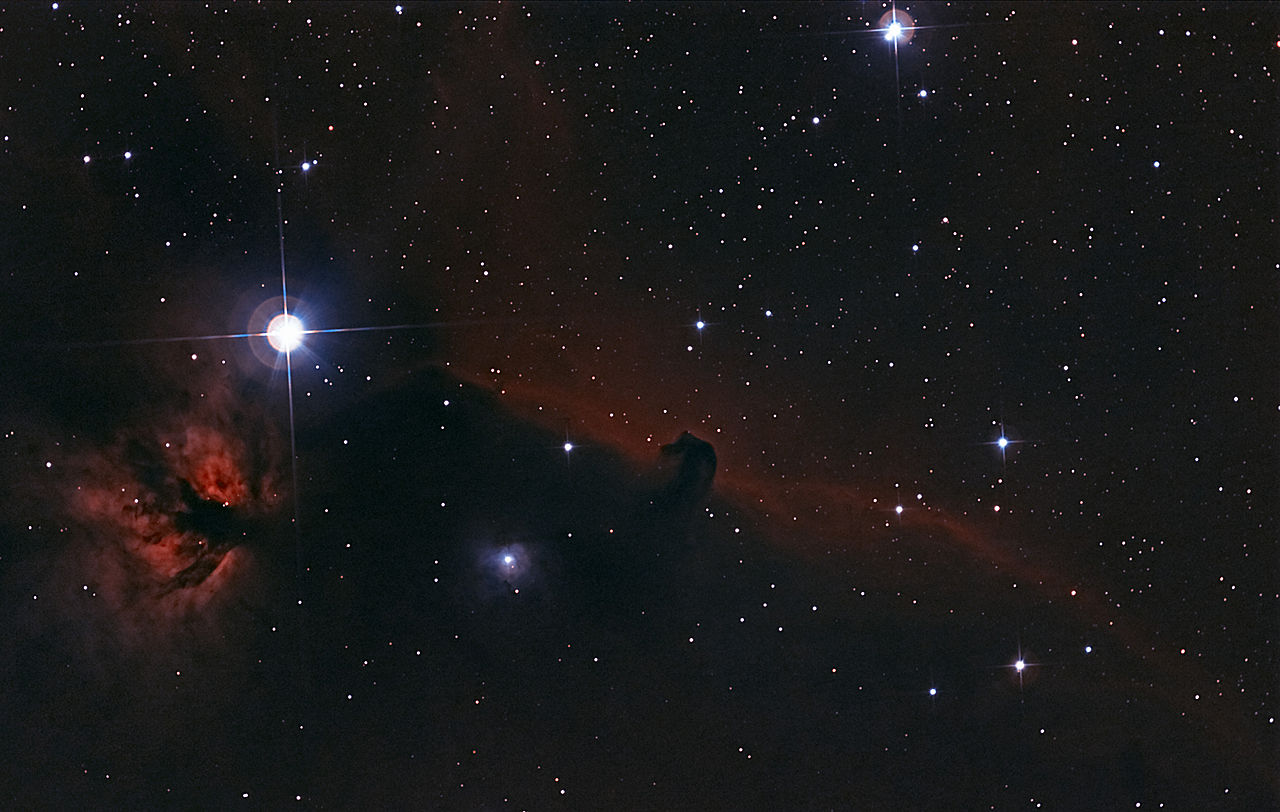




Composition and appearance
Dark nebulae consist largely of molecular gas (primarily molecular hydrogen) mixed with microscopic dust grains made of carbonaceous and silicate material. Dust causes extinction and reddening of light passing through the cloud, so stars seen through a dark nebula appear dimmer and redder than they otherwise would. Visually they range from small, round Bok globules to extended, filamentary clouds that carve complex shapes across the Milky Way.
Observation methods
Because dark nebulae block visible light, astronomers study them using infrared and radio wavelengths that penetrate dust. Infrared observations reveal embedded young stars and warm dust, while radio measurements of molecules such as carbon monoxide (CO) trace the distribution and motion of the cold gas. Dense cores can also be mapped through submillimeter emission from cold dust. Optical photography still plays a role when dark clouds are seen in silhouette against rich star fields.
Role in star formation
Many dark nebulae are part of larger molecular clouds and contain regions of higher density where gravity can overcome internal pressure, initiating the collapse that leads to protostar formation. Smaller isolated dark clouds, often called Bok globules, were proposed as potential sites for star birth and are observed to host protostellar objects and outflows. Thus dark nebulae are central to understanding the earliest stages of stellar evolution and the initial conditions for planet formation.
History and cataloguing
Observers in the 19th and early 20th centuries noted conspicuous dark patches in the Milky Way. The most influential modern compilation was prepared by the American astronomer Edward Emerson Barnard, who produced a catalogue of dark markings now known as Barnard objects. Subsequent surveys using photographic and digital imaging expanded the list and enabled quantitative studies of extinction and cloud structure.
Examples and distinctions
Well-known dark nebulae include the Horsehead Nebula (a dust silhouette in Orion), the Coalsack visible to southern observers, Barnard 68 (a nearby isolated dark cloud), and the Pipe Nebula near the Galactic center. Important distinctions: dark nebulae obscure light; reflection nebulae scatter starlight and appear blue; emission nebulae shine by emission from ionized gas. Together, these classes help map the interstellar medium and its role in galactic ecology.
- Typical study wavelengths: infrared, submillimeter, radio
- Related terms: Bok globule, molecular cloud, extinction, reddening
Related articles
Author
AlegsaOnline.com Dark nebula Leandro Alegsa
URL: https://en.alegsaonline.com/art/25530
Sources
- doi.org : 10.1086/111527