
Dagger (typography)
A typographic mark (†) used as a reference or editorial symbol; includes the single dagger and double dagger, their history, uses, and encoding in modern text systems.
Overview
The dagger is a small, cross‑like typographic mark most commonly rendered as † (single dagger) and ‡ (double dagger). In printed and digital text it functions as a reference mark, an editorial sign, or a compact annotation marker when footnote symbols are needed beyond the asterisk. The symbol is sometimes called an obelisk or obelus in historical contexts.
Image gallery
1 Image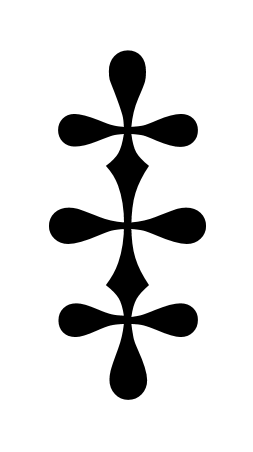
Appearance and variants
Visually the dagger has a short horizontal arm intersecting a vertical stroke; the double dagger repeats this motif to form a twin‑barred sign. Designers may position the mark on the baseline or as a superscript depending on its role (inline reference vs. footnote marker). Different typefaces present subtle stylistic differences in stroke weight and proportions.
History and origin
Its ancestor is the ancient obelus, a simple mark used by classical scholars and medieval scribes to flag questionable or spurious passages in manuscripts. Over centuries the mark evolved from a marginal sign of criticism into a compact device in printed editions and scholarly apparatus. By the era of movable type printers regularly employed the dagger as one of several reference symbols.
Uses and conventions
Typical applications include:
- Footnote sequencing: used after the asterisk when multiple symbols are preferred instead of numbers.
- Editorial apparatus: to mark variants, interpolations, or points of textual doubt in critical editions.
- Biographical listings and obituaries: a dagger sometimes denotes the date of death when placed before or after a year.
- Scholarly and technical notation: occasional use as a compact marker in tables, lists, or side notes.
Encoding and input
In modern character sets the single dagger is encoded as U+2020 and the double dagger as U+2021; many environments also provide named entities (for example † and ‡) for use in markup. For further typographic detail see typographic reference and Unicode information at Unicode resources.
Notable distinctions
Although visually similar to religious crosses, the dagger is primarily a neutral editorial symbol; context determines meaning. Its practical role is to conserve space while signalling a secondary note or editorial comment without interrupting the main text. Usage norms vary by publisher, language, and scholarly field, so style guides should be consulted when precise ordering or placement matters.
Related articles
Author
AlegsaOnline.com Dagger (typography) Leandro Alegsa
URL: https://en.alegsaonline.com/art/25075