
Comet Hale–Bopp (C/1995 O1) — the Great Comet of 1997
Comet Hale–Bopp was a spectacular long‑period comet discovered in 1995 that became one of the brightest and most widely observed comets of the 20th century in 1997.
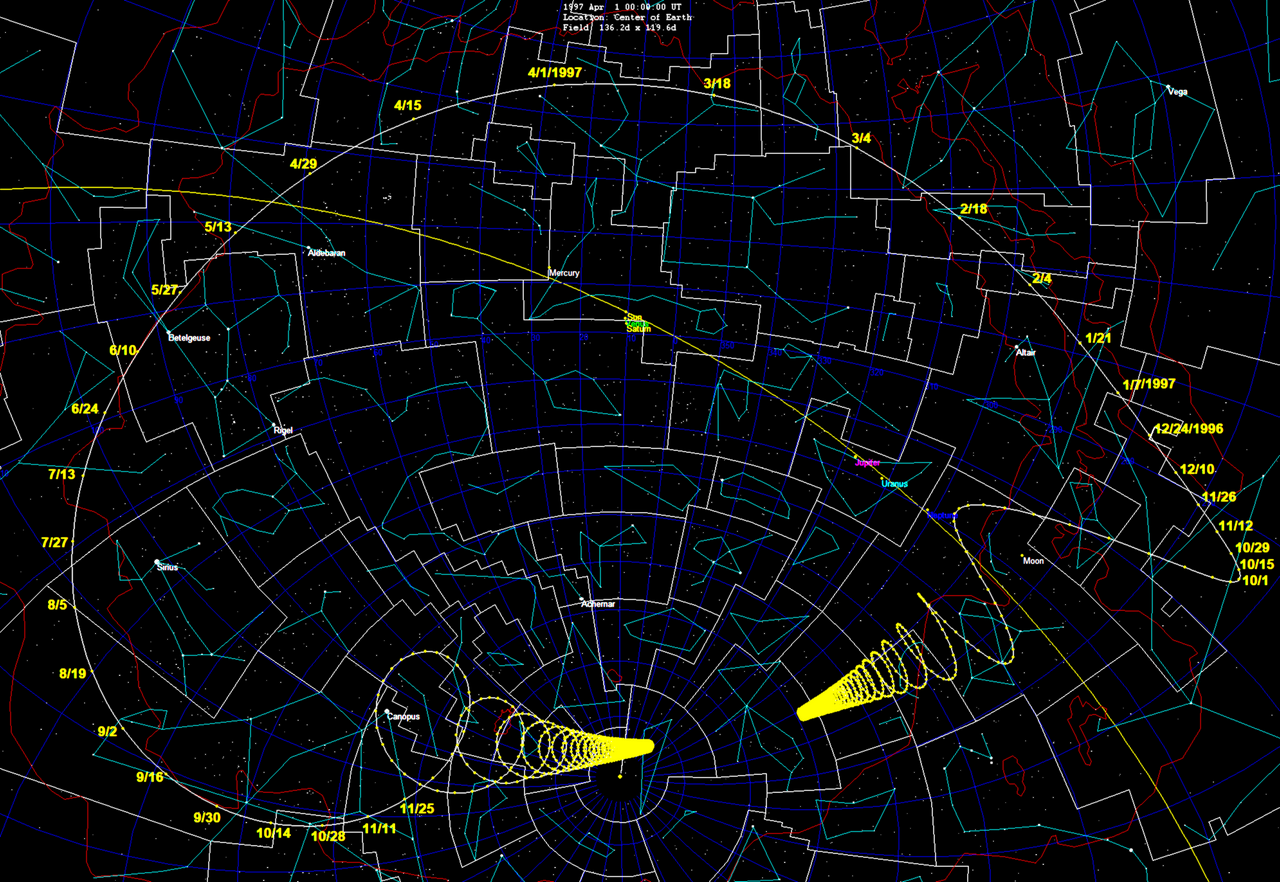
Overview: Comet Hale–Bopp, formally designated C/1995 O1, emerged as one of the most widely seen comets of modern times. Discovered in 1995, it became spectacularly visible to the unaided eye during 1996–1997 and is often called the Great Comet of 1997. It is notable for its prolonged visibility, striking twin tails, and an unusually active, large nucleus compared with many comets observed in recent centuries. For more general resources see Comet Hale–Bopp and observational context relative to Earth.
Image gallery
10 Images






Key characteristics
Hale–Bopp displayed the classic features of a bright comet: a dense, luminous coma surrounding the nucleus and two distinct tails — a broad dust tail and a narrower ion (gas) tail. Its coma grew to enormous apparent size and the dust tail showed complex structure under binoculars and long-exposure photography. Spectroscopic and radio observations during the apparition revealed abundant volatile gases that drove activity even when the comet was still relatively far from the Sun.
Discovery and orbit
The comet was discovered independently by two amateur astronomers in July 1995 and quickly received intensive follow-up. Its orbit classifies it as a long‑period comet, meaning it takes many centuries to millennia to complete one revolution around the Sun. Because of that long orbit and its strong activity, it offered a rare opportunity to study material that had spent most of its existence in the outer Solar System.
Observations and scientific significance
Hale–Bopp was observed extensively across the electromagnetic spectrum by amateur and professional observers, including ground-based telescopes and space observatories. The wealth of images and spectra helped astronomers characterize its composition, dust environment, and gas production rates. The comet’s pronounced activity at large distances provided evidence for abundant highly volatile ices, and its large, active nucleus made it an important case for understanding cometary evolution and the diversity of comet nuclei.
Public response and cultural impact
Because it was bright, long-lasting, and visible from both hemispheres, Hale–Bopp captured widespread public attention. It inspired a surge of interest in astronomy, numerous photographs, and public viewing events. The apparition also intersected with darker cultural episodes; most notably, a fringe religious group interpreted the comet as a sign, an association that had tragic consequences. Overall, the comet left a lasting impression on public awareness of comets and on how transient astronomical events can influence society.
Notable distinctions
- One of the brightest and longest-visible comets of the late 20th century.
- Displayed two prominent tails and an exceptionally large, active coma.
- Provided extensive multiwavelength observational data that advanced comet science.
Hale–Bopp remains a benchmark event for both professional research and public engagement with astronomy, illustrating how a single, well‑observed comet can deepen scientific understanding while becoming a memorable cultural phenomenon.
Tags
Related articles
Author
AlegsaOnline.com Comet Hale–Bopp (C/1995 O1) — the Great Comet of 1997 Leandro Alegsa
URL: https://en.alegsaonline.com/art/21913