
Colonization of Mars: prospects, challenges, and approaches
A balanced overview of human colonization of Mars: why Mars is considered, what technical and biological challenges exist, historical proposals, likely infrastructure and ethical/legal issues.
Overview
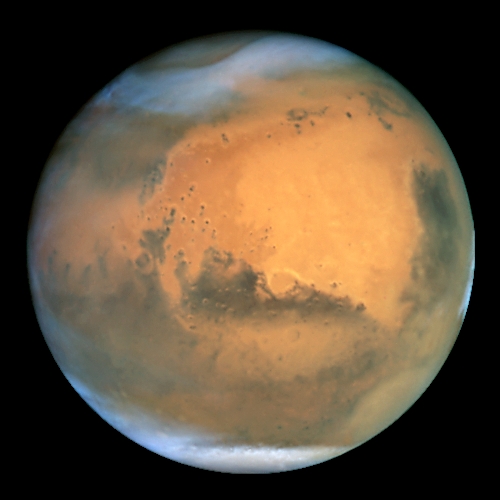
The colonization of Mars refers to establishing long-term human presence on the planet Mars. This idea has been discussed by scientists, engineers and the public for decades and remains an active topic of research and debate. Public and scientific debate surrounds feasibility, costs and benefits. Interest spans national space agencies, private companies and academic groups; proponents point to Mars's relative proximity to Earth and the presence of water ice as reasons why it is the most practical target beyond the Moon. Many advocates say efforts to settle Mars would transform science and technology, while others caution about risks. The planet itself—often referenced simply as Mars—has features that both attract and complicate human settlement.
Image gallery
10 Images





Environment and resources
Mars has a thin atmosphere composed mostly of carbon dioxide, surface gravity lower than Earth’s, large daily temperature swings and frequent dust activity. Remote sensing and lander data, including satellite observations, have revealed abundant water ice at the poles and in some subsurface regions; traces of hydrated minerals suggest past aqueous environments. The availability of frozen water and accessible minerals is central to in-situ resource utilization (ISRU) concepts, which propose extracting local water, oxygen and building materials on Mars. Water ice, in particular, is often cited as a key enabler of long-term habitation and life-support systems (subsurface and polar ice).
History of ideas and current proposals
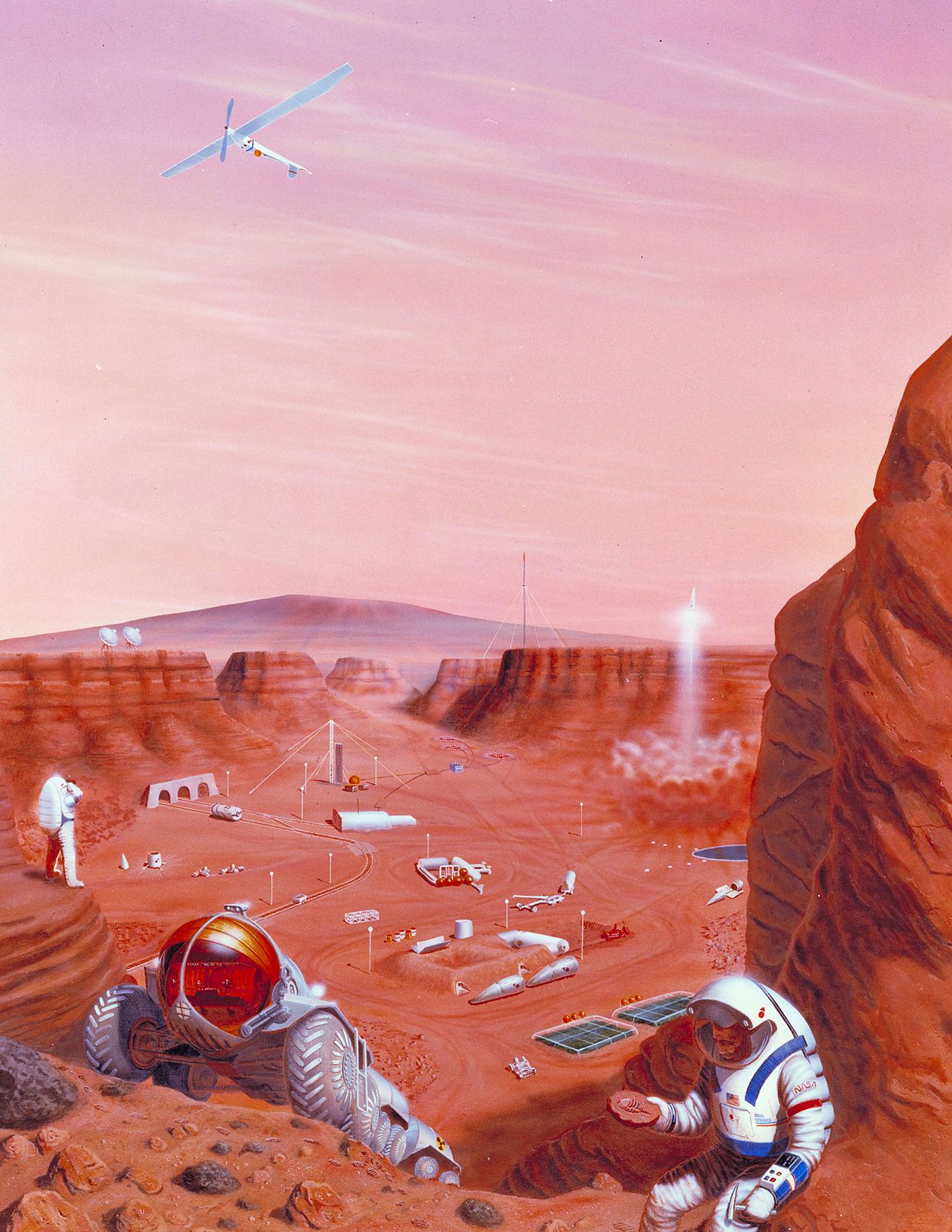
Concepts for human missions to Mars date back to early 20th-century speculation and matured with mid-20th-century engineering studies. Robotic exploration has progressively improved knowledge of Martian conditions and resources. Contemporary plans range from short-duration scientific bases to permanent settlements; these are pursued by governmental programs and private ventures alike. Proponents envision habitats, pressurized modules and greenhouses fed by power systems and local resources, while studies continue to refine approaches to life support, radiation shielding and crew transportation. The question of whether Mars could ever host self-sustaining human communities intersects with research into the potential for past or present microbial life and the need to prevent contamination of Martian environments (planetary protection).
Infrastructure, methods and examples
Typical mission architectures include transfer trajectories timed for energy-efficient windows, descent and landing systems adapted to the thin atmosphere, and surface infrastructure for power, shelter and resource processing. Proposed technologies emphasize closed-loop life support, use of local water and regolith for construction, and reliable energy from nuclear or solar sources. Some planners contrast Mars with the Moon as an initial stepping-stone: the Moon is closer but lacks confirmed accessible water over wide areas, while Mars offers greater scientific value and potential for long-term habitability (Mars vs. Moon, lunar comparisons).
Challenges, risks and legal-ethical issues
Key technical challenges include protecting crews from cosmic and solar radiation, coping with reduced gravity, managing psychological stresses of isolation, and safely landing heavy payloads in a gravity well. Environmental hazards such as dust, temperature extremes and the corrosive nature of perchlorates in Martian soil complicate life-support and agriculture. There are also legal and ethical considerations: international agreements and norms govern activities on other worlds, and debates continue over resource rights, environmental preservation and the responsibilities of earthly nations and companies to avoid harmful contamination. Multiple organizations and initiatives study and advocate different approaches to these issues (organized efforts).
Importance and future outlook
Advocates argue Mars colonization could advance science, provide economic opportunities, and serve as a long-term insurance policy for human civilization. Critics highlight large costs, technical uncertainty and the moral question of altering another planet. Near-term steps likely involve more robotic exploration, demonstration of ISRU technologies and international cooperation on legal frameworks. Whether permanent colonies emerge within decades or centuries depends on political will, technological progress and sustained funding. For more introductory material and current proposals consult general resources and program summaries via public debate summaries and agency overviews linked throughout this article.
- Relevant topics: habitat design, ISRU, life support, planetary protection.
- Distinctions: Mars offers greater potential for long-term settlement than the Moon but poses more complex engineering challenges.
Questions and answers
Q: What is the debate about?
A: The debate is about colonizing the planet Mars.
Q: What evidence suggests that Mars can host humans and other organic life?
A: Satellite imagery shows that there is frozen ground water on the planet, and it has a thin atmosphere which makes it possible to host humans and other organic life.
Q: Why hasn't the Moon been proposed as a location for human colonization?
A: The Moon has not been proposed as a location for human colonization because it is not known to have air or water.
Q: What are some of the risks associated with landing on Mars?
A: Some of the risks associated with landing on Mars include gravity wells.
Q: Are there any organizations that support the colonization of Mars?
A: Yes, there are many organizations that support the colonization of Mars.
Related articles
Author
AlegsaOnline.com Colonization of Mars: prospects, challenges, and approaches Leandro Alegsa
URL: https://en.alegsaonline.com/art/21721
Sources
- docs.google.com : Resource Utilization Concepts for MoonMars
- praxis-publishing.co.uk : MARTIAN OUTPOST: The Challenges of Establishing a Human Settlement on Mars
- springer.com : springer.com/astronomy/space exploration/book/978-0-387-98190-1
- amazon.com : amazon.com/Martian-Outpost-Challenges-Establishing-Exploration/dp/038798190X
- news.idg.no : Ice, mineral-rich soil could support human outpost on Mars