
Comet Swift–Tuttle (109P/Swift–Tuttle) — parent of the Perseid meteor shower
Periodic Halley-type comet with a 133-year orbit and ~26 km nucleus, discovered in 1862; recorded in antiquity, linked to the Perseid meteor shower, and periodically returns to produce notable displays.
Overview
Comet Swift–Tuttle (109P/Swift–Tuttle) is a long-period periodic comet best known as the parent body of the Perseid meteor shower. It follows an elongated orbit around the Sun with an orbital period of about 133 years, which places it among the classical Halley-type comets. Modern observations have measured a relatively large nucleus, and the comet has a history of bright appearances recorded by observers both in historical chronicles and with modern instruments. For a general classification see periodic comet and notes on its Halley-type status.
Image gallery
9 Images






Physical characteristics
Measurements from telescopic observations and photometric studies indicate that the comet's solid nucleus is unusually large for a comet, with an estimated diameter of roughly 26 kilometres. The nucleus is composed of volatile ices and dust, which sublimate as the comet approaches the Sun and create a surrounding coma and tail. The size of the nucleus influences both the brightness of the comet at perihelion and the quantity of debris it sheds that later becomes meteoroids intersecting Earth's orbit.
Orbit and classification
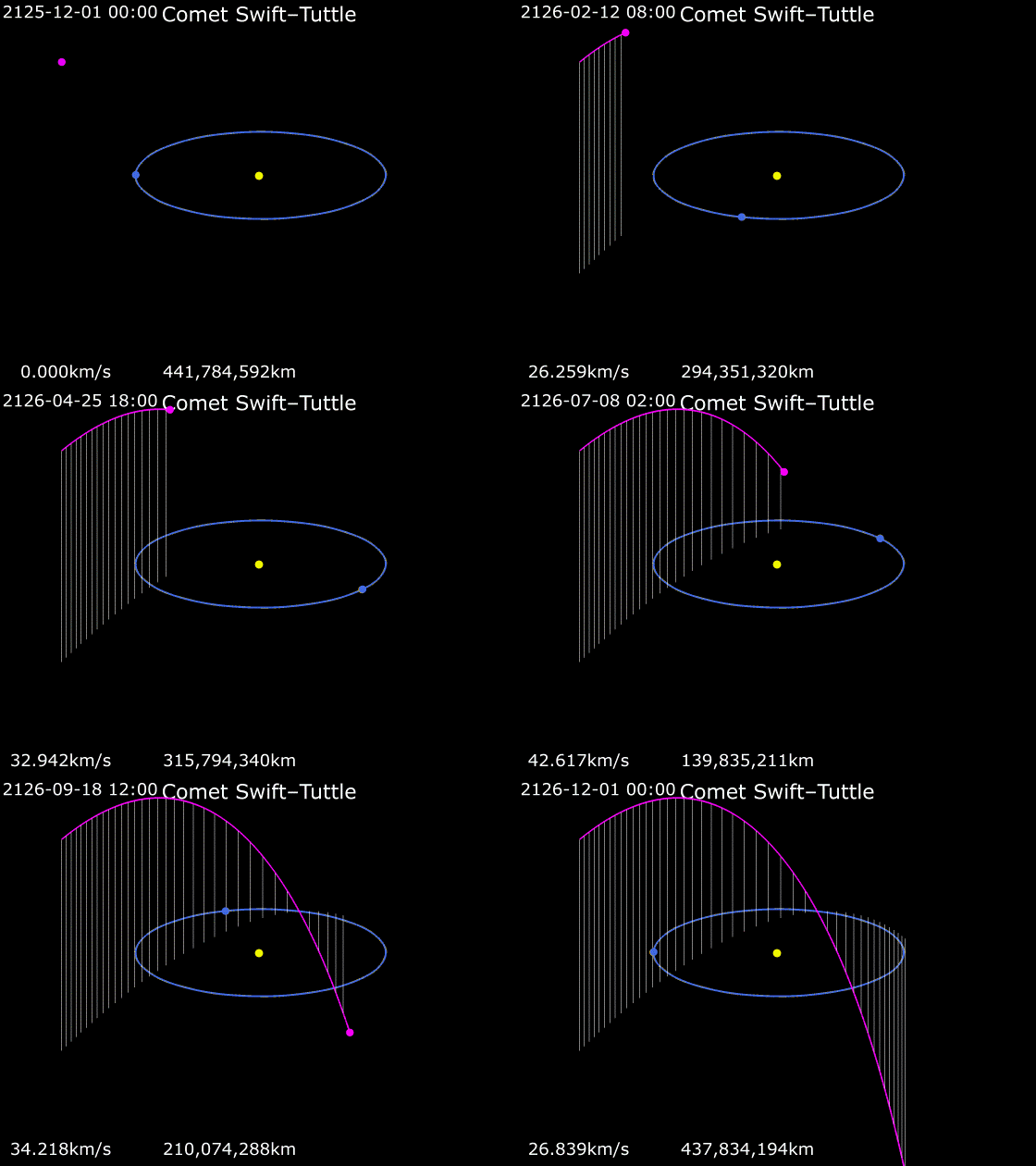
Swift–Tuttle's orbit is highly elliptical and well determined from many apparitions and modern astrometric data; detailed ephemerides are available from observatory databases and orbit catalogs. Its orbital period of about 133 years places it between short-period and truly long-period comets and fits the conventional definition of a Halley-type comet, typically meaning periods between about 20 and 200 years. For technical orbit elements and trajectory diagrams consult published orbit resources orbit data and periodic-comet summaries orbital period.
Discovery and historical observations
The comet was independently discovered in July 1862 by Lewis Swift and Horace Parnell Tuttle during a well-observed apparition that produced a bright display visible to the naked eye in some locations. Historical records suggest the comet or its apparition may have been seen much earlier: Chinese astronomical chronicles include observations in 188 AD that have been associated with this comet, described as unusually bright for their time. More recent returns have been observed with modern instruments; for example, the 1992 apparition was detected with binoculars and small telescopes binoculars, though it was not as spectacular as some historical passages.
Connection to the Perseid meteor shower
Swift–Tuttle is the parent body of the Perseid meteor shower, one of the most reliable and widely observed annual meteor displays. Each August, Earth crosses debris left behind by the comet; these tiny particles enter the atmosphere at high speed and produce bright meteors. The shower's strong and recurring activity is tied to the comet's historical passages and the distribution of debris along its orbit. For more about the shower and observing advice see the summaries on the Perseids Perseid meteor shower and meteor shower resources meteor shower details.
Notable facts, future returns and study
- Independent discovery: credited to Lewis Swift and Horace P. Tuttle in 1862.
- Size: nucleus ~26 km in diameter, larger than most short-period comets.
- Brightness history: ancient Chinese records and 19th-century observers describe unusually bright apparitions.
- Future visibility: the comet is predicted to return in coming centuries; some specific apparitions are forecast to be more favorable, and ongoing calculations estimate apparent magnitudes for those returns.
Astronomers continue to monitor Swift–Tuttle because of its size, dynamical evolution and role in producing the Perseids. Its well-measured orbit allows long-term studies of how planetary perturbations and nongravitational forces alter cometary paths. For public-facing orbit summaries and observing predictions see the periodic comet resources periodic comet and orbit pages orbit data.
Questions and answers
Q: What is Comet Swift-Tuttle?
A: Comet Swift-Tuttle is a periodic comet with an orbital period of 133 years.
Q: Does Comet Swift-Tuttle fit the definition of a Halley-type comet?
A: Yes, Comet Swift-Tuttle fits the classical definition of a Halley-type comet with a period between 20 and 200 years.
Q: Who discovered Comet Swift-Tuttle?
A: Comet Swift-Tuttle was independently discovered by Lewis Swift and Horace Parnell Tuttle in July 1862.
Q: What is the size of Comet Swift-Tuttle's nucleus?
A: Comet Swift-Tuttle has a comet nucleus 26 km in diameter.
Q: How bright was Comet Swift-Tuttle in 188 AD?
A: According to Chinese records, Comet Swift-Tuttle reached apparent magnitude 0.1 in 188 AD.
Q: How bright was Comet Swift-Tuttle in 1862?
A: In 1862, the comet was as bright as Polaris.
Q: What is the significance of Comet Swift-Tuttle in relation to the Perseid meteor shower?
A: Comet Swift-Tuttle is the parent body of the Perseid meteor shower, perhaps the best known shower and among the most reliable in performance.
Related articles
Author
AlegsaOnline.com Comet Swift–Tuttle (109P/Swift–Tuttle) — parent of the Perseid meteor shower Leandro Alegsa
URL: https://en.alegsaonline.com/art/21915
Sources
- ssd.jpl.nasa.gov : "JPL Small-Body Database Browser: 109P/Swift–Tuttle"
- ui.adsabs.harvard.edu : 1994MNRAS.266..305Y
- doi.org : 10.1093/mnras/266.2.305
- books.google.com : David Levy's guide to observing meteor showers
- space.com : "Top 10 Perseid Meteor Shower Facts"
- amsmeteors.org : "AMS Meteor Showers page"
- ui.adsabs.harvard.edu : 1995Icar..114..372C
- doi.org : 10.1006/icar.1995.1069
- books.google.com : Impact!: the threat of comets and asteroids
- cambridge.org : "The cometary impactor flux at the Earth"
- doi.org : 10.1017/S1743921307003559 · webcitation.org