
Crux (Southern Cross): constellation, history, navigation and cultural symbols
Crux, known as the Southern Cross, is the smallest modern constellation; a compact, bright cross of stars used for navigation and widely depicted on flags and emblems across the Southern Hemisphere.
Overview
Crux, commonly called the Southern Cross, is a small but prominent constellation of the southern sky. Its Latin name, Crux, simply means "cross," referring to the distinctive four-star pattern that forms a visible cross shape. Despite occupying only a modest area on the celestial sphere, the constellation's main stars are bright enough to make the cross easy to spot across much of the Southern Hemisphere. Crux is also the smallest of the 88 modern constellations, a fact often noted in reference works.
Image gallery
10 Images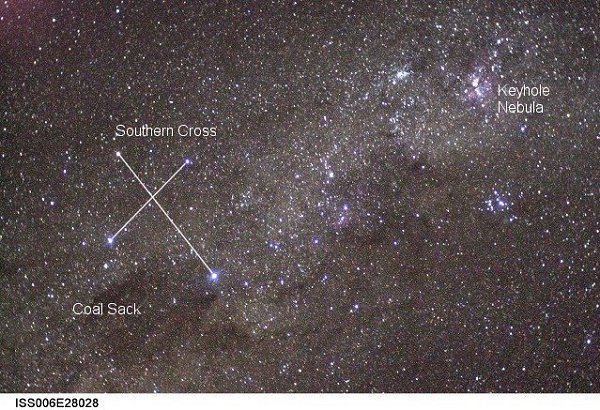








Stars and structure
The most conspicuous members of Crux are the four bright stars that mark the arms of the cross. These are traditionally identified by Bayer designations: Alpha, Beta, Gamma and Delta Crucis. Alpha Crucis is commonly called Acrux and is the constellation's brightest star; Beta Crucis is often referred to as Mimosa; Gamma Crucis is Gacrux. Delta Crucis completes the prominent quartet. Each of these main stars has an apparent visual magnitude brighter than about +2.8, which helps the pattern to stand out against the background sky. In addition to the four main stars, several fainter stars and nearby systems help define the familiar kite- or cross-shaped asterism, and multiple-star structure is present among the brightest components.
Visibility and location
Crux lies in the far southern sky and is not well seen from most of the Northern Hemisphere. It is circumpolar in many southern latitudes, meaning it can be visible year-round from places farther south. The long axis of the cross points roughly toward the south celestial pole, which has made Crux especially useful as a visual pointer by observers and navigators. The bright stars Alpha and Beta Centauri, which lie near Crux, are often used as "pointer" stars to locate the cross from different sky positions.
History and identification
Indigenous peoples of the Southern Hemisphere recognised the pattern long before European exploration and incorporated it into their star lore and navigation. In European records, Crux was first described to wide audiences in the early 16th century as navigators charted southern skies; Andrea Corsali made a notable account in 1515. Prior to such documentation, the stars of Crux were often treated as part of neighbouring constellations in classical (northern) star lists because the formation is not visible from much of the ancient Mediterranean world.
Navigation and cultural uses
Because the cross is easily identified and roughly points to the south celestial pole, sailors and land travellers in southern latitudes used Crux as a simple orientation aid at night. Polynesian navigators, Aboriginal Australians and other peoples of the southern regions incorporated the cross into traditional ways of finding direction and marking seasonal cycles. In European-derived navigation the cross and adjacent bright stars provided a practical celestial reference long before modern instruments and satellite navigation.
Cultural symbolism and flags
The Southern Cross has a wide cultural resonance across the Southern Hemisphere and appears on national and regional flags and emblems as a symbol of place, identity and heritage. Notable modern uses include its depiction on the flags of Australia, New Zealand, Brazil, Papua New Guinea and Samoa. The cross was also used on the Eureka flag flown by miners at Ballarat, Victoria during the 1854 Eureka Stockade, and it has since appeared in various historical and political contexts in Australia and elsewhere.
Science, observation and related features
For amateur astronomers Crux offers bright guide stars for finding nearby objects and dark-sky features. Close to the cross is the Coalsack, a conspicuous dark nebula that is visible to the naked eye as a dark patch against the Milky Way; it has been noted and named by many cultures. Modern astronomical study treats the constituent stars of Crux like other bright stellar systems, with spectroscopy and astrometry revealing multiplicity, stellar type and motion for the principal components.
Further reading
- Crux: constellation overview
- Shape and prominent stars
- Etymology of the name Crux
- Visibility and observing tips
- Brightness and magnitudes
- Celestial directions: north in the southern sky
- Celestial directions: south
- Celestial directions: east
- Celestial directions: west
- Historical navigation using Crux
- Use of the Southern Cross on the Australian flag
- Use on the flag of Brazil
- Use on the New Zealand flag
- Use on the Papua New Guinea flag
- Use on the Samoan flag
- Historical uses: Eureka and the Ballarat miners
- Later cultural and political symbolism
Related articles
Author
AlegsaOnline.com Crux (Southern Cross): constellation, history, navigation and cultural symbols Leandro Alegsa
URL: https://en.alegsaonline.com/art/24432
Sources
- ianridpath.com : "Crux: The southern cross"