
Chu River (Chǔ) — river of northern Kyrgyzstan and southern Kazakhstan
The Chu River (Chǔ) is a roughly 1,067 km river flowing from the Tian Shan foothills through Kyrgyzstan and Kazakhstan into the Central Asian steppe; important for irrigation, local communities and cross-border water management.
Overview
The Chu River, also rendered Chu or Shu and historically referenced by the Chinese name 楚 (chǔ), is a major watercourse in Central Asia. It is about 1,067 km long and runs from the mountains of northern Kyrgyzstan into the plains of southern Kazakhstan. As one of the longer rivers in Central Asia, the Chu supplies water to steppe landscapes and irrigated valleys and has played a persistent role in regional settlement and agriculture.
Image gallery
9 Images



Course and basin
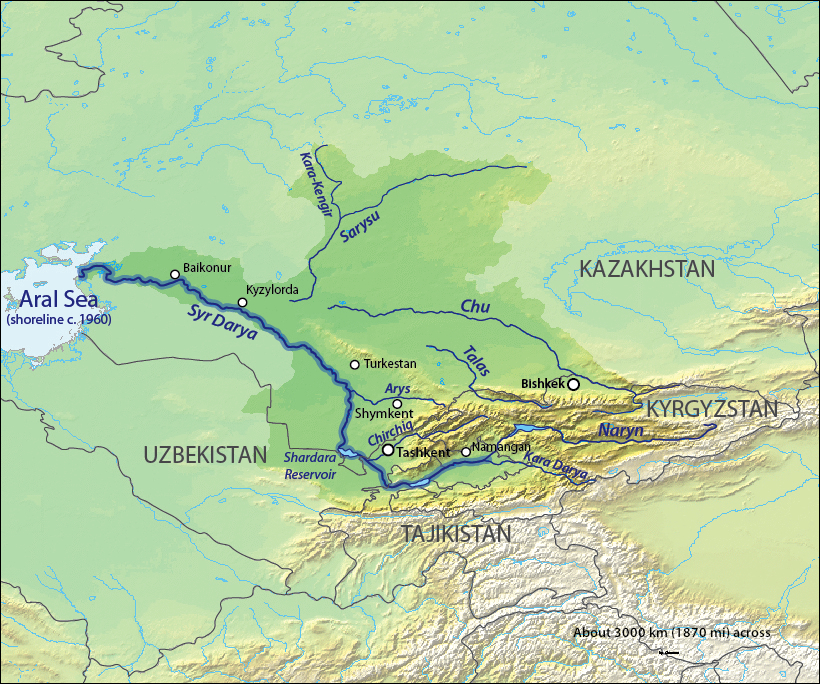
The river rises in upland areas and descends into a broad alluvial plain where it fans into distributaries and seasonal channels. In its lower reaches the Chu does not reach the sea; instead it disperses across arid areas and into saline depressions. Its floodplain and associated groundwater recharge zones are focal points for farming and pasture in an otherwise dry region. The Chu is frequently described simply as a river that links mountain runoff to steppe ecosystems.
Hydrology and environment
Flow in the Chu is strongly seasonal, reflecting snowmelt and precipitation patterns in the mountains. Water volumes can vary year to year, so the river supports a mosaic of habitats: riparian belts, wetlands where water collects, and dry steppe farther from the channel. These habitats sustain birds and riparian plants and are sensitive to changes caused by irrigation diversion, groundwater abstraction and climate variability.
History, culture and people
The valleys and plains along the Chu have long attracted pastoralists and farmers. Various Turkic and other Central Asian communities have used its water for grazing and crops. The river valley is also associated with the Dungan community, a group that settled in parts of the region after migrations connected to the late Qing period; see the entry for the Dungan people and historical context of the Qing dynasty for broader background.
Uses, management and challenges
Today the Chu is principally valued for irrigation, supplying fields and orchards in both Kyrgyzstan and Kazakhstan. Water management is a transboundary concern: cooperative agreements and local infrastructure aim to allocate seasonal flows, maintain channels and limit salinization. Challenges include balancing agricultural demand with ecological flows, sustaining groundwater levels and adapting to variable runoff.
Notable aspects and distinctions
- The Chu is a rare long river in an otherwise landlocked region and is prominent in national hydrology of both countries.
- It functions as an international river that requires binational cooperation for use and conservation.
- Its lower course illustrates how Central Asian rivers often terminate in inland basins rather than reaching an ocean, a common feature of arid continental interiors.
For further reading on regional rivers, water management and local communities see linked resources on the river name, countries and cultural groups: name origin, river systems, Kyrgyzstan, Kazakhstan, Central Asia, Dungan people and Qing dynasty.
Related articles
Author
AlegsaOnline.com Chu River (Chǔ) — river of northern Kyrgyzstan and southern Kazakhstan Leandro Alegsa
URL: https://en.alegsaonline.com/art/20242
Sources
- commons.wikimedia.org : Chu River