
Colombo Central Bank bombing (1996)
A January 31, 1996 suicide truck bombing at Sri Lanka's Central Bank in Colombo killed about 90 people and injured over 1,400, a major attack during the Sri Lankan civil war.
The Colombo Central Bank bombing was a major terror attack that struck the heart of Sri Lanka's capital on January 31, 1996. A heavy vehicle laden with explosives forced its way through the bank's main gate and detonated in the compound, inflicting extensive structural damage and causing a large number of civilian casualties. The blast is remembered as one of the deadliest incidents connected to the island's long-running internal conflict.
Image gallery
2 Images
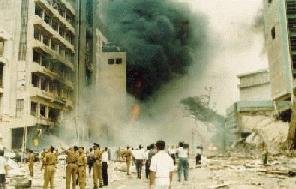
Attack and immediate effects
According to contemporaneous reports, the explosive-laden truck—carrying roughly 200 kilograms (about 440 pounds) of high explosives—penetrated the Central Bank's perimeter before detonating. The explosion wrecked the bank building and damaged several neighboring structures. Eyewitnesses described a powerful blast, a plume of smoke, shattered glass and debris scattered across nearby streets and markets. Rescue teams, medical staff and ordinary citizens collaborated to evacuate the wounded and recover the dead amid continuing chaos.
Context and perpetrators
The bombing occurred during the decades-long Sri Lankan civil war, a conflict between the government of Sri Lanka and separatist militants. Responsibility for the attack was widely attributed to the Liberation Tigers of Tamil Eelam (LTTE) by national authorities and many analysts, reflecting the wider pattern of large-scale attacks in urban centers. The event took place in Colombo, the country's main commercial hub, and represented an assault not only on a financial institution but on a busy civic area with markets and shops frequented by civilians.
Casualties, damage and aftermath
Official tallies reported about 90 people killed and approximately 1,400 wounded, the majority being civilians or people working in the small businesses and public spaces around the bank. In addition to human losses, the bombing disrupted banking operations, damaged historic and commercial properties nearby, and alarmed residents and investors. The attack was followed months later by another deadly incident, the Dehiwala train bombing in July 1996, underscoring a period of intensified violence.
Investigations, impact and significance
Investigations and intelligence assessments in the wake of the blast focused on the methods used to breach security and the logistics of large vehicular explosives. Authorities implemented stricter checkpoints, vehicle screening and building protections at key facilities. The bombing became a reference point in debates over counterterrorism measures, urban security planning and the human cost of the conflict. It also influenced domestic and international perceptions of the crisis and prompted calls for renewed efforts to reduce civilian harm.
Notable facts
- The attack targeted a central financial institution and occurred in a busy commercial district, magnifying civilian exposure.
- It remained one of the deadliest single bombings linked to the conflict until later attacks in the 2000s.
- The human toll—approximately 90 killed and 1,400 injured—made the incident a national tragedy and a subject of continued historical study.
The Colombo Central Bank bombing is frequently cited in overviews of Sri Lanka's late-20th-century turmoil as an example of how the civil war extended beyond battlefields into urban life, affecting everyday commerce, finance and public safety. For broader context on the conflict and its consequences, see resources on the civil war, the country of Sri Lanka, the LTTE, and the city of Colombo. Contemporary accounts also emphasize the heavy toll on ordinary civilians who were present in the area at the time of the explosion.
Related articles
Author
AlegsaOnline.com Colombo Central Bank bombing (1996) Leandro Alegsa
URL: https://en.alegsaonline.com/art/18012