
Cartwheel Galaxy (ESO 350-40)
A striking ring galaxy in Sculptor, created by a galactic collision; notable for its luminous ring, radial spokes and active star formation about 500 million light-years away.
Overview
The Cartwheel Galaxy, catalogued as ESO 350-40 and commonly called the Cartwheel, is a striking ring-shaped system located in the southern constellation Sculptor. It is usually described as a disturbed lenticular galaxy that now appears dominated by an expanding ring of bright regions and knots. Distance estimates place it at roughly 500 million light-years from Earth, making it a relatively nearby laboratory for studying how strong interactions reshape galaxies.
Image gallery
3 Images

Structure and composition
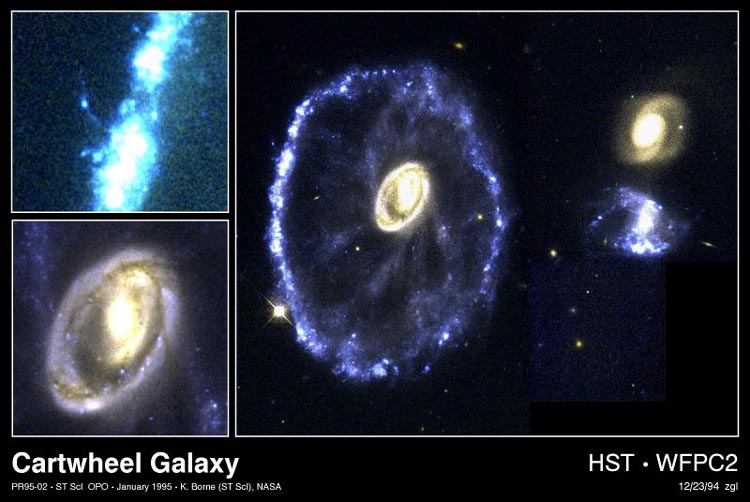
The galaxy measures on the order of 150,000 light-years across, slightly larger than the Milky Way in diameter. Its stellar mass is estimated to be on the order of a few billion solar masses, according to various mass estimates, and its disk shows measurable rotation (reported values around a few hundred kilometers per second). The most visually striking element is the bright, star-forming outer ring, inside which a fainter central region and radial features — often called spokes — connect the ring to the core.
Formation and evolution
Most astronomers interpret the Cartwheel as the product of a nearly head-on collision between a compact intruder galaxy and a larger disk galaxy. The rapid passage of the intruder sent a density wave outward through the disk, compressing gas and triggering a ring of intense star formation that propagates like ripples in a pond. Over time, the system relaxes and the ring expands and fades; the Cartwheel illustrates a transient but dramatic phase in galactic evolution caused by collisions.
Observations and notable features
Since its discovery by Fritz Zwicky in 1941, the Cartwheel has been observed across many wavelengths. Optical imaging highlights the luminous blue star clusters and the system of radial features, while longer-wavelength studies reveal cold gas and dust. It exhibits distinct patterns in different bands: optical observations show one set of spokes, and radio studies detect another; these spokes do not always coincide, indicating complex distributions of stars, ionized gas and synchrotron-emitting particles.
- Discovery: reported by Fritz Zwicky in 1941, who noted its complex structure.
- Appearance: a bright, clumpy ring with radial connections to the inner region.
- Signatures: active star formation in the ring and multiwavelength differences between optical and radio features.
Importance and ongoing research
The Cartwheel Galaxy remains important for understanding collision-driven starbursts, ring formation mechanisms and the fate of gas in violent encounters. It serves as a reference case for numerical simulations of galaxy impacts and for multiwavelength campaigns that trace young stars, neutral and molecular gas, and high-energy processes. Continued observations aim to refine the timeline of the collision, locate the intruder remnant, and clarify how such encounters influence long-term galactic structure.
Questions and answers
Q: What is the Cartwheel galaxy?
A: The Cartwheel galaxy is a lenticular galaxy that is about 500 million light-years away in the constellation Sculptor.
Q: How big is the Cartwheel galaxy?
A: The Cartwheel galaxy is about 150,000 light years across, slightly larger than the Milky Way.
Q: What is the mass of the Cartwheel galaxy?
A: The Cartwheel galaxy has a mass of about 2.9–4.8 × 10^9 solar masses.
Q: Who discovered the Cartwheel galaxy?
A: The Cartwheel galaxy was discovered by Fritz Zwicky in 1941.
Q: What did Fritz Zwicky say about his discovery of the Cartwheel galaxy?
A: Fritz Zwicky said his discovery of the Cartwheel galaxy was "one of the most complicated structures awaiting its explanation on the basis of stellar dynamics".
Q: What does the Cartwheel galaxy show?
A: The Cartwheel galaxy shows radio and optical spokes, but they are not the same spokes.
Q: At what speed does the Cartwheel galaxy rotate?
A: The Cartwheel galaxy rotates at 217 km/s.
Related articles
Author
AlegsaOnline.com Cartwheel Galaxy (ESO 350-40) Leandro Alegsa
URL: https://en.alegsaonline.com/art/17359
Sources
- amazing-space.stsci.edu : "Amazing Space - fast facts: Cartwheel Galaxy"
- ui.adsabs.harvard.edu : 1998A&A...330..881A
- ui.adsabs.harvard.edu : 2005Ap&SS.299..371G
- doi.org : 10.1007/s10509-005-3423-5
- arxiv.org : astro-ph/0506275
- ui.adsabs.harvard.edu : 2005ApJ...628L..33M
- doi.org : 10.1086/432644
- sites.csn.edu : "Cartwheel Galaxy"
- nasa.gov : "Cartwheel galaxy makes waves in new NASA image"