
Cassini–Huygens: NASA/ESA Mission to Saturn and Titan
Cassini–Huygens was a multinational robotic mission (1997–2017) that orbited Saturn, studied its rings and moons, and delivered the Huygens probe to Titan's surface.
Overview
The Cassini–Huygens mission was a long-duration robotic exploration of the Saturn system undertaken by an international partnership. The program combined the Cassini orbiter and the European-built Huygens probe to study Saturn, its complex ring system and its diverse satellites. Launched in 1997, the spacecraft arrived at Saturn in 2004 and operated in the system until an intentional end-of-mission dive into the planet in September 2017.
Image gallery
10 Images




Spacecraft and mission profile
Cassini was equipped with a suite of scientific instruments to image, measure and analyze Saturn's atmosphere, magnetosphere, rings and moons, while Huygens was designed to descend through the thick atmosphere of Titan and return surface data. The mission was a collaboration led by NASA with major participation from the European Space Agency and the Italian Space Agency. After a multi-planet gravity-assist trajectory, the combined spacecraft entered the Saturn system and separated, allowing Huygens to make its descent and Cassini to begin long-term orbital operations.
Key discoveries and scientific results
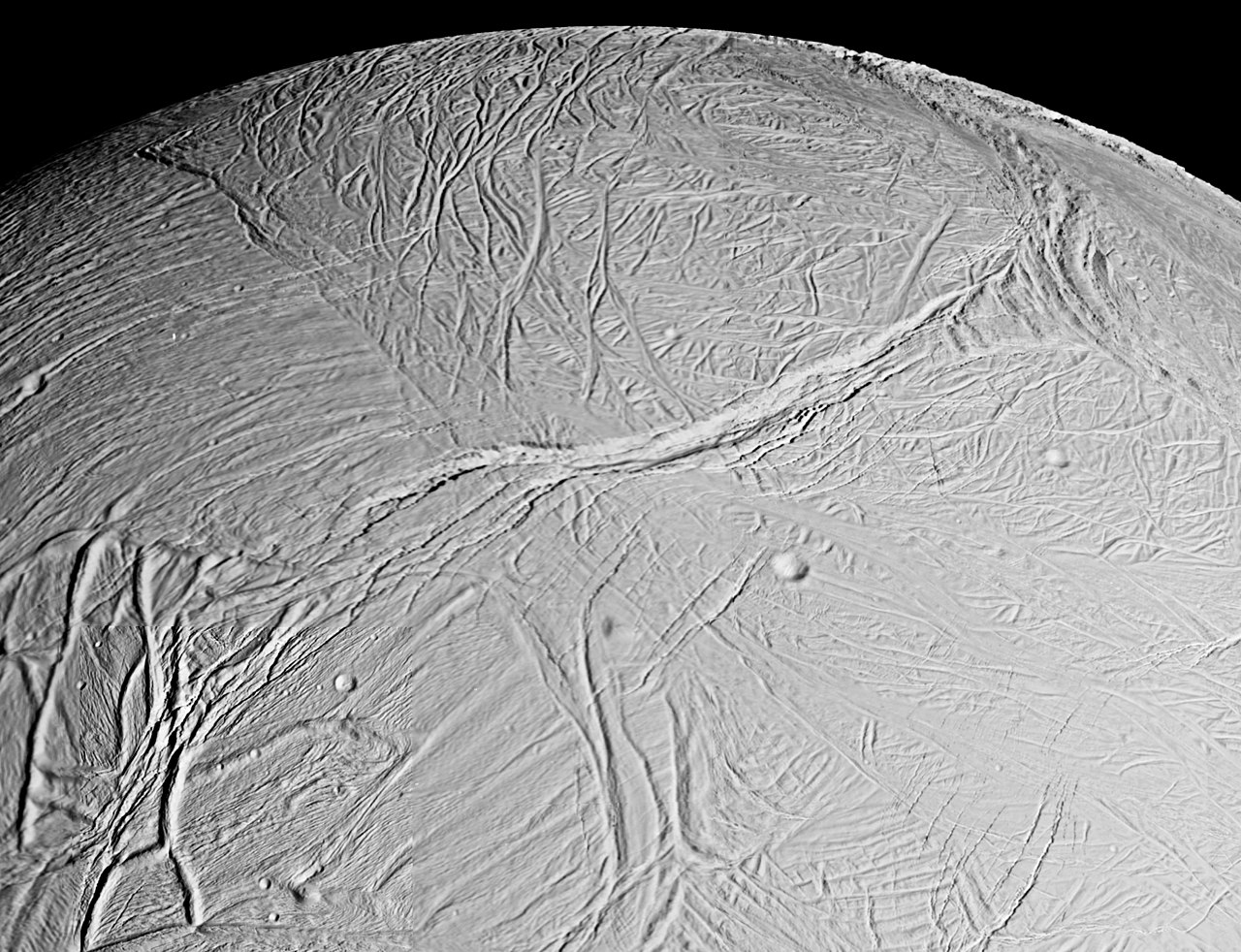
Cassini–Huygens transformed understanding of Saturn and its moons. Huygens made the first and only landing on Titan, revealing methane-rich skies, river channels and surface materials unlike Earth's water geology. Cassini documented active geyser-like plumes on Enceladus that signaled a subsurface salty ocean, mapped seasonal changes in Saturn's atmosphere, and provided detailed observations of ring structure and dynamics.
- First probe to touch down on Titan and directly sample its atmosphere and surface.
- Evidence for a global subsurface ocean on Enceladus and material ejected into space.
- High-resolution surveys of Saturn's rings and discovery of previously unknown ring phenomena.
Historical context and mission end
The mission built on earlier flyby visits to Saturn and represented a major step in outer-planet exploration. Huygens' descent in January 2005 provided ground-truth data for remote sensing studies, while Cassini's long-duration observations enabled time-domain science across Saturnian seasons. Concern over potential contamination of icy moons and a desire to gather final science guided the decision to end the mission with a controlled plunge into Saturn's atmosphere in 2017, which safely disposed of the spacecraft.
Legacy and significance
Cassini–Huygens left a lasting legacy: a rich catalog of imagery and measurements, improved models of planetary rings and satellite geology, and compelling evidence that some icy moons may host environments suitable for further astrobiological study. The mission's data continue to be analyzed and inform future mission planning. For additional technical details and historical resources, see mission archives at project summaries and agency pages such as orbital insertion reports that document key milestones.
Questions and answers
Q: What was the purpose of the Cassini–Huygens space mission?
A: The Cassini–Huygens space mission was sent to study Saturn, its rings, and its moons.
Q: Which space organizations took part in the Cassini–Huygens mission?
A: The Cassini–Huygens mission was made by NASA, the European Space Agency (ESA), and Italian Space Agency (ASI).
Q: What were the two main parts of the Cassini–Huygens spacecraft?
A: The two main parts of the Cassini–Huygens spacecraft were the Cassini orbiter and the Huygens probe.
Q: When was the Cassini–Huygens spacecraft launched?
A: The Cassini–Huygens spacecraft was launched on October 15, 1997.
Q: When did the Cassini–Huygens spacecraft enter into orbit around Saturn?
A: The Cassini–Huygens spacecraft entered into orbit around Saturn on July 1, 2004.
Q: Was the Cassini–Huygens spacecraft the first to orbit Saturn?
A: Yes, the Cassini–Huygens spacecraft was the first spacecraft to orbit Saturn.
Q: When did the Cassini–Huygens mission end?
A: The Cassini–Huygens mission ended in September 2017.
Related articles
Author
AlegsaOnline.com Cassini–Huygens: NASA/ESA Mission to Saturn and Titan Leandro Alegsa
URL: https://en.alegsaonline.com/art/17442
Sources
- saturn.jpl.nasa.gov : "Cassini–Huygens: Quick Facts"
- space.skyrocket.de : "Cassini / Huygens"
- saturn.jpl.nasa.gov : "Insider's Cassini: Power, Propulsion, and Andrew Ging"
- saturn.jpl.nasa.gov : "The Grand Finale Toolkit"