
Caiman
A group of New World crocodilians in the family Alligatoridae. Caimans are small-to-large freshwater predators native to Central and South America with six living species and varied conservation statuses.
Overview
Caimans are crocodilian reptiles classified within the family Alligatoridae. They belong to the subfamily Caimaninae and are closely related to true alligators; together these animals make up the alligator lineage within the broader crocodilian order. Caimans range in size and ecology from relatively small, secretive species to large apex predators. They are commonly encountered in slow-moving freshwater habitats and play important roles in wetland food webs.
Image gallery
10 Images


Classification and species
There are six living species commonly recognized across three genera. These species are often listed together as distinct caiman types and differ in size, snout shape and habitat preferences. For a concise reference on the modern species list see the linked overview: six living species.
- Caiman crocodilus — spectacled caiman, widely distributed and adaptable.
- Caiman yacare — yacare or Paraguayan caiman, common in parts of South America.
- Caiman latirostris — broad‑snouted caiman, with a wide, blunt snout suited to crushing prey.
- Melanosuchus niger — black caiman, the largest member of the group and a top predator in Amazonian waters.
- Paleosuchus palpebrosus — Cuvier’s dwarf caiman, one of the smaller species.
- Paleosuchus trigonatus — smooth‑fronted (Schneider’s) caiman, another small, often forest‑stream specialist.
Physical characteristics
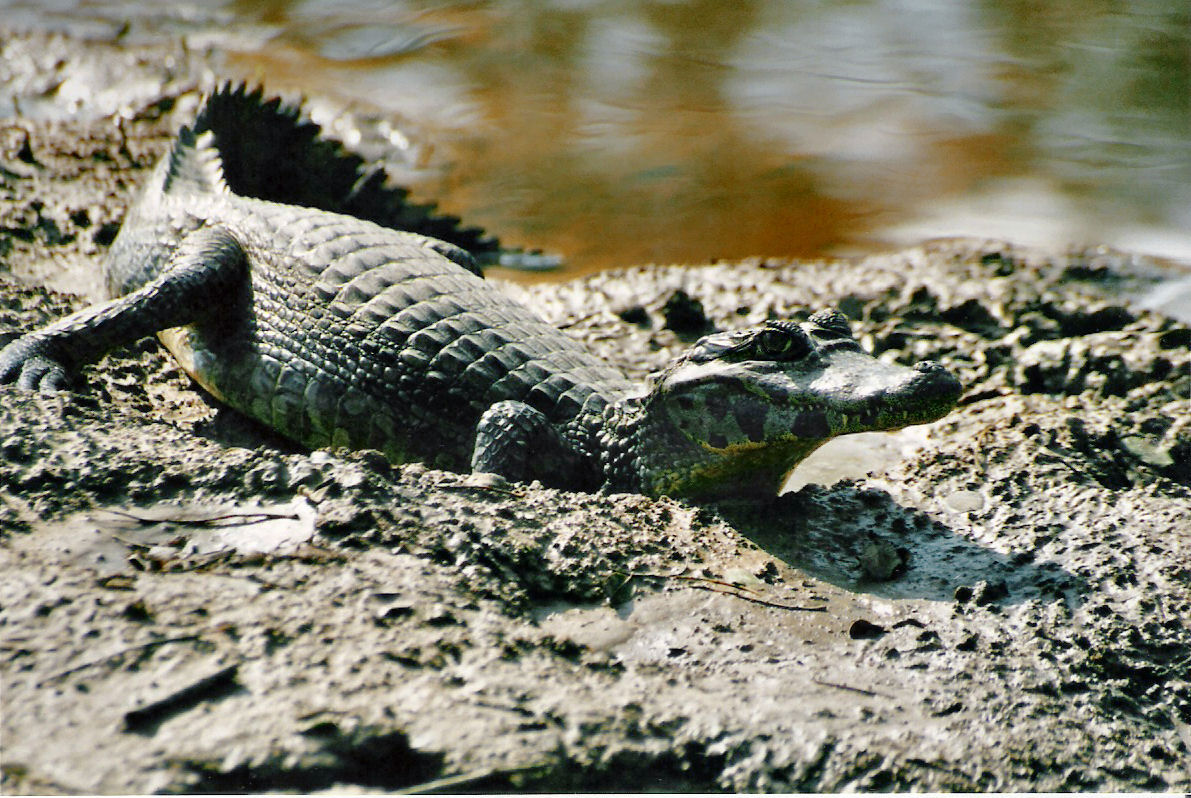
Caimans show the typical crocodilian body plan: armored skin with bony scutes, powerful tails, and long jaws lined with sharp teeth. Size varies from species under 2 m (dwarf species) to the black caiman, which can exceed 4 m in length. Snout shape is an important distinguishing feature: some caimans have narrow, pointed snouts for catching fish while others have broader snouts adapted for crushing crustaceans and mollusks. Several species display a raised bony ridge between the eyes — the feature that gives the spectacled caiman its common name.
Distribution, habitat and behavior
Caimans are native primarily to South America (South America), with the spectacled caiman extending into parts of Central America (Central America). They inhabit rivers, lakes, marshes, seasonal floodplains and forest streams. Diets are opportunistic and change with size: juveniles feed on insects, crustaceans and small fish, while adults take larger fish, birds and mammals when available. Like other crocodilians, caimans exhibit temperature‑dependent sex determination during egg incubation, construct nests or use mound sites for eggs, and often show parental attendance for hatchlings.
Life history and ecology
Compared with many crocodylian relatives, members of the alligator family, including caimans, tend toward slower growth rates and can have relatively long lifespans. Their life histories reflect adaptations to seasonal wetlands: rapid reproduction during favorable seasons, use of flooded vegetation for cover, and strong dependence on aquatic prey. In many ecosystems caimans are both predator and scavenger, influencing fish populations and nutrient dynamics.
Conservation and human interactions
Conservation status varies by species. Several caiman species were once heavily hunted for their skins, and habitat loss from drainage, agriculture and damming remains a threat for some populations. Where protected and managed, some species have recovered; in other areas small, localized populations remain at risk. Caimans appear in human culture across their range, sometimes feared as dangerous animals but also valued in ecotourism and as indicators of healthy wetlands. Management measures typically include habitat protection, regulated harvesting where appropriate, and community education.
Notable distinctions
Caimans differ from true alligators and crocodylids in skull proportions, osteoderm patterns and certain behavioral traits. The black caiman stands out as the largest and most ecologically powerful species, while the dwarf Paleosuchus species are among the smallest crocodilians and are adapted to life in forest streams. For a general comparison within the alligator group see the family overview: alligator family.
Related articles
Author
AlegsaOnline.com Caiman Leandro Alegsa
URL: https://en.alegsaonline.com/art/15987