
Cable modem: device for internet over cable television networks
A cable modem connects homes and businesses to the internet by carrying data over cable television infrastructure. Overview, operation, standards, common features, and distinctions.
Overview
A cable modem is a hardware device that provides high-speed access to packet-based networks by using the same coaxial or hybrid fiber-coaxial wiring used for cable television. In general usage the term refers to the customer-premises equipment that converts between a household network and the broadband signals on a cable system. The device is a type of modem intended to carry mostly digital data over Cable television infrastructure and is commonly used to provide residential and small-business internet services through the cable television network.
Image gallery
2 Images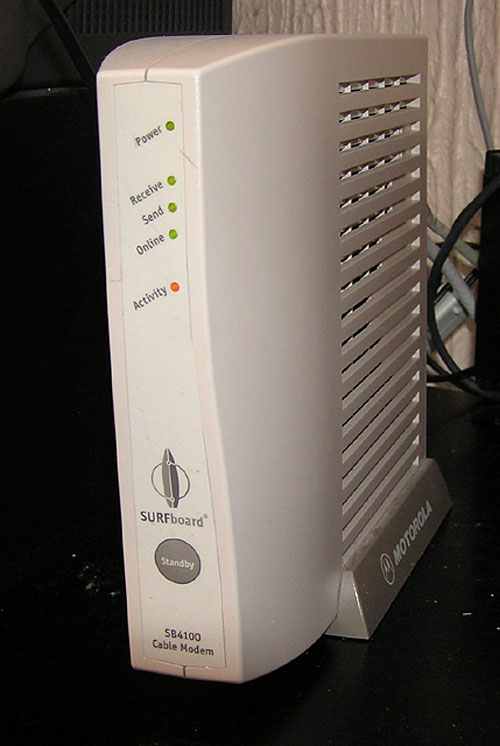

How it works
A cable modem translates between the RF spectrum on the cable plant and local network interfaces. Downstream and upstream data travel on allocated radio-frequency channels; the modem demodulates incoming signals and presents them to a local network via Ethernet ports or, less commonly, USB. It uses modulation techniques suited to coaxial plant and shared medium access to avoid interference, then forwards packets to routers or directly to client devices.
Standards and development
Modern cable modems typically implement standards from the Data Over Cable Service Interface Specification (DOCSIS) family. DOCSIS defines physical and MAC layer behaviors so equipment from different vendors can interoperate. Over successive versions the standards increased channel capacity, spectral efficiency, and introduced features for quality of service and security.
Capabilities and common features
- Multiple Ethernet ports or integrated wireless routers for local distribution.
- Support for voice services using VoIP, allowing the modem to carry telephone service alongside internet access.
- Technical roles as a network bridge, operating primarily at layer 2 of the OSI model while sometimes providing routing functions when combined with gateway firmware.
Installation, operation and examples
Installation usually involves connecting the modem to the incoming coaxial line and to a home router or a single computer. The cable operator authenticates and provisions the modem before full service is available. In homes the modem is often combined with a wireless access point to create a single gateway box; in some deployments operators supply managed modems to handle firmware updates and diagnostics.
Distinctions and notable facts
Unlike dial-up or many fiber modems, cable modems share portions of the physical medium with neighbors, which can affect performance during peak usage if the plant is congested. Upgrades to DOCSIS and network segmentation have reduced contention. Cable modems remain a widely used, cost-effective option for broadband where cable TV infrastructure exists.
For further technical background see vendor documentation and standards references: modem, digital, data, Cable television, infrastructure, internet, cable television network, signals, Ethernet, USB, Radio frequency, VoIP, telephone, network bridge, OSI model.
Related articles
Author
AlegsaOnline.com Cable modem: device for internet over cable television networks Leandro Alegsa
URL: https://en.alegsaonline.com/art/15857