
Signal (electrical engineering)
A signal is a time-varying physical quantity that conveys information. This article explains types, representations, history, analysis tools, applications, and key distinctions in engineering contexts.
A signal, in electrical engineering and related fields, is any quantity that varies with time (and sometimes space) and can carry information about a physical phenomenon or an abstract message. The term appears across communications, signal processing, and general electrical engineering contexts. Signals may be electrical voltages or currents, acoustic pressure waves, optical intensities, or sampled numerical values; what unites them is that their value changes and may be measured, transmitted, or processed.
Image gallery
7 Images





Characteristics and types
Signals are classified by several practical and mathematical attributes. Common distinctions include:
- Analog vs. digital: Analog signals vary continuously in amplitude and time; digital signals take on discrete amplitude levels, often representing bits.
- Continuous-time vs. discrete-time: Continuous-time signals are defined for every instant, while discrete-time signals are defined only at specific sampling instants.
- Deterministic vs. stochastic: Deterministic signals follow a known rule or formula; stochastic (random) signals are modeled statistically, often as random processes.
- Periodic vs. aperiodic, and energy vs. power classifications used in analysis.
Mathematical representation and analysis
Formally, many signals are represented as functions of time x(t) (continuous) or sequences x[n] (discrete). Analysis is performed in the time domain and frequency domain. Fourier methods decompose signals into sinusoidal components, while Laplace and Z transforms extend this analysis to complex-frequency domains for system and stability studies. The Nyquist–Shannon sampling theorem provides conditions under which a continuous signal can be exactly recovered from samples, a foundation of modern digital signal processing.
History and development
The study of signals grew with telegraphy and telephony, which converted physical phenomena such as sound into electrical waveforms for transmission. Advances in mathematical analysis—most notably Fourier analysis—made it possible to understand and manipulate frequency content. Later foundational work on sampling and information by pioneers in communication theory led to rigorous treatment of how signals carry information and how they are affected by noise and channel limitations.
Applications and examples
Signals appear in almost every branch of technology and science. Examples include audio and speech waveforms in telephony and music, image and video pixel sequences in broadcasting and streaming, radio-frequency carriers in wireless communications, sensor outputs in control systems, and financial time series in econometrics. Practical processes applied to signals include filtering, modulation and demodulation, compression, detection, and estimation. Engineers routinely use signal models to design filters, amplifiers, and digital algorithms that improve fidelity, reduce interference, or extract information.
Key distinctions and practical considerations
In information-theoretic contexts a signal often denotes the encoded sequence that represents a message; this highlights a difference between the raw physical waveform and the abstract information it conveys. Real-world signals are corrupted by noise and distortions, so concepts like signal-to-noise ratio, bandwidth, and power are central to system design. Tools and standards for handling signals include the Fourier transform, the Laplace transform, and the Z transform, as well as practical rules such as sampling and quantization. For further technical introductions see resources in information theory and practical engineering texts; introductory descriptions of voltage signals are available in basic electronics references such as those covering voltage.
Questions and answers
Q: What is a signal?
A: A signal is any time-varying quantity.
Q: How would you define a signal specifically in information theory?
A: In information theory, a signal is a codified message, i.e., the sequence of states in a communications channel that encodes a message.
Q: What happens in a communications system?
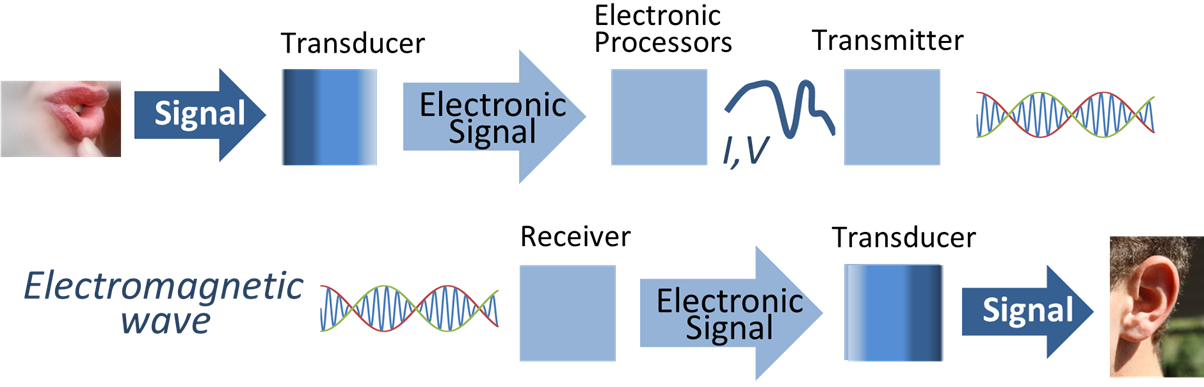
A: In a communications system, a transmitter encodes a message into a signal, which is carried to a receiver by the communications channel.
Q: Can you give an example of how a message might be transmitted in a communications system?
A: For example, the words "Mary had a little lamb" might be the message spoken into a telephone. The telephone transmitter converts the sounds into an electrical voltage signal. The signal is transmitted to the receiving telephone by wires; and at the receiver it is reconverted into sounds.
Q: Is the concept of a signal easy to define precisely?
A: No, the concept of a signal is broad and hard to define precisely.
Q: What is a common practice in defining the term signal in subfields?
A: Definitions specific to subfields are common.
Q: In which fields is the concept of signal used?
A: The concept of signal is used in the fields of communications, signal processing, and in electrical engineering more generally.
Related articles
Author
AlegsaOnline.com Signal (electrical engineering) Leandro Alegsa
URL: https://en.alegsaonline.com/art/90322
Sources
- cm.bell-labs.com : corrected reprint