
Burgundian Netherlands: Late Medieval political and cultural entity (1384–1482)
A late medieval composite polity in the Low Countries ruled by the Valois dukes of Burgundy (and their Habsburg heirs), covering much of present-day Belgium, the Netherlands, Luxembourg and parts of northern France.
Overview
The Burgundian Netherlands refers to a collection of duchies, counties and lordships in the medieval Low Countries that came under the personal authority of the Valois dukes of Burgundy and, after 1482, their Habsburg descendants. Existing roughly between 1384 and 1482, this political formation was not a single centralized state but a composite of feudal territories held together by dynastic rule and common institutions.
Image gallery
7 Images


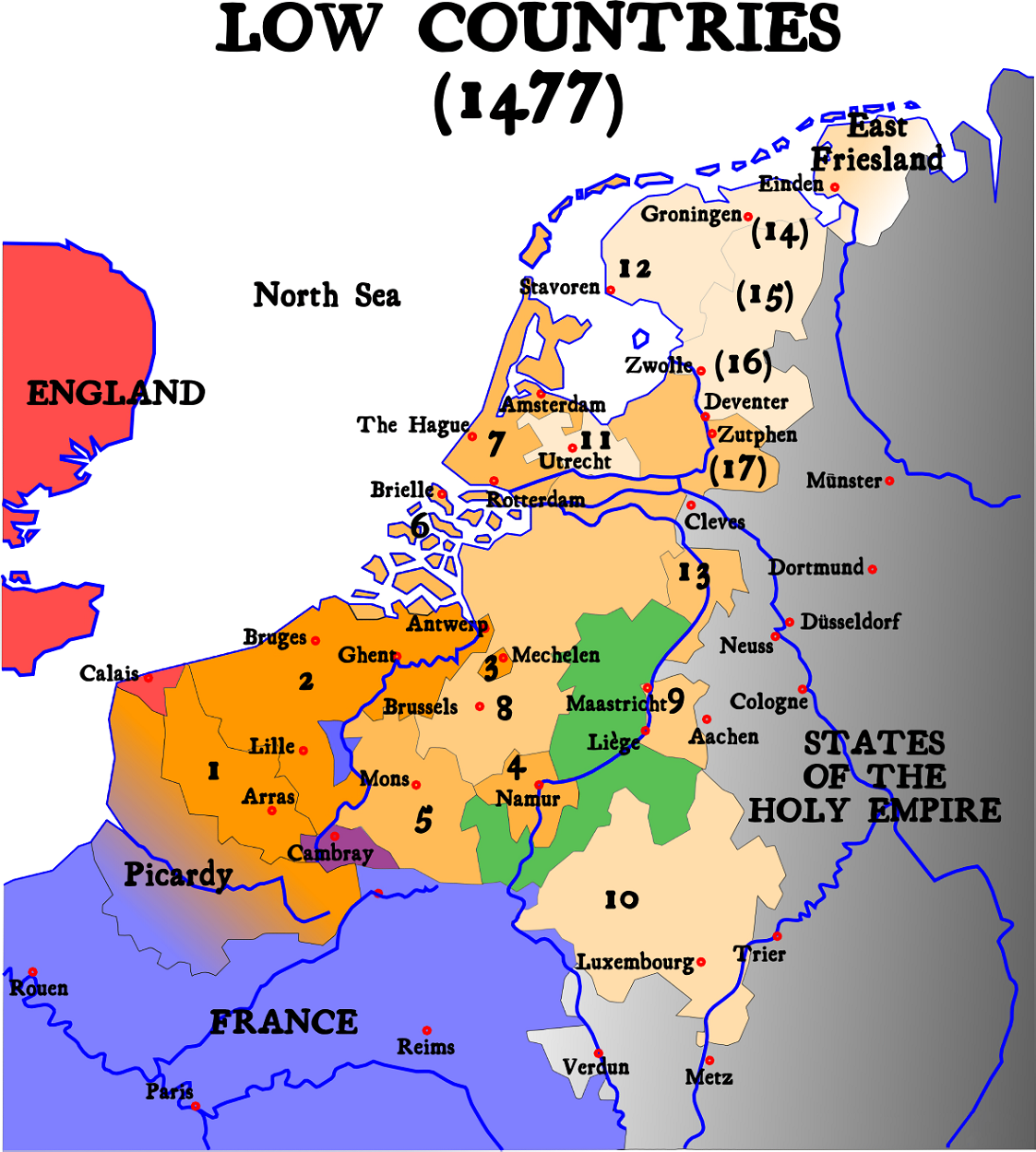


Territory and government
At its height the Burgundian possessions comprised large parts of what are now Belgium, the Netherlands, and Luxembourg, together with adjoining provinces in northern France. Many constituent units were originally independent Imperial or French fiefs. The dukes ruled these lands in personal union, meaning the same ruler held multiple titles and territories while local laws and privileges generally remained in place.
History and development
The Burgundian expansion was driven by dynastic marriages, inheritance and purchases under the Valois-Burgundy line (House of Valois-Burgundy). Over the course of the fifteenth century the dukes consolidated administrative practices, created common councils, and intervened in local affairs to strengthen their authority. The line passed to the Habsburg house at the end of the period through marriage and inheritance, a transition that set the stage for later Habsburg rule in the Low Countries.
Economy, society and culture
The region was an economic powerhouse of medieval Europe: prosperous towns, active international trade (especially in cloth), and a dense network of market cities fostered urban wealth. Burgundian rulers became notable patrons of art, literature and courtly culture, attracting artists and administrators whose work had a lasting influence on northern Renaissance art and governance.
Legacy and significance
- The Burgundian period helped shape the political map of the Low Countries and created administrative practices that endured under later rulers.
- Its towns and economic structure laid foundations for both the Dutch Republic and the southern provinces that evolved into modern Belgium and Luxembourg.
- As a composite monarchy it illustrates how medieval dynastic politics created large trans-regional polities without erasing local identities.
For further reading on the political structures and cultural achievements of the Burgundian era see specialized works and archival collections: Low Countries overview, institutional studies at Imperial history portals, and focused biographies of Burgundian and Habsburg figures via Valois and Habsburg resources.
Related territorial guides: Belgium, Netherlands, Luxembourg, northern France.
Related articles
Author
AlegsaOnline.com Burgundian Netherlands: Late Medieval political and cultural entity (1384–1482) Leandro Alegsa
URL: https://en.alegsaonline.com/art/15423