
Total Solar Eclipse of December 14, 2020
A total solar eclipse occurred on 14 December 2020, with a narrow path of totality across parts of Chile and Argentina and a wide partial eclipse over much of western South America.
Overview
A total solar eclipse took place on Monday, December 14, 2020. During a solar eclipse the Moon moves between the Earth and the Sun, casting a shadow on Earth and, for observers within a narrow track, obscuring the bright solar disk. This event produced a band of totality where the solar disk was completely covered by the Moon, surrounded by a much wider region that experienced a partial eclipse. For general background and maps see eclipse resources.
Image gallery
2 Images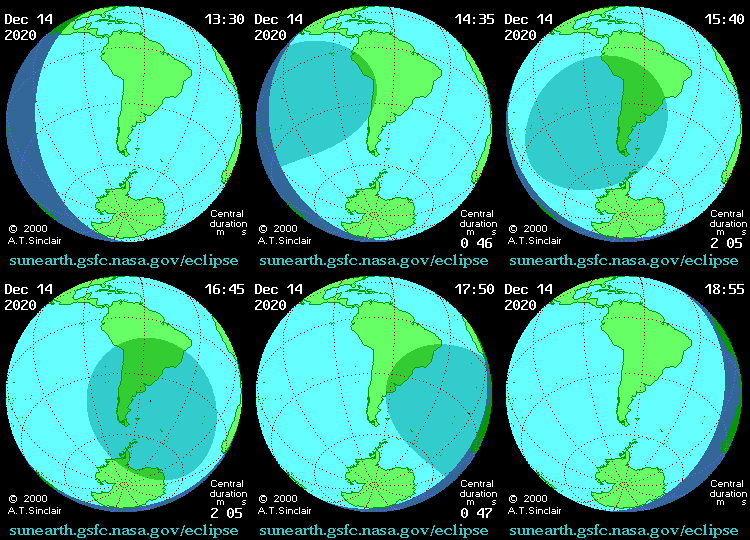

Orbital mechanics and appearance
A total solar eclipse occurs when the apparent diameter of the Moon exceeds that of the Sun as seen from Earth. The December 14 event occurred roughly 1.8 days after the Moon’s perigee (its closest approach to Earth), so the Moon appeared sufficiently large to produce totality along the central path. Observers along this path saw the Sun’s photosphere disappear and, for a few minutes at most at any single location, the solar corona, prominences and other features normally hidden by the bright disk.
Path and visibility
The narrow path of totality crossed southern parts of South America. The central track traversed regions of Chile and Argentina, where many towns and viewing sites experienced complete totality. A broad partial eclipse was visible across much of western and central South America, including Bolivia, Brazil, Ecuador, Paraguay, Peru, and Uruguay. Local weather, elevation and horizon conditions affected how well observers could see the Sun and the corona.
Timing and duration
Exact local times varied along the path; at any given observing site totality generally lasted for only a few minutes. The sequence of partial phases before and after totality extended the observable event over a longer period, during which the Sun appeared progressively more covered by the Moon. Observers consult local timings and contact predictions in advance to plan observations.
Scientific opportunities
Total solar eclipses enable studies of the Sun’s outer atmosphere (the corona), transient features such as prominences and coronal mass ejections, and short-term responses in Earth’s upper atmosphere and ionosphere. Professional teams and amateur astronomers used the 2020 eclipse to photograph coronal structure, measure brightness and polarization of the corona, and coordinate multi-site observations to compare conditions along the path. For technical resources and publications see research links and outreach pages hosted by observatories.
Cultural, environmental and logistical notes
Eclipses frequently attract public interest and travel, and they are used for education and outreach by planetariums and societies. The 2020 eclipse occurred during the global COVID-19 pandemic, which affected travel, public gatherings and some planned events. Wildlife responses to sudden daytime darkness are commonly reported during totality; birds and livestock may alter behaviour briefly, and observers often note changes in ambient light and temperature.
Observation safety and practice
Viewing any partial phase requires proper eye protection: certified solar filters or eclipse glasses that meet safety standards must be used whenever the bright solar disk is exposed. Only during the brief moments of complete totality is it safe to view the eclipsed Sun without filters; filters must be replaced immediately when totality ends. Photographers use solar filters on lenses for every exposure except during totality and plan sequences to capture the faint corona and stars near the Sun.
Legacy and further information
The December 14, 2020 eclipse reinforced how predictable orbital mechanics are and illustrated how the Moon’s varying distance (perigee versus apogee) affects eclipse type and appearance. For maps, detailed timings, observing reports and country-specific summaries consult outreach pages and national astronomical societies: Chile, Argentina, Bolivia, Brazil, Ecuador, Paraguay, Peru, and Uruguay. Additional general resources and maps are available from major observatories and science outreach groups (see resources), and for background on the Moon consult introductory material about the Moon and its interactions with Earth and the Sun.
- What observers saw: complete obscuration of the solar disk within the path; a partial eclipse beyond it.
- Where it was seen: totality in parts of Chile and Argentina; partial phases across much of western South America.
- Where to learn more: national astronomical societies and public outreach pages (additional reading).
Author
AlegsaOnline.com Total Solar Eclipse of December 14, 2020 Leandro Alegsa
URL: https://en.alegsaonline.com/art/145872