
Book of Optics — Ibn al‑Haytham's seven‑volume study of light and vision
A comprehensive overview of the Book of Optics by Ibn al‑Haytham: contents, methods, historical transmission, influence on later science, and common misconceptions.
The Book of Optics is a landmark medieval scientific work composed by the scientist commonly known as Ibn al‑Haytham (965–1040). Written in Arabic, it appears across seven books produced in the early 11th century and treats the nature of light, visual perception, and related physical and physiological phenomena. Ibn al‑Haytham—described in many sources as an Arab polymath—organized observations, arguments, and experiments in a way that later readers recognized as a major advance in scientific method.
Image gallery
4 Images


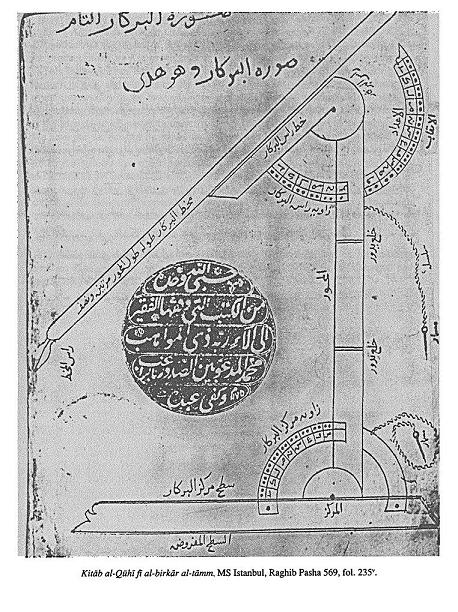
Scope and main ideas
The treatise treats both theoretical and practical aspects of optics and adjacent fields. Topics include the geometry of sight, the anatomy and function of the eye, image formation, reflection, refraction, visual perception and illusions, and applications such as mirrors and lenses. Ibn al‑Haytham rejected the ancient emission theory (that the eye emits rays) and argued instead that vision results from rays of light originating at external sources and entering the eye. He used geometric constructions to explain how images form and how apertures and lenses affect them.
Structure and methods
The work is notable for its repeated reliance on experiment and systematic testing. Ibn al‑Haytham described controlled observations, thought experiments, and simple apparatus such as dark rooms and apertures—the principle behind the pinhole camera—to test hypotheses about image formation. This emphasis on empirical verification and critique of unsupported claims is often cited as a forerunner of the experimental scientific method.
Contents at a glance
- Geometry of visual rays and perspective
- Anatomical discussion of the eye and perception
- Reflection from plane and curved surfaces
- Refraction at interfaces and behaviour of lenses
- Psychological aspects of seeing and optical illusions
Transmission, translations, and influence
Originally composed in Arabic, the treatise was later rendered into other languages, including Persian and Latin; parts and commentaries circulated in medieval Europe and Renaissance Italy. Translations and extended commentaries helped transmit its ideas into the Latin West, where they influenced optical and visual theories for centuries. Italian scholars and instrument makers built on these foundations; references to Italian reception appear in historical studies of scientific diffusion (Italian reception is one strand among many).
Legacy, significance, and common misconceptions
The Book of Optics is widely credited with advancing the study of light and vision and with promoting experimental inquiry. Ibn al‑Haytham is sometimes called the "father of optics" for his systematic approach. Some popular claims surrounding the book are unreliable: for example, there is no credible historical evidence that a four‑year‑old nephew co‑wrote parts of the treatise. Such anecdotes do not appear in reputable manuscript catalogues or critical editions and should be regarded as spurious unless documented by primary sources.
Today the Book of Optics is studied both for its substantive scientific content and for its role in the history of scientific method. Scholars continue to examine manuscript traditions, translations, and the work’s reception to understand how medieval ideas about light and vision shaped later developments in optics, astronomy, physiology and engineering.
For introductions and further reading on the author and his work see general references on Ibn al‑Haytham and surveys of medieval optics: Ibn al‑Haytham biography, discussions of Arabic scientific culture (Arabic) and the textual transmission into Persian and Italian contexts. For the methodological impact see treatments of the experimental scientific method.
Related articles
Author
AlegsaOnline.com Book of Optics — Ibn al‑Haytham's seven‑volume study of light and vision Leandro Alegsa
URL: https://en.alegsaonline.com/art/12988