
Bush ballad: narrative poetry and song of the Australian bush
The bush ballad is an Australian narrative poem and folk-song tradition that uses plain language, strong rhythms and storytelling to depict life in the bush, from droving and bushrangers to drought and mateship.
Overview
The bush ballad (also called a bush song or bush poem) is a form of narrative verse and folk music that developed in Australia. It uses direct, colloquial language, a steady metre and straightforward rhyme to tell stories rooted in rural, frontier and working life. Ballads range from humorous and rousing to plaintive and reflective; many were intended to be sung or recited aloud, and they emphasise incident, character and landscape rather than experimental lyricism. The tradition has been an important part of Australian cultural identity and popular literature, and it continues to be practised and revived in clubs and festivals.
Image gallery
5 Images


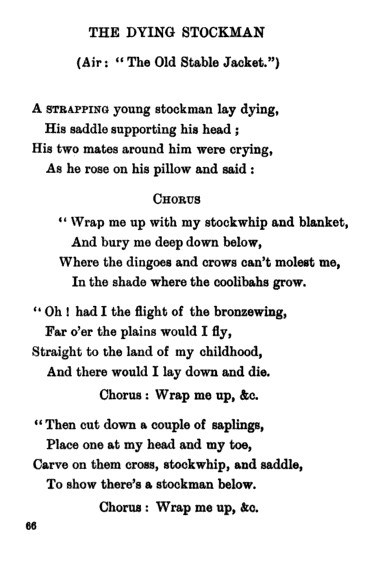
Characteristics
Common features of bush ballads include:
- Plain, conversational diction that echoes local speech and slang.
- Regular metre and simple rhyme schemes that aid memorability and oral performance.
- A strong narrative focus: episodes, clear protagonists and an economy of detail.
- Themes of labour, travel and hazard—droving, shearing, floods, droughts and life on the frontier.
- An interplay of humour, irony and pathos used to portray ordinary people and hardship.
These features make bush ballads distinct from more introspective or formally experimental poetry, and they allowed many works to be shared both as verse and as songs.
Origins and development
The earliest ballads were adapted from British and Irish folk-song patterns brought by settlers and convicts. Oral transmission was central: verses were commonly learned by ear, changed in performance and circulated at work sites, public houses and gatherings. Printed outlets such as newspapers and magazines helped to stabilise and disseminate particular texts, while also shaping ideas about national character and values. For discussion of the literary and musical context see general entries on poetry and folk music.
Themes and social context
Bush ballads commonly treat practical and dramatic subjects: droving and stock work, encounters with the elements, the exploits of bushrangers and the everyday solidarities of mateship. They also reflect settler society and its tensions, including changing relations between Indigenous and non-Indigenous Australians; such representations can be historically revealing but are often shaped by colonial perspectives and should be read with caution. For material on specific subjects see entries on bushranging and on aspects of Indigenous history.
Notable poets and publications
The late 19th and early 20th centuries produced some of the best-known bush poetry. Newspapers and periodicals promoted writers whose work celebrated egalitarian ideals and the resilient worker. Collections of early ballads and historical studies of settler culture, including the roles of convicts and itinerant labourers, document how the form took shape. Two of the most prominent figures associated with the tradition are Henry Lawson and Banjo Paterson, whose poems remain widely read, anthologised and performed. The tradition is discussed in broader accounts of Australian literature.
Performance, preservation and influence
Bush ballads have been preserved through oral performance, printed anthologies, radio broadcasts and recordings. Recitation competitions, bush poetry clubs and local festivals sustain the practice, while many traditional texts have been set to music or adapted by performers in country music contexts. Contemporary writers sometimes rework the form to address modern concerns or to foreground previously marginal voices.
Reception and critical perspectives
Scholars and critics have described bush ballads both as authentic expressions of popular sentiment and as cultural constructions that helped to define national myths. The form has been praised for its accessibility and storytelling power, but it has also been examined for its selective representations of class, gender and race. Critical discussions often place the ballad in debates about egalitarianism and national identity; for more on these themes see treatments of egalitarianism and the political context of Federation.
Continuing practice
Although the heyday of the bush ballad as mass-cultural currency is past, the tradition survives. Community events, academic collections and online archives keep texts available to new audiences, while contemporary performers and poets draw on the form for both homage and innovation. For those seeking primary texts, historical anthologies and specialist collections offer many examples, and local clubs and festivals remain active sites for performance and learning.
Further reading and resources
Readers interested in the form can consult anthologies of colonial and early national verse, histories of Australian folk song, and studies of rural life and labour. Helpful starting points include general overviews of poetry and folk music, specialised discussions of bushranging, the place of Indigenous histories in settler storytelling, and collections of early ballads and material about convicts. Scholarly work on national identity links the form to debates about egalitarianism and the era of Federation, while biographies and collected works feature poets such as Henry Lawson and Banjo Paterson. For introductions to the literary context see surveys of Australian literature, and for musical continuities consult resources on country music.
Questions and answers
Q: What is a bush ballad?
A: A bush ballad is a style of poetry and folk music that depicts the life, character, and scenery of the Australian bush.
Q: What is the rhyme structure of bush ballads?
A: Bush ballads usually have a simple rhyme structure.
Q: What are some topics that bush ballads typically address?
A: Bush ballads typically tell stories of action and adventure about bushranging, droving, droughts, floods, life on the frontier, and relations between Indigenous and non-Indigenous Australians.
Q: Who originally created bush ballads?
A: The first ballads were created by British and Irish settlers and convicts who brought with them the folk music of their homelands.
Q: How did bush ballads evolve over time?
A: Bush ballads grew into a unique style over the years, becoming very popular in the late 19th and early 20th centuries.
Q: What values did bush ballads and associated media promote in early Australia?
A: Through bush poetry, newspapers and magazines, like The Bulletin, promoted mateship, egalitarianism, anti-authoritarianism, and a concern for the "battler" as being ideal Australian values.
Q: Are bush ballads still popular in modern times?
A: Bush ballads are not as popular in modern times, but the poems written up to Federation are still some of the best-known and loved poems in Australia. Clubs and festivals devoted to bush poetry can be found throughout the country, and the tradition lives on in Australian country music.
Related articles
Author
AlegsaOnline.com Bush ballad: narrative poetry and song of the Australian bush Leandro Alegsa
URL: https://en.alegsaonline.com/art/15581
Sources
- poetrylibrary.edu.au : Bush ballads
- bushballadeers.com.au : "The Australian Bush Balladeers Association"
- abc.net.au : abc.net.au
- books.google.com : books.google.com/books?id=dnUYVikeJwYC&pg=PA24&dq=bush+songs
- abc.net.au : abc.net.au/news/programs/730
- cultureandrecreation.gov.au : "Bush songs and music - australia.gov.au"
- youtube.com : youtube.com/watch?v=hKP9t-thgnQ
- theage.com.au : theage.com.au/entertainment/art-and-design/keeping-bush-ballads-alive-and-well-20050517-g…
- accessmylibrary.com : accessmylibrary.com/coms2/summary_0286-19874044_ITM
- discogs.com : Shirley Thoms - Australia's Yodelling Sweetheart (Vinyl) at Discogs
- bushballadeers.com.au : "The Australian Bush Balladeers Association"
- deanperrett.com : "Bio"
- rumentertainment.com : "RUM ENTERTAINMENT NEWS FEB 07"