
Pervez Musharraf: Pakistani military chief and president (1943–2023)
Summary of Pervez Musharraf's life: military career, 1999 coup, presidency (2001–2008), alignment in the War on Terror, controversies, legal cases, exile and legacy.
Syed Pervez Musharraf (born 11 August 1943) was a Pakistani army officer who led a coup in 1999 and served as the country's head of state during much of the first decade of the 21st century. His tenure combined ambitious economic and administrative reforms with assertive security policies and repeated constitutional crises. Internationally he is best known for reversing Pakistan's previous stance after 11 September 2001 and cooperating with the United States in the global War on Terror, a decision that reshaped Pakistan's foreign relations and internal security dynamics.
Image gallery
10 Images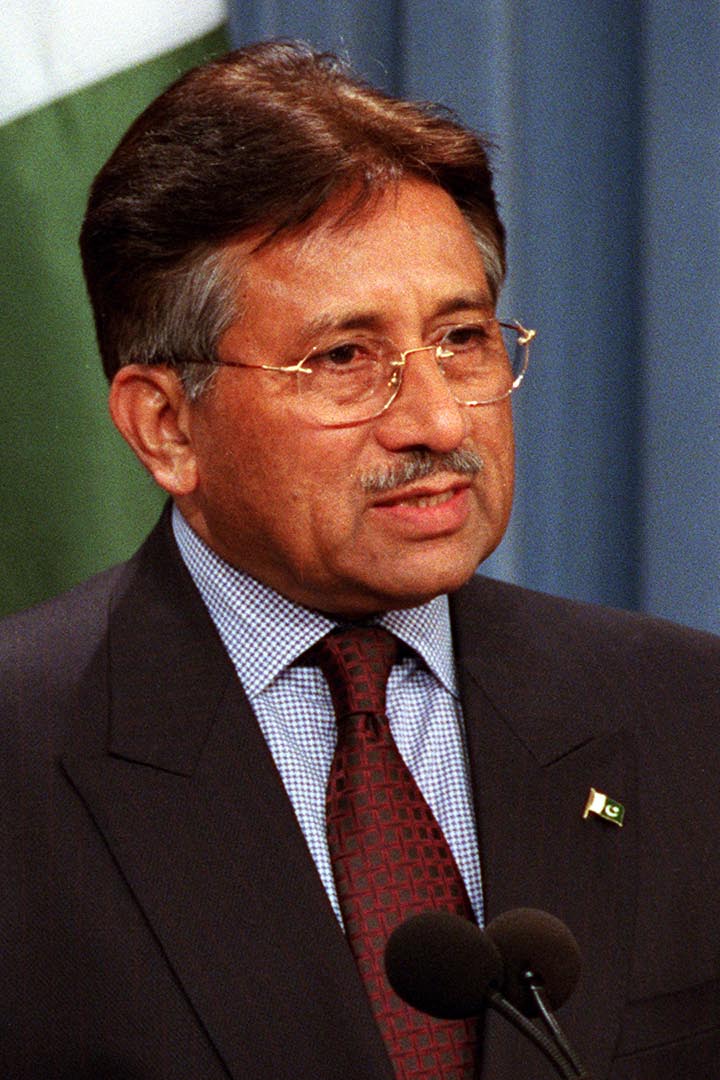


Early life and military background
Musharraf was born in Delhi, British India, and his family moved to what became Pakistan after partition. He spent parts of his childhood in Karachi and also lived in Istanbul before returning to Pakistan for formal education. He studied mathematics at Forman Christian College and later attended the Royal College of Defence Studies in the United Kingdom. In 1961 he entered the Pakistan Military Academy and was commissioned into the Pakistan Army in 1964. He saw active service during the Indo-Pakistani War of 1965 as a second lieutenant and rose through command and staff positions, including artillery and special forces units, before becoming a general.
Rise to power and presidency
In 1998 Prime minister Nawaz Sharif promoted Musharraf to four‑star rank and made him chief of army staff. Less than a year later, in October 1999, Musharraf removed Sharif's elected government and assumed control as chief executive. He formally became President of Pakistan in 2001 and held that office until his resignation in August 2008 to avoid impeachment. His government carried out a mix of economic liberalization measures and attempts at judicial and administrative reform while simultaneously confronting a violent insurgency in the northwest.
- His ascent marked a decisive military intervention in Pakistan's politics and followed a period of strained civil‑military relations.
- Musharraf authorised the Kargil operation in 1999, a conflict that escalated tensions with India and nearly led to full‑scale war between the two states.
- After 2001 he allied closely with the United States against extremist groups, altering Pakistan's security priorities and bringing substantial international engagement and aid.
Controversies, legal cases and later life
Musharraf's rule included the imposition of emergency measures in 2007, suspension of parts of the constitution and the dismissal or detention of judges, moves that produced strong domestic and international criticism. Following his resignation in 2008 he lived in self‑imposed exile for several years. He returned to Pakistan in 2013 to contest politics but soon faced multiple legal challenges, including accusations connected with the deaths of political opponents and a 2019 conviction in absentia for high treason. He spent his final years largely abroad for medical treatment and died in 2023.
Assessment of Musharraf's legacy remains contested. Supporters credit him with relative economic growth, infrastructure initiatives and an attempt to modernize the state's institutional capacities. Critics highlight the erosion of constitutional norms, the curtailment of judicial independence, and policies that arguably intensified militancy and political polarization. His life illustrates the central role the military has played in Pakistan's post‑independence political development and continues to be cited in debates about civilian control, counterterrorism, and democratic consolidation.
For further reading on his military career, presidency and the political context of his actions, see profiles of the Pakistan Army, the office of the President of Pakistan, accounts of the 1999 removal of Nawaz Sharif (Nawaz Sharif) and analyses of the regional dynamics involving India and Pakistan. Background material on his origins and education can be found through sources addressing Delhi in British India, the British Raj, and urban life in Karachi and Istanbul. His career trajectory included roles identified as operational and administrative, with military ranks and appointments such as major general and commands later described in official records. The legal and political debates around impeachment and emergency powers refer to processes commonly labelled impeachment and executive emergency actions in constitutional histories.
Additional context about his academic studies in mathematics, training at defense institutions and his commission into service reflect a conventional military professional background. Histories of Pakistan's civil‑military relations and analyses of the post‑2001 security environment place Musharraf at the centre of pivotal shifts that affected both domestic politics and international alliances.
Author
AlegsaOnline.com Pervez Musharraf: Pakistani military chief and president (1943–2023) Leandro Alegsa
URL: https://en.alegsaonline.com/art/128446