
Blister beetle (Meloidae): overview, biology and significance
Blister beetles (family Meloidae) are a diverse group of beetles that produce cantharidin, can cause skin blisters, have complex larval stages, and influence pollinators, agriculture and livestock health.
Overview
The blister beetle is a common name for members of a distinctive group of beetles; the term refers to both their appearance and their chemical defense. The beetle group is often introduced in entomological texts as a distinct taxon within the order Coleoptera, and the family is known as Meloidae. These beetles occur worldwide: approximately 7,500 species have been described and they are found in a wide range of habitats from arid deserts to grasslands.
Image gallery
10 Images


Appearance and chemical defense
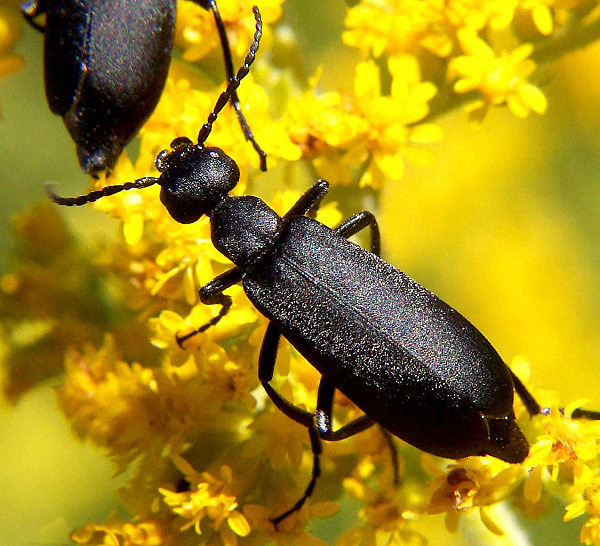
Adults show considerable variation in size, color and patterning but commonly have soft, elongate bodies and flexible wing covers. Their best-known trait is the secretion of the oily compound cantharidin, a potent vesicant. Contact with the substance can produce painful blisters on exposed skin; ingestion or contamination of forage can be toxic to animals, particularly horses.
Life cycle and behavior
Blister beetles undergo a form of development called hypermetamorphosis, in which the larvae pass through several distinct forms. Early larval stages are often mobile and adapted to find hosts. In many species the mobile larva (often called a triungulin) seeks out solitary bees, attaching to a visiting adult bee and riding back to the bee’s nest. There it feeds on the nest provisions and immature bees. Other species specialize on insect eggs, notably grasshopper eggs, where larvae develop by consuming those egg pods.
Ecological and agricultural importance
Adult blister beetles frequently feed on flowers and foliage. They are attracted to flowering crops and plants and can form local aggregations. Notably, adults are often drawn to alfalfa and to various weeds when those plants are in bloom. In agricultural settings, heavy feeding can defoliate crops or contaminate harvested forage. Because cantharidin remains in the bodies of dead beetles, contaminated hay can poison livestock if beetles are baled into fodder.
Risks to animals and humans
Cantharidin is toxic and a strong skin irritant. In humans its blistering action has been used historically in small, controlled medical treatments, but such uses are risky and not recommended without expert medical oversight. For livestock, ingestion of even small quantities of crushed beetles in hay can cause serious illness; horses are particularly sensitive to cantharidin poisoning and can suffer severe symptoms.
Management and research
Managing blister beetles in crops and forage relies on integrated approaches: timing harvests to avoid peak beetle activity, inspecting and removing contaminated plant material, and using targeted pest control where necessary. Biological and ecological research continues to explore their complex life histories, host relationships with pollinators and potential roles in natural pest control by consuming other insect eggs.
Summary
Blister beetles of the family Meloidae are a widespread, diverse group recognized by cantharidin production and complex larval behavior. They have mixed effects on ecosystems and agriculture: they are interesting subjects for biological study, beneficial in some contexts for egg predation, but also pose documented risks to pollinators, livestock and human handlers.
Related articles
Author
AlegsaOnline.com Blister beetle (Meloidae): overview, biology and significance Leandro Alegsa
URL: https://en.alegsaonline.com/art/12194