
Gustav Kirchhoff: circuits, spectroscopy, thermal radiation and optics
Gustav R. Kirchhoff (1824–1887) was a German physicist who formulated circuit and radiation laws, advanced spectroscopy (discovered rubidium with Bunsen), contributed to optics and thermochemistry, and influenced quantum theory.
Gustav Robert Kirchhoff (12 March 1824 – 17 October 1887) was a German physicist whose careful experiments and theoretical insight shaped several branches of physics. Born in Königsberg, he combined laboratory work with clear general principles and held professorships at German universities, including periods of collaboration with Robert Bunsen. For a concise life outline see biography.
Image gallery
2 Images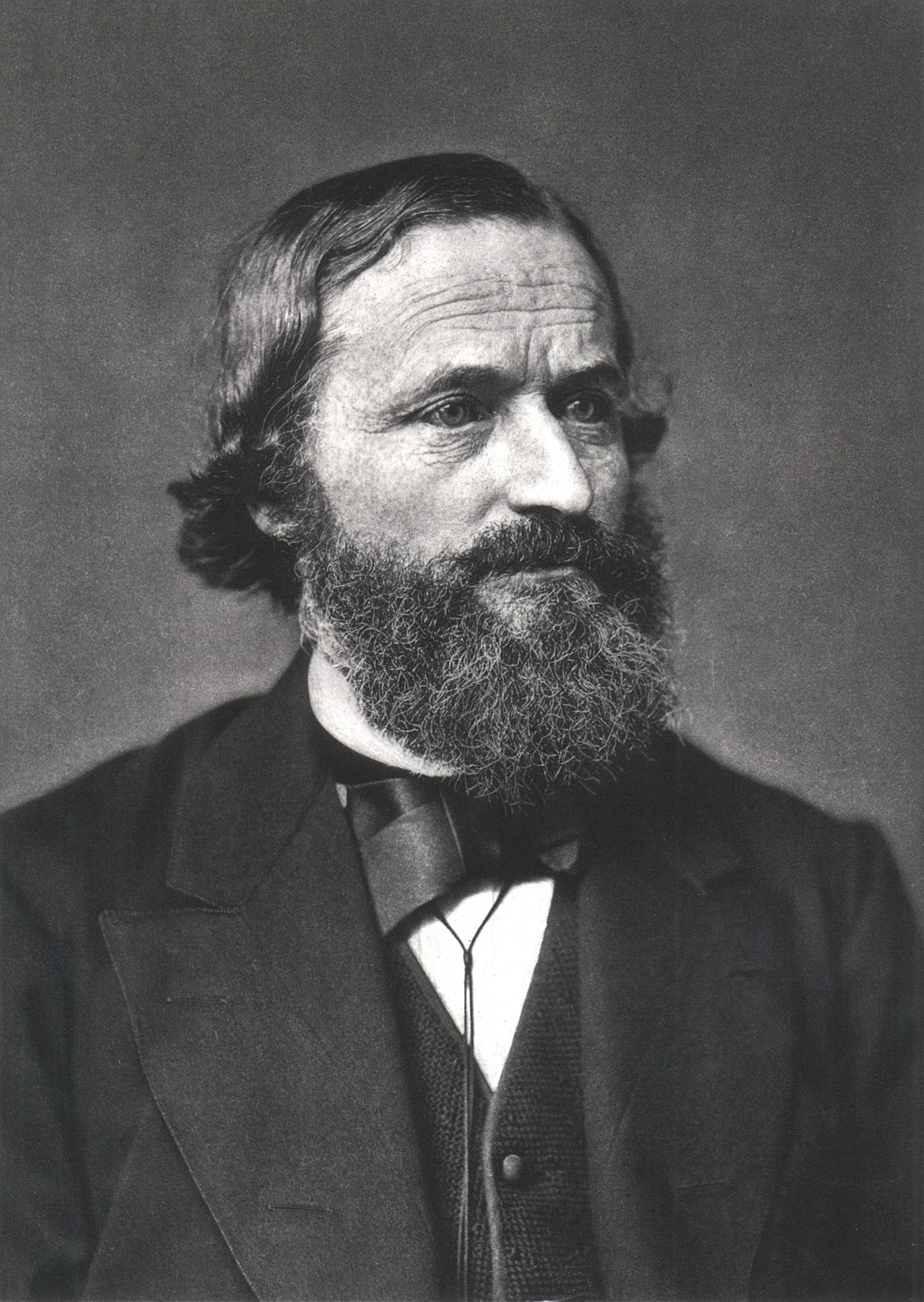

Electrical circuit theory
Kirchhoff set out two basic rules for electrical networks that remain fundamental in physics and engineering. The first, commonly called Kirchhoff's current law, states that the algebraic sum of currents entering a junction equals zero (conservation of charge). The second, Kirchhoff's voltage law, states that the sum of potential differences around any closed loop vanishes (conservation of energy). These principles provide a systematic method for analysing circuits and are often introduced in courses on circuit theory and when discussing circuit laws.
Spectroscopy and chemical analysis
Working with Robert Bunsen, Kirchhoff applied flame and discharge spectroscopy to chemical analysis and showed that elements produce characteristic spectral lines. This approach established that spectral patterns can identify elements and led to the discovery of rubidium in 1861. The partnership is commemorated by the Bunsen–Kirchhoff Award, and accounts of their work appear under spectroscopy and the rubidium discovery.
Thermal radiation and thermochemistry
In studies of heated bodies Kirchhoff formulated a foundational statement about thermal emission: at thermal equilibrium, an object's emissive power at a wavelength is proportional to its absorptive power at that wavelength. This relation, often stated as emissivity equals absorptivity for bodies in equilibrium, underlies the black-body concept and helped focus problems that later led to quantum theory; see more on radiation and the notion of a black-body. In thermochemistry he derived a relation linking the temperature dependence of a reaction's enthalpy change to differences in heat capacity, a practical tool for correcting heat measurements (thermochemistry law).
Optics and other work
Kirchhoff also made contributions to wave optics, formulating integral relations used in diffraction theory and in the mathematical description of wave propagation. His combination of experiment and theory, clarity of formulation and influence on later developments made his name attached to several distinct laws and theorems across physics.
Legacy
Kirchhoff's laws remain part of standard curricula: circuit rules in electrical engineering, spectral methods in analytical chemistry and his radiation principle in thermal physics. His questions about black-body emission helped create the context that led to Planck's quantum hypothesis. Awards, historical studies and textbooks continue to cite his work and experiments as milestones in 19th-century physics.
Related articles
Author
AlegsaOnline.com Gustav Kirchhoff: circuits, spectroscopy, thermal radiation and optics Leandro Alegsa
URL: https://en.alegsaonline.com/art/120139